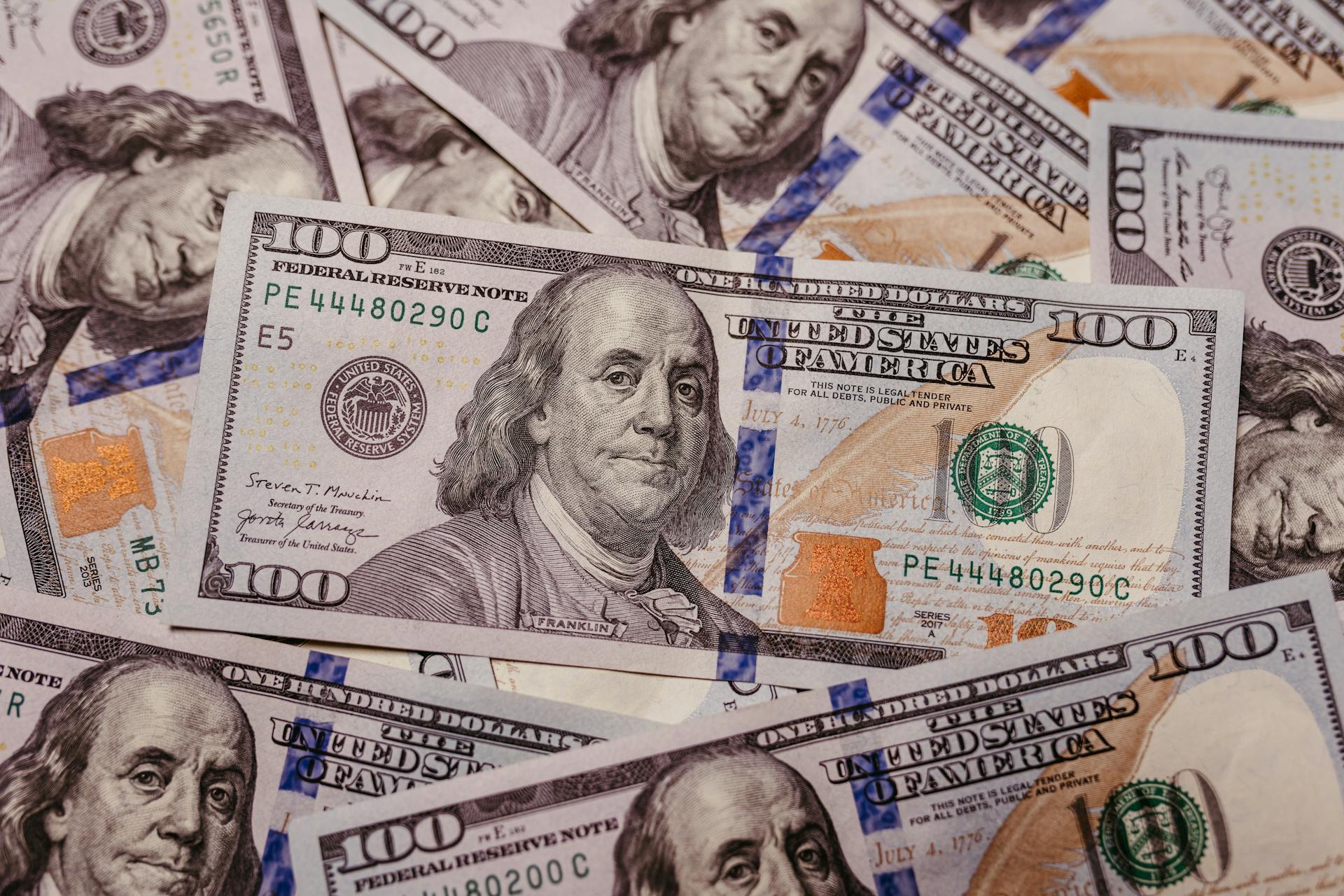
Foreign exchange reserves, also known as forex reserves, are a country's holdings of foreign currencies and other foreign assets.
These reserves serve as a cushion against a country's economic downturns, allowing it to meet its international payment obligations and maintain a stable exchange rate.
Forex reserves can be used to pay off foreign debts, finance imports, and even intervene in the foreign exchange market to stabilize the currency.
A country's forex reserves can be in the form of cash, bonds, or other securities, and are typically held in a central bank or government agency.
Worth a look: Pak Forex Reserves
What Are FX Reserves?
Foreign exchange reserves, or FX reserves for short, are the foreign currencies held by a country's central bank or monetary authority.
These reserves are used to back the country's domestic currency and ensure the government has enough foreign currency to pay for international transactions, such as imports or debt repayments.
FX reserves can include banknotes, deposits, bonds, treasury bills, and other foreign government securities.
Having sufficient FX reserves is an essential indicator of a country's ability to repay foreign debt.
The two most popular foreign assets held in FX reserves are US dollar-denominated assets and euro-denominated assets.
About 61.5% of all foreign exchange reserves are held in US dollars, and 26.2% of all foreign exchange reserves are held in euros.
Here's a breakdown of the two most popular foreign assets held in FX reserves:
- US dollar-denominated assets: 61.5%
- euro-denominated assets: 26.2%
Key Concepts
Foreign exchange reserves are assets denominated in a foreign currency held by a nation's central bank. They can include foreign currencies, bonds, treasury bills, and other government securities. Most foreign exchange reserves are held in U.S. dollars, with China being the largest foreign currency reserve holder in the world.
Economists suggest that it's best to hold foreign exchange reserves in a currency that is not directly connected to the country's own currency. This is because it reduces the risk of currency depreciation and helps maintain the stability of the foreign exchange market.
Foreign reserves are crucial for a country's international trade and finance. They help pay for imports, meet external debt commitments, and facilitate transactions by citizens traveling abroad. In fact, a country faces external financial difficulties when it doesn't have enough reserves to meet its external obligations.
Here are the key components of foreign exchange reserves:
- Currency Reserves: Holdings in major international currencies like the U.S. dollar, euro, Japanese yen, and British pound.
- Gold Reserves: A fundamental part of foreign exchange reserves due to its intrinsic value and ability to act as a hedge against inflation and currency depreciation.
- Special Drawing Rights (SDRs): An international reserve asset created by the International Monetary Fund (IMF) that can be exchanged for freely usable currencies.
- Foreign Securities: Investments in foreign government and corporate bonds that provide returns on investment while maintaining liquidity.
- Deposits with Foreign Banks: Central banks hold deposits in foreign banks to provide immediate liquidity and facilitate international payments.
- Other Reserve Assets: International monetary assets like IMF reserve positions, other financial derivatives, and assets held by sovereign wealth funds.
In Fiji, foreign reserves are used to facilitate international trade, particularly in the importation of goods like rice from Australia. The level of foreign reserves in Fiji increases when foreigners buy more goods and services produced in Fiji, while it declines when residents take out money to buy foreign goods and services.
For your interest: Currency Exchange Buy or Sell Rate
How FX Reserves Work
Foreign exchange reserves are a crucial component of a country's financial stability, and understanding how they work can be fascinating.
Countries accumulate foreign exchange reserves through trade surpluses, where exports exceed imports, foreign investments, borrowing from international organizations, and purchasing foreign currencies. This helps build a stockpile of foreign assets.
Central banks manage these reserves using various strategies to balance risk and return, diversifying across different currencies and assets like U.S. dollars, euros, gold, and Special Drawing Rights (SDRs).
Reserves are used to stabilize the national currency during periods of economic instability. If a country's currency depreciates, the central bank can use its reserves to buy the national currency, thus supporting its value.
Here are some key strategies that central banks use to manage foreign exchange reserves:
- Diversification across different currencies and assets
- Intervention in the foreign exchange market to manage exchange rates
- Liquidity provision to ensure the country can meet its international financial obligations
- Confidence building through holding substantial reserves
Effective management of foreign exchange reserves helps countries navigate global economic challenges, contributing to overall financial stability and fostering international economic cooperation.
Example and Case Studies
Let's take a look at some real-world examples of foreign exchange reserves in action. China, for instance, holds the largest amount of foreign exchange reserves globally, with over $3 trillion in reserves. This massive accumulation is primarily due to the country's consistent trade surpluses and substantial foreign direct investment inflows.
China's export-driven economy consistently generates more revenue from exports than it spends on imports, leading to a trade surplus that's a major source of foreign exchange reserves. The country attracts significant foreign investment, further boosting its foreign exchange reserves. Foreign investors bring capital into the country, which the central bank can then add to its reserves.
The Chinese government uses its reserves to manage the value of the yuan. By intervening in the foreign exchange market, the People's Bank of China (PBOC) can buy or sell foreign currencies to stabilize the yuan's exchange rate, supporting economic stability and maintaining competitiveness in global trade.
Saudi Arabia also holds considerable foreign exchange reserves, primarily due to its reliance on oil exports. The country keeps large amounts of foreign funds in reserves to act as a cushion in case oil prices drop rapidly. This would help stabilize the economy and prevent a significant decline.
Russia's foreign exchange reserves are held mostly in U.S. dollars, but the country also keeps some of its reserves in gold. However, relying on gold as a reserve has its risks, as its value can fluctuate based on market demand. This highlights the importance of diversifying foreign exchange reserves to minimize risk.
Here's a breakdown of some key facts about foreign exchange reserves:
- China holds the largest amount of foreign exchange reserves globally, with over $3 trillion in reserves.
- Saudi Arabia holds considerable foreign exchange reserves, primarily due to its reliance on oil exports.
- Russia's foreign exchange reserves are held mostly in U.S. dollars, with some reserves in gold.
- The Chinese government uses its reserves to manage the value of the yuan.
- Saudi Arabia keeps large amounts of foreign funds in reserves to act as a cushion in case oil prices drop rapidly.
These examples demonstrate the importance of foreign exchange reserves in supporting economic stability and facilitating international trade.
Importance and Impact
Foreign exchange reserves play a crucial role in managing a country's economy, providing an extra layer of financial security.
Having sufficient reserves ensures a country can meet its international financial obligations, boosting investor confidence. This confidence is essential for attracting foreign investment and promoting economic growth.
In times of economic uncertainty or volatility, substantial reserves can act as a buffer against economic shocks, helping to stabilize the currency and maintain liquidity in the foreign exchange market.
A country with substantial reserves can also defend itself against speculative attacks on its currency. This was evident during the 1997 Asian Financial Crisis, where countries with low foreign exchange reserves were more vulnerable to the crisis's impacts.
Having substantial reserves allows a country to influence its currency's value to benefit its domestic economy.
Intriguing read: Financial Ratios Definition
Building and Managing FX Reserves
Countries accumulate foreign exchange reserves by exporting goods and services, a straightforward way to earn foreign currencies.
Receiving foreign investments is another key avenue, as it brings in foreign currencies that can be added to the reserves.
Central banks and monetary authorities play a crucial role in managing these reserves, buying or selling foreign currencies to influence the domestic currency's value as needed.
This careful management helps maintain a stable domestic currency and supports the country's economic stability.
How Countries Build Wealth

Countries build wealth by accumulating foreign exchange reserves through various channels. One key way is by exporting goods and services, which brings in foreign currency.
Exporting goods and services is a vital source of foreign exchange earnings for many countries. This is because it allows them to receive payment in foreign currencies, which can then be added to their reserves.
Countries also receive foreign investments, which can be a significant source of foreign exchange income. This can come in the form of foreign direct investment, portfolio investment, or other types of investment.
Borrowing from international financial markets is another way countries can accumulate foreign exchange reserves. Central banks and monetary authorities manage these reserves, buying or selling foreign currencies as needed to influence the domestic currency's value.
Worth a look: List of Countries by Foreign-exchange Reserves
Optimal Retention Level
In determining the optimal retention level of foreign reserves, a common benchmark is to maintain reserves equivalent to the value of about 3 months of imports. This level is a good starting point for many countries.
However, individual circumstances and preferences can vary greatly, and a country like Fiji may choose to maintain a higher level of reserves to account for external factors such as rising commodity prices and natural disasters. Fiji's current target is a minimum of 4 months of retained import cover, deemed fairly comfortable.
A country's reserve levels can be influenced by various factors, including inflows from tourism earnings, remittances, and sugar export proceeds, as well as large outflows from payments for mineral fuels, machinery, and transport equipment, and food.
Factors Influencing
Economic policies have a significant impact on foreign exchange reserves, with policies promoting exports and restricting imports leading to trade surpluses that increase reserves.
A stable political environment fosters investor confidence, leading to increased foreign investments and trade, thereby enhancing reserves.
Global market trends, such as changes in commodity prices and interest rates, can boost or deplete foreign exchange reserves. High commodity prices can boost the reserves of exporting countries, while global recessions might reduce foreign investments and trade, diminishing reserves.
Expand your knowledge: What Is World Reserve Currency

A country's trade balance directly affects its foreign exchange reserves. A positive trade balance (surplus) increases reserves, while a negative trade balance (deficit) depletes reserves.
Capital flows, including foreign direct investment (FDI) and portfolio investments, influence foreign exchange reserves. High levels of FDI and portfolio investments boost reserves, while capital outflows reduce reserves.
Central banks' policies on exchange rates determine how reserves are used and accumulated. For example, a fixed exchange rate regime requires significant reserves to maintain the pegged rate.
Inflation can erode the value of foreign exchange reserves, prompting central banks to adopt measures to protect the reserves' purchasing power and maintain economic stability.
Here are the key factors influencing foreign exchange reserves:
- Economic policies
- Global market trends
- Political stability
- Trade balances
- Capital flows
- Exchange rate policies
- Inflation rates
- Foreign aid and loans
US Dollar and Global Economy
The US dollar plays a vital role in the global economy, being the world's primary reserve currency.
Central banks and governments hold over $7 trillion in US dollar-denominated foreign exchange reserves.
The dollar's dominance is largely due to the United States' strong economy and the dollar's stability.
Readers also liked: Us Bank Altitude Reserve vs Chase Sapphire Reserve

The International Monetary Fund (IMF) has been a major holder of US dollars, with over $100 billion in reserves.
The dollar's value can fluctuate based on economic indicators such as inflation and GDP growth.
A strong dollar can make imports cheaper, but it can also make exports more expensive.
The dollar's value is also influenced by interest rates set by the Federal Reserve.
Central banks use their foreign exchange reserves to stabilize their economies and prevent currency fluctuations.
The dollar's global usage is widespread, with over 60% of international transactions being settled in US dollars.
Broaden your view: Us Dollar Shekel Exchange Rate History
Frequently Asked Questions
What are the 5 reserve currencies?
The SDR is valued against a basket of five major currencies: the US dollar, euro, Chinese renminbi, Japanese yen, and British pound sterling. These currencies form the foundation of the SDR's value and stability.
Featured Images: pexels.com