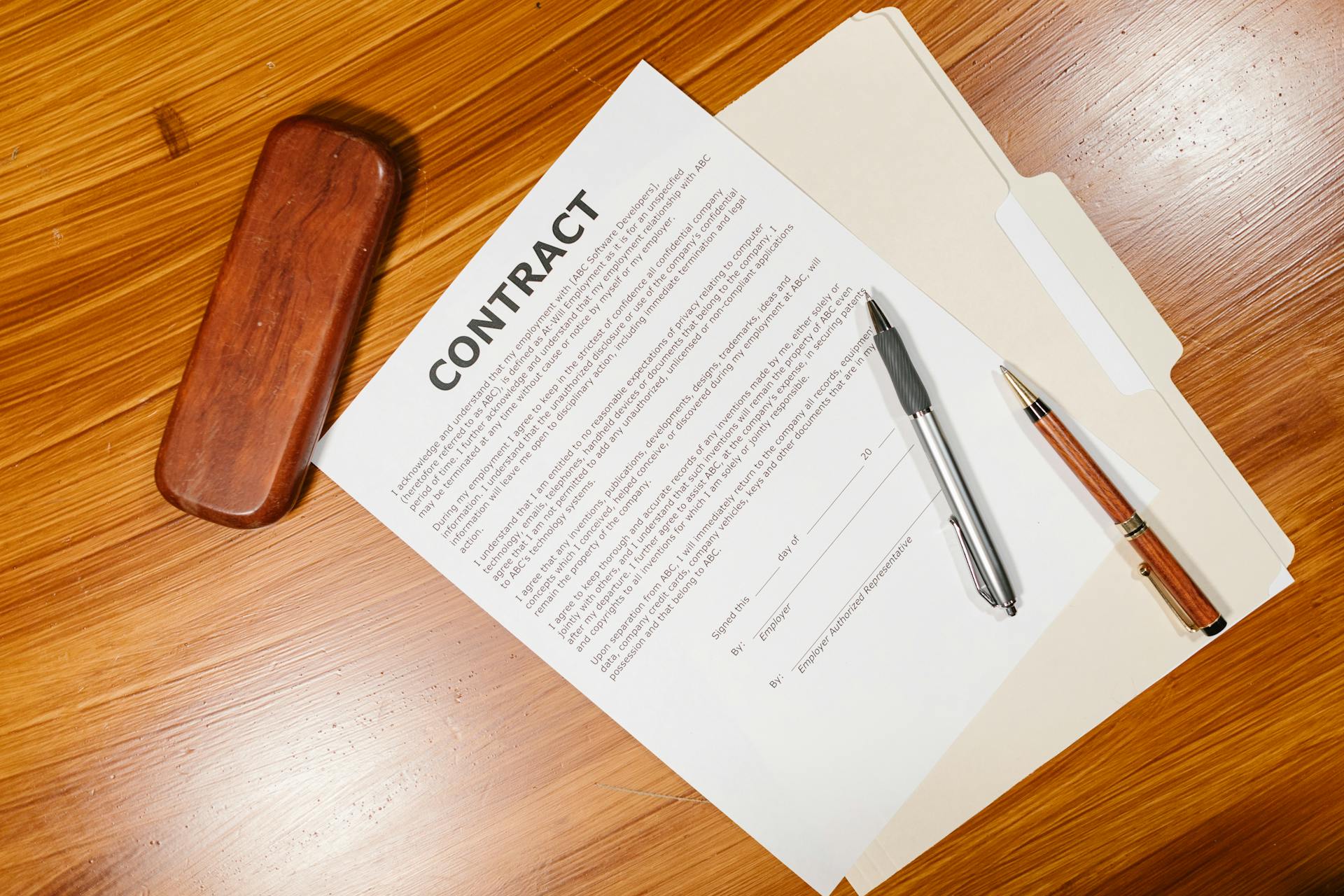
A formal contract is a legally binding agreement between two or more parties that outlines the terms and conditions of a business deal or transaction. It's essential to have a clear understanding of what a formal contract entails.
In most cases, a formal contract should be in writing, signed by all parties, and include essential elements such as the parties involved, the purpose of the contract, and the terms and conditions. It's also a good idea to have a lawyer review the contract before signing.
The purpose of a formal contract is to protect the interests of all parties involved and provide a clear understanding of their obligations and responsibilities. This can help prevent disputes and ensure a smooth transaction.
A well-written formal contract can save you time, money, and stress in the long run.
Readers also liked: Payment Terms and Conditions Format
What is a Formal Contract?
A formal contract is a written agreement that contains several essential elements. It's considered binding, just like an informal contract, as long as all other contract elements exist, such as parties agreeing to comply with each other's wishes.
Check this out: List the Required Elements of a Legal Contract
A formal contract can be formed by a greater authority, like a government or corporation. According to the Twelfth Edition of Business Law: Text Cases, formal contracts require a special form or method of creation to be enforceable. Examples of formal contracts include negotiable instruments like checks, drafts, promissory notes, and certificates of deposit, which must have special formation under the Uniform Commercial Code.
Formal contracts are typically written and contain all the necessary elements, including an offer, acceptance, consideration, and the intention of forming a legally binding agreement. They provide more certainty for both parties than informal contracts, as they clearly set out the details of the agreement.
The key elements of a formal contract are:
- An offer made by one party to another party in exchange for goods or services
- Acceptance of the offer by the other person
- Consideration, which is something of value to be provided by both parties
- Parties have to have legal rights to contract
- Parties have the capacity to enter into the contract
- The intention of forming a legally binding agreement
These elements ensure that a formal contract is legally valid and can be enforced in a court of law if necessary.
When is a Formal Contract Needed?
A formal contract is needed in situations where you need to outline specific obligations and rights for a project. This could be for a partnership, a business deal, or even a new job.
You'll want to use a formal contract when there are many essential terms to adhere to, such as completion or payment dates. This will help prevent misunderstandings and ensure that both parties are on the same page.
When large sums of money are involved, a formal contract is a must. This will protect both parties in case something goes wrong.
You'll also want to use a formal contract when you want to keep a degree of confidentiality between you and the other party. This could be for a non-disclosure agreement or a license agreement.
Here are some important points you might need to include in a formal contract:
- Profit-sharing arrangements
- Management structure
- Provisions for sharing losses
- How to resolve disputes between partners
- Skills & resources to be shared among the partnership
Key Provisions of a Formal Contract
A formal contract is a written agreement between two or more parties that outlines the terms and conditions of their agreement. It's essential to include specific provisions to ensure the contract is enforceable and protects the rights of all parties involved.
A different take: Is a Contract Binding If Not Signed by All Parties
A formal contract should include clauses that detail the financial or skills investments of each partner, as well as the daily management structure. This is crucial in a partnership agreement, where each partner has a significant role to play.
The partnership agreement should also include provisions for profit-sharing arrangements, provisions for sharing losses, and rules about removing money from the business. This ensures that all partners are on the same page and have a clear understanding of their responsibilities.
A formal contract should also address ownership, responsibilities, and dispute resolution. This is essential in high-stakes or long-term business dealings, where the consequences of a dispute can be severe.
Here are some key provisions to include in a formal contract:
A formal contract is a crucial document that outlines the terms and conditions of an agreement between two or more parties. It's essential to include specific provisions to ensure the contract is enforceable and protects the rights of all parties involved.
Benefits and Importance of Formal Contracts
Having a formal contract in place is crucial for any business or partnership. It protects both parties involved and ensures that each party understands their responsibilities.
A formal contract provides clarity for both parties, so there is no confusion about what is expected or required. This can help avoid disagreements or conflict later on.
Formal contracts create accountability for both parties involved. Each party knows what they are responsible for and can be held accountable if they do not uphold their end of the agreement.
In the event that something goes wrong, a formal contract can provide a clear resolution path. This can save time and money by avoiding costly litigation.
A formal agreement requires a written, signed document and often includes witnesses or notarization. Informal agreements may be valid but are harder to enforce without written proof.
Here are some key takeaways about formal agreements:
- A formal agreement requires a signed document in addition to verbal consent.
- Formal agreements are ideal for situations with significant risk, financial stakes, or long-term obligations.
- Formal agreements are generally easier to enforce in court.
Having a formal contract in place can give both parties security and peace of mind. It outlines the duties, responsibilities, payment, and overall relationship of employers and employees, providing ample protection when terms or conditions are breached.
Formal contracts are essential for high-stakes or long-term business dealings. They include common types of formal agreements such as employment contracts, NDAs, sales contracts, and leases.
Curious to learn more? Check out: How to Write a Formal Letter
Writing and Managing Formal Contracts
Writing a formal contract can be a daunting task, but it's essential to have a clear and concise document that outlines the terms of the agreement. A formal contract should be easy to read and understand, with all terms clearly defined and no ambiguity.
To write a formal contract, you need to include all relevant details, such as the names of the parties, what is being agreed upon, and any deadlines or timelines that are involved. This will ensure that both parties are on the same page and understand their obligations.
A formal contract is a written contract that contains several elements, including an offer made by one party to another party in exchange for goods or services, acceptance of the offer by the other person, consideration, which is something of value to be provided by both parties, and the intention of forming a legally binding agreement.
Here are the essential elements that make a formal agreement legally enforceable:
- Offer and Acceptance: One party must make a clear offer, and the other must accept it under the same terms.
- Consideration: Both parties must exchange something of value, such as services, goods, or money.
- Mutual Intent to Contract: The parties must intend for the agreement to have legal consequences.
- Legal Capacity: Each party must be of legal age and mentally competent to understand the agreement.
- Legality of Purpose: The contract must not involve illegal activities.
- Proper Form: Formal agreements are often required to be in writing and may need to be signed, dated, notarized, or witnessed to be enforceable.
Formal contracts are essential in business, especially when starting a partnership. A formal partnership agreement is a necessity to prevent disputes from arising and help resolve disagreements that do occur. It's also important to note that even if you don't create a partnership agreement, you are still legally bound by the provisions of the 1890 Partnership Act.
Discover more: Economic Partnership Agreement
Types and Uses of Formal Contracts
There are four main types of formal contracts: service contracts, employment contracts, construction contracts, and sales contracts. Each type serves a specific purpose.
Service contracts are commonly used in business settings where one company hires another to provide a service, such as cleaning or security. They can also be used for personal services, like hiring a lawn care company.
Employment contracts, on the other hand, outline the terms and conditions of the employment relationship between an employer and an employee. They typically include provisions regarding duties, compensation, benefits, and termination.
Construction contracts are used for building projects and typically set forth the scope of work, schedules, payment terms, and other important details. They can be either fixed-price or cost-plus contracts.
Sales contracts, as the name suggests, are used for buying and selling goods or services. They outline the terms and conditions of the sale.
Here are some examples of formal contracts and their uses:
- Service contracts: hiring a lawn care company, cleaning services
- Employment contracts: setting terms and conditions of employment
- Construction contracts: building projects, fixed-price or cost-plus
- Sales contracts: buying and selling goods or services
Formal contracts are flexible and can be tailored to the specific needs of your business or relationship. It's a good idea to have a business attorney or legal representative review the contract to ensure it's legally valid before signing.
For more insights, see: Formal Business Structure
Avoiding Conflicts and Litigation
Having a formal contract in place can help avoid costly and time-consuming litigation proceedings. This is because written contracts serve as a general reference on what the parties have agreed to, making it easier to determine who is at fault.
A well-prepared written contract can reduce the need for litigation, saving you time and money. Written contracts can also help prevent disputes from arising in the first place.
However, it's worth noting that formal contracts can be inflexible and may not allow for changes or adaptations as circumstances change. This can lead to difficulties in enforcing the terms of the contract if either party fails to uphold their end of the bargain.
To avoid these issues, it's essential to have a clear and precise contract that takes into account potential changes or adaptations. Having a legal professional review your formal agreement can help ensure this.
If a formal agreement lacks clarity, it can lead to legal complications. Courts will interpret the document by giving words their plain, ordinary meanings and assessing whether key contract elements are present.
For another approach, see: Does a Contract Have to Be Written
Here are some possible outcomes when a contract lacks clarity:
- Referral to industry standards or previous dealings between the parties.
- Assessment of the behavior of each party after signing the contract.
- Implied terms based on fairness and practicality.
- Invalidation of the contract entirely if no meeting of the minds occurred or consideration is missing.
Simplifying Formal Contract Management
A centralized platform is a must-have for managing formal contracts. It can act as an intranet for all employees relating to company contracts and other relevant documents.
With a contract management platform, you can save all your contracts in one place, eliminating the risk of miscommunications caused by outdated or wrong versions of company contracts.
You'll also be able to know who has access to your contracts, which can speed up approval processes by allowing managers to approve contracts and chat with employees within the platform.
Notifications and reminders on key dates can help employees remember critical milestones such as renewal and payment dates, eliminating the need for time-consuming follow-ups.
Contract management platforms can also integrate with other tools vital in the contract management process, allowing managers and relevant personnel to approve and sign contracts on-the-go at any time.
Here are some benefits of using a contract management platform:
- Automates and standardizes the contract management process
- Prevents miscommunications and errors
- Speeds up approval processes
- Reminds employees of critical milestones
- Integrates with other tools
Frequently Asked Questions
What is the difference between a simple and formal contract?
A simple contract is straightforward and can be oral or written, while a formal contract is typically written and may involve witnesses and complex terms. Formal contracts are often more comprehensive and detailed, making them a better choice for important agreements.
Featured Images: pexels.com