Ford Motor Company has a rich history of innovation that spans over a century. The company was founded by Henry Ford in 1903.
One of the key innovations that put Ford on the map was the assembly line production method, which was introduced in 1913. This revolutionized the manufacturing process, making it faster and more efficient.
The first car to roll off the assembly line was the Model T, which was a game-changer in the automotive industry. It was affordable, reliable, and easy to maintain.
Company History
The Ford Motor Company has a rich history that spans over 100 years. It was founded by Henry Ford, who was 39 years old at the time, and has been in continuous family control for over a century.
The company's innovative approach to manufacturing began with the introduction of the moving assembly line, which significantly reduced production time and costs. This innovation allowed for the mass production of goods, including the iconic Model T.
A fresh viewpoint: 5 Years
The Model T was the first affordable car mass-produced for the average U.S. consumer, democratizing vehicle ownership and transforming the way Americans traveled. It created a mobile society, greatly expanding geographical access for social and commercial purposes.
Ford's mass production methods led to the creation of jobs, with the company topping 100,000 employees in 1923 and reaching a peak of 256,000 in the late 1970s. This was particularly significant for "unskilled labor" workers.
The company's commitment to innovation continued throughout the 20th century, with a focus on designing and building fuel-efficient cars and trucks in the 1980s and 1990s. This shift in focus helped the company stay competitive in a changing market.
Here are some key dates in Ford's history:
- 1914: Ford implements its $5 daily wage policy, helping to usher in the emergence of the American middle class.
- 1923: Ford's employee count tops 100,000.
- 1970s: The OPEC Oil Shock leads to a surge in demand for smaller, fuel-efficient vehicles.
- 1980s: Ford prioritizes designing and building fuel-efficient cars and trucks.
- 1990s: Ford continues to innovate, with a focus on environmentally sustainable and "smart" products.
- 2000s: Ford develops hybrid, electric, and self-driving vehicles.
20th Century Developments
By the 1920s, Ford Motor Company was producing more than half of America's automobiles, a significant milestone in automotive history.
In the 1920s, Ford's global presence expanded significantly, with more than 20 overseas assembly plants established in various countries. By the end of the decade, Ford had become the world's most familiar make of car, with 15 million Model Ts produced.
A different take: Bank Runs 1920s
Ford's innovations continued with the introduction of the first Ford V-8 engine in 1932. The company also acquired the Lincoln Motor Company in 1922, which would later produce Ford's luxury Lincolns, including the flagship Continental.
In the 1990s, Ford refocused its attention on its automotive concerns and financial services, making several key purchases, including Jaguar, Aston Martin, Hertz Corporation, Volvo, and Land Rover.
The Model T and the Moving Assembly Line
Henry Ford built his first experimental car in a workshop behind his home in Detroit in 1896. The first Ford car, the original Model A, was assembled at the Mack Avenue plant in July 1903.
The highly successful Model T was introduced in 1908, and demand for the car was so great that Ford developed new mass production methods to manufacture it in sufficient quantities.
Ford opened its first international sales branch in Paris in 1908, the same year the Model T was introduced.
You might enjoy: Old Age Pensions Act 1908
In 1911, the company established the industry's first U.S. branch assembly plant in Kansas City, Missouri, and opened its first overseas production plant in Manchester, England.
The world's first moving assembly line for cars was introduced by Ford in 1913, which proved to be a game changer for both the automobile industry and American business as a whole.
Assembly-line production allowed the price of the Model T touring car to be lowered to less than $300 in 1925 from $850 in 1908.
The Great Depression
The Great Depression was a devastating period in American history. By 1932, the unemployment rate in Detroit had risen to 30%.
Many families faced real hardship, with thousands struggling to make ends meet. Henry Ford angered many by making public statements that the unemployed should do more to find work for themselves.
The situation escalated when the Ford Hunger March took place on March 7, 1932. Some 3,000–5,000 unemployed workers assembled in West Detroit to march on Ford's River Rouge plant to demand more support.
The protest turned ugly as the police fired tear gas into the crowd and fire trucks were used to soak the protesters with icy water. The violence culminated in the police and plant security guards firing live rounds through the gates of the plant at the unarmed protesters.
Soviet Gorky

The Soviet Gorky was a significant development in the 20th century. In 1929, the Soviet Union signed an agreement with the Ford Motor Company to purchase $13 million worth of automobiles and parts.
Many American engineers and skilled auto workers moved to the Soviet Union to work on the Gorki Automotive Plant, which was named after the Russian writer Maxim Gorky. The plant was completed in 1932.
The Gorki Automotive Plant produced a range of vehicles, including the Ford Model-A passenger car, called the GAZ-A, and a light truck, the GAZ-AA. Both of these models were adopted for military use.
By the late 1930s, production at Gorki was 80,000-90,000 vehicles per year. This significant production played a role in the Soviet Union's victory in World War II.
Stalin even wrote a letter to the U.S. Chamber of Commerce in 1944, stating that Henry Ford was "one of the world's greatest industrialists".
Post-WWII Developments
The post-WWII period was a time of rapid technological advancements.
The invention of the first commercial jet airliner, the de Havilland Comet, in 1952 revolutionized air travel.
The development of the first successful polio vaccine by Jonas Salk in 1955 led to a significant decline in polio cases.
The first commercial nuclear power plant, Calder Hall, began operating in 1956, marking a new era in energy production.
The launch of Sputnik 1, the first artificial satellite, by the Soviet Union in 1957 sparked a space race with the United States.
The first commercial satellite, Telstar 1, was launched in 1962, enabling the first transatlantic television signals.
For another approach, see: Sino Satellite Communications
1920s-1930s: New Models and Global Expansion
By the end of the 1920s, Ford had established more than 20 overseas assembly plants in various countries.
In 1923, Ford was producing more than half of America's automobiles, a significant milestone in automotive history. This marked a period of rapid growth for the company.
Ford's global presence expanded significantly in the 1920s, making it the world's most familiar make of car. Over 15 million Model Ts were produced during this time.
The introduction of the Ford V-8 engine in 1932 was a notable innovation for the company. This new engine helped to propel Ford's continued growth and success.
In 1922, Ford acquired the Lincoln Motor Company, which would later produce Ford's luxury Lincolns, including the flagship Continental.
You might like: Florida Land Boom of the 1920s
1970s–2000s: Diversification and Acquisitions
In the 1970s and 1980s, Ford Motor Company began to diversify its business, starting with the purchase of Jaguar in 1989-90.
Ford also acquired Aston Martin in 1993, which marked a significant expansion into the luxury sports car market.
During this period, the company raised its stake in Mazda Motor Corporation to 33.4% in 1996, a move that would eventually lead to Ford's complete divestment of Mazda in 2015.
In the late 1990s, Ford made several key purchases, including Hertz Corporation in 1994 and Volvo's automobile division in 1999.
The company also acquired Land Rover from BMW in 2000, further expanding its presence in the sport utility vehicle market.
Here's a rundown of Ford's major acquisitions during this period:
These strategic acquisitions helped Ford expand its reach into new markets and solidify its position as a major player in the automotive industry.
21st Century Developments
In the 21st century, Ford Motor Company has continued to innovate and adapt to changing times. The company has made significant investments in electric vehicle technology, with the introduction of the Ford Focus Electric in 2012.
Ford has also been a pioneer in the field of autonomous vehicles, with the development of its own autonomous driving system, called BlueCruise. This system allows drivers to take their hands off the wheel on the highway, but still be in control of the vehicle.
The company has also made a commitment to sustainability, with plans to produce only electric and hybrid vehicles by 2030. This is a significant shift for the company, which has traditionally been associated with gas-guzzling trucks and SUVs.
Ford's commitment to innovation has also led to the development of new manufacturing technologies, such as 3D printing and robotic assembly. These technologies have allowed the company to produce vehicles more efficiently and with greater precision.
The company's focus on electric vehicles has also led to the creation of new business models, such as car-sharing and subscription services.
Worth a look: Chicago International Produce Market
Business Operations
Ford Motor Company's business operations are a testament to its enduring success. The company's global presence is a key factor in its growth, with operations in over 125 countries worldwide.
Ford's manufacturing facilities are strategically located to meet the demands of its diverse customer base, with a focus on efficient production and supply chain management.
The company's commitment to innovation is evident in its use of advanced technology, such as robotics and automation, to improve productivity and reduce costs.
Executive Management
The leadership of Ford Motor Company has undergone significant changes over the years. Henry Ford acquired 58.5% of the company's stock as early as 1906.
Henry Ford's son, Edsel Ford, took over as president in 1919 and led the company until his death in 1943. His father resumed the presidency after Edsel's passing.
In 1945, Henry Ford II became the president of Ford Motor Company, restructuring the company's financial management system and hiring talented younger managers. He also launched successful models like the Thunderbird and the Mustang.
The company's leadership continued to evolve, with Henry Ford II serving as CEO from 1945 to 1970 and chairman of the board from 1960 to 1980. This period also saw the introduction of the Edsel, a notable failure that made the name "Edsel" synonymous with failure.
As of January 2025, the Ford board consists of 15 members, including executive chairman William Clay Ford Jr. and president and CEO Jim Farley. Jim Farley succeeded Jim Hackett as CEO in August 2020 and previously served as Ford's chief operating officer.
Take a look at this: Gap Inc Leadership
Business Trends
Ford Motor Company's revenue has grown steadily over the years, from $151 billion in 2016 to $176 billion in 2023.
The company's net profit has been a mixed bag, with a high of $17.9 billion in 2021, but also a significant loss of $1.2 billion in 2020.
Ford's total assets have increased over time, reaching $273 billion in 2023.
In 2021, the company had 183,000 employees.
Here's a breakdown of Ford's car sales worldwide from 2016 to 2024:
Ownership
Ford's ownership structure is quite interesting. Institutional investors own a significant 60% of shares, making them the primary shareholders.
The Vanguard Group is the largest shareholder, with an 8.71% stake in the company as of December 2023. This is a significant holding, and it's likely that Vanguard has a substantial influence on Ford's decision-making process.
BlackRock is another major player, owning 7.20% of shares. State Street Corporation rounds out the top three, with a 4.46% stake in the company.
Here's a breakdown of the top shareholders in Ford:
- The Vanguard Group (8.71%)
- BlackRock (7.20%)
- State Street Corporation (4.46%)
- Newport Trust (3.98%)
- Charles Schwab Corporation (2.25%)
- Geode Capital Management (1.94%)
- Fisher Investments (1.52%)
- Morgan Stanley (1.31%)
- Norges Bank (1.00%)
- Northern Trust (0.94%)
Automotive Products
Ford Motor Company has a rich history of producing a wide range of automobiles under various brands. The company has sold vehicles under the Ford marque worldwide, as well as luxury automobiles under the Lincoln marque in the United States.
The Ford brand has introduced several notable models over the years, including the Thunderbird in 1954 and the Mustang in 1964. The Edsel brand was introduced in 1958, but unfortunately, it was discontinued in 1960 due to poor sales.
Ford has also acquired and sold several other brands throughout its history, including Aston Martin, Volvo Cars, and Jaguar and Land Rover. Today, the company is focusing on producing pickup trucks and SUVs, with the Mustang being the sole surviving North American automobile model.
Broaden your view: Cost of Goods Sold
Automobiles
Ford Motor Company is a well-established brand with a rich history in the automotive industry. They have sold vehicles under various marques, including Ford, Lincoln, and Mercury.
The Mercury brand was introduced by Ford in 1939 and continued production until 2011, when poor sales led to its discontinuation. Ford also introduced the Edsel brand in 1958, but it was short-lived, being discontinued in 1960.
In the 1980s, Ford experimented with new brands, introducing the Merkur brand in the United States in 1985 to market products produced by Ford of Europe. However, this brand was also discontinued in 1989.
Ford has also made strategic acquisitions and divestments over the years. They acquired Aston Martin in 1989, but sold it in 2007, retaining an 8% stake in the company.
The company has also sold other brands, including Jaguar and Land Rover to Tata Motors of India in 2008.
Take a look at this: Pokemon Go Sold to Scopely
Trucks
Ford has been producing trucks since 1908, starting with the Ford Model TT. The company has a long history of manufacturing trucks, with various models being produced over the years.
One of the most popular Ford truck lines is the F-Series, which was used as the base for light trucks in North America from the 1940s to the late 1970s. The F-Series is still a significant part of Ford's truck lineup today.
See what others are reading: Daimler Truck
Ford has also produced a range of heavy trucks, including the F-Series, N-Series, and L-Series. These trucks were made for the North American market and were popular among commercial fleets.
Here's a list of some of the heavy trucks made by Ford for the North American market:
- Ford F-Series
- Ford N-Series (1963–1969)
- Ford L-Series trucks (1970–1998)
- Ford C-Series (1957–1990)
- Ford Cargo/CF-Series (1986–1997)
- Ford H-Series (1961–1966)
- Ford W-Series (1966–1977)
- Ford CL-Series (1978–1995)
Ford's truck production has been significant in North America, but the company has also had a presence in other markets. In Europe, Ford manufactures the Ford Transit, a large van that's popular among commercial fleets. The Transit has a payload of up to 2,265 kg and comes in various configurations, including a panel van, pickup, and chassis cab.
Intriguing read: Transit Australia Group
Tractors
The Fordson tractors were first made in Henry Ford's hometown of Springwells, Michigan, from 1907 to 1928. They were also produced in Cork, Ireland, from 1919 to 1932.
Ford reentered the tractor market in 1939 with the Ford N-series tractors. The Ford 8N, introduced in 1947, became the most popular tractor of all time in North America.
Curious to learn more? Check out: Punjab Tractors Ltd.
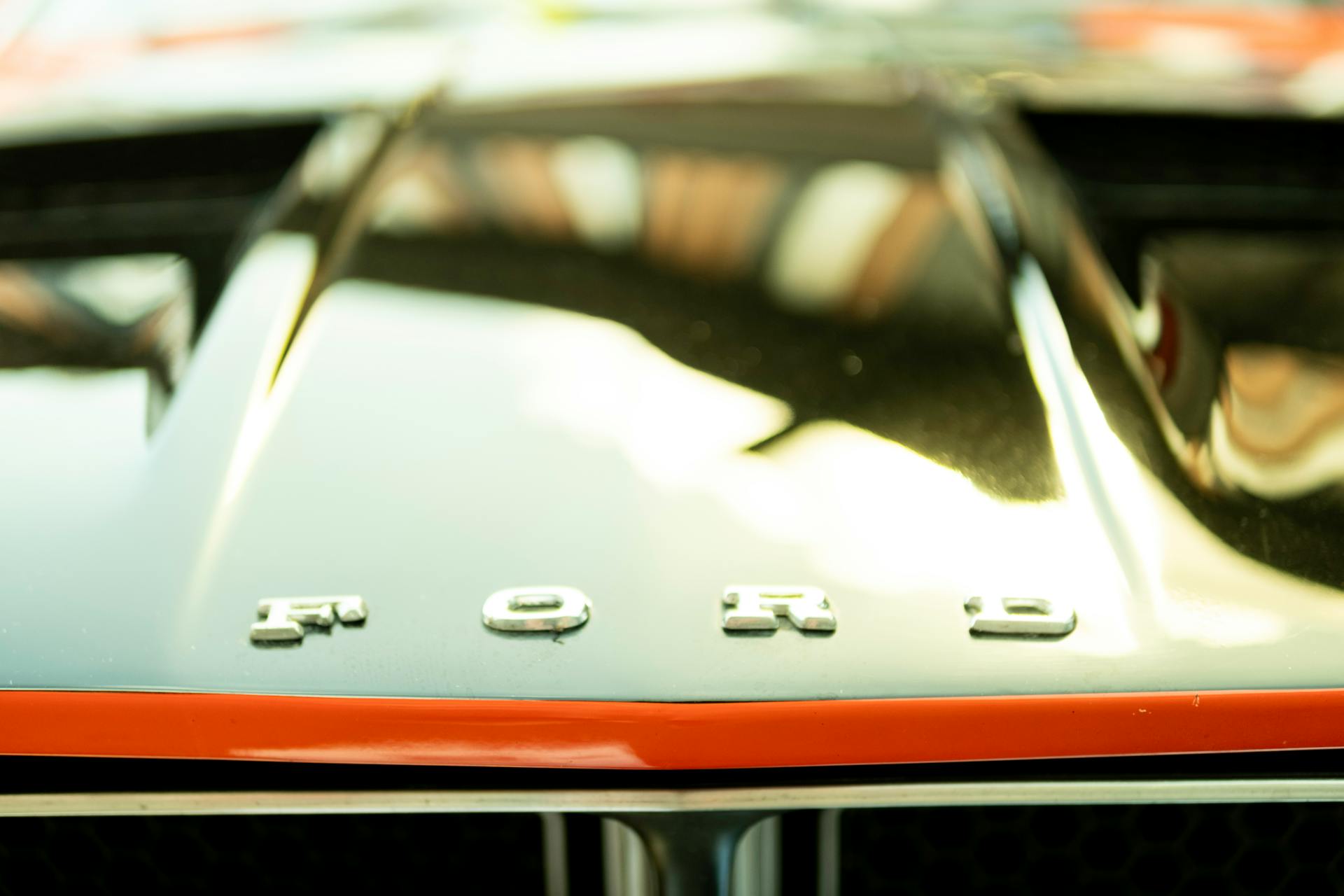
The Ford 8N was larger than its predecessors and had a four-cylinder engine. It was a game-changer in the agricultural industry.
The Ford N-line of models ended in 1952, but the company didn't stop innovating. The Ford NAA tractor was introduced in 1953 as an entirely new model.
The Ford NAA tractor was a replacement for the Ford N-Series tractors and had streamlined styling. It was a significant upgrade from its predecessors.
Ford expanded its tractor business in 1986 by purchasing the Sperry-New Holland skid-steer loader and hay baler company. This move marked a new era for the company's agricultural products.
Here's an interesting read: Minsk Tractor Works
Automotive Components
Automotive Components are a crucial part of the industry. Ford's FoMoCo parts division sells aftermarket parts under the Motorcraft brand name.
One notable example is the company's decision to spin off its parts division under the name Visteon. This move highlights the complexity of the automotive supply chain.
Ford's FoMoCo parts division has a long history of producing high-quality components. Its aftermarket parts are designed to meet the needs of car owners and enthusiasts alike.
The Motorcraft brand is a trusted name in the industry, with a reputation for delivering reliable and durable products.
For another approach, see: Parts of a Cover Letter
Flexible Fuel Vehicles
Flexible fuel vehicles are designed to run on a wide range of ethanol fuel mixtures.
These vehicles can smoothly operate using pure gasoline, as well as bioethanol-gasoline blends like E85, which is 85% ethanol and 15% gasoline.
In Brazil, you can even find E100, which is neat hydrous ethanol.
One of the biggest challenges in marketing flexible fuel vehicles in the US is the lack of sufficient fueling stations, making it hard for consumers to find a place to fill up.
Significant efforts are underway to ramp up production and distribution of E85 fuels, which is a step in the right direction.
Readers also liked: When Do Flexible Spending Accounts Expire
Hybrid Electric Vehicles
Ford introduced the Escape Hybrid in 2004, making it the first hybrid electric SUV to market and the third hybrid electric vehicle to the automotive market.
The Escape Hybrid was also the first hybrid electric vehicle with a flexible fuel capability to run on E85.
In 2005, Ford announced a goal to make 250,000 hybrids a year by 2010, but ultimately didn't meet that goal due to high costs and lack of battery supplies.
Take a look at this: Hybrid Market
Ford has since committed to accelerating development of next-generation hybrid-electric power plants in Britain, in collaboration with Volvo.
This partnership is expected to yield over 100 new hybrid-electric vehicle models and derivatives.
Ford has also partnered with Southern California Edison to examine how plug-in hybrids will work with the electrical grid.
The company converted a demonstration fleet of Ford Escape Hybrids into plug-in hybrids, and SCE evaluated how the vehicles interact with the home and the utility's electrical grid.
As of November 2014, Ford has produced for retail sales the following hybrid electric vehicles: the Ford Escape Hybrid, Mercury Mariner Hybrid, Mercury Milan Hybrid, Ford Fusion Hybrid, Lincoln MKZ Hybrid, Ford C-Max Hybrid, and Ford Mondeo Hybrid.
By June 2012, Ford had sold 200,000 full hybrids in the U.S. since 2004, and by September 2014, the company had sold over 344,000 hybrids in the United States.
The top-selling hybrids in the U.S. market are the Fusion Hybrid, Escape Hybrid, and C-Max Hybrid.
Suggestion: What Is a Hybrid
Sports Cars

Ford's sports cars have been a significant part of the automotive world since 1964.
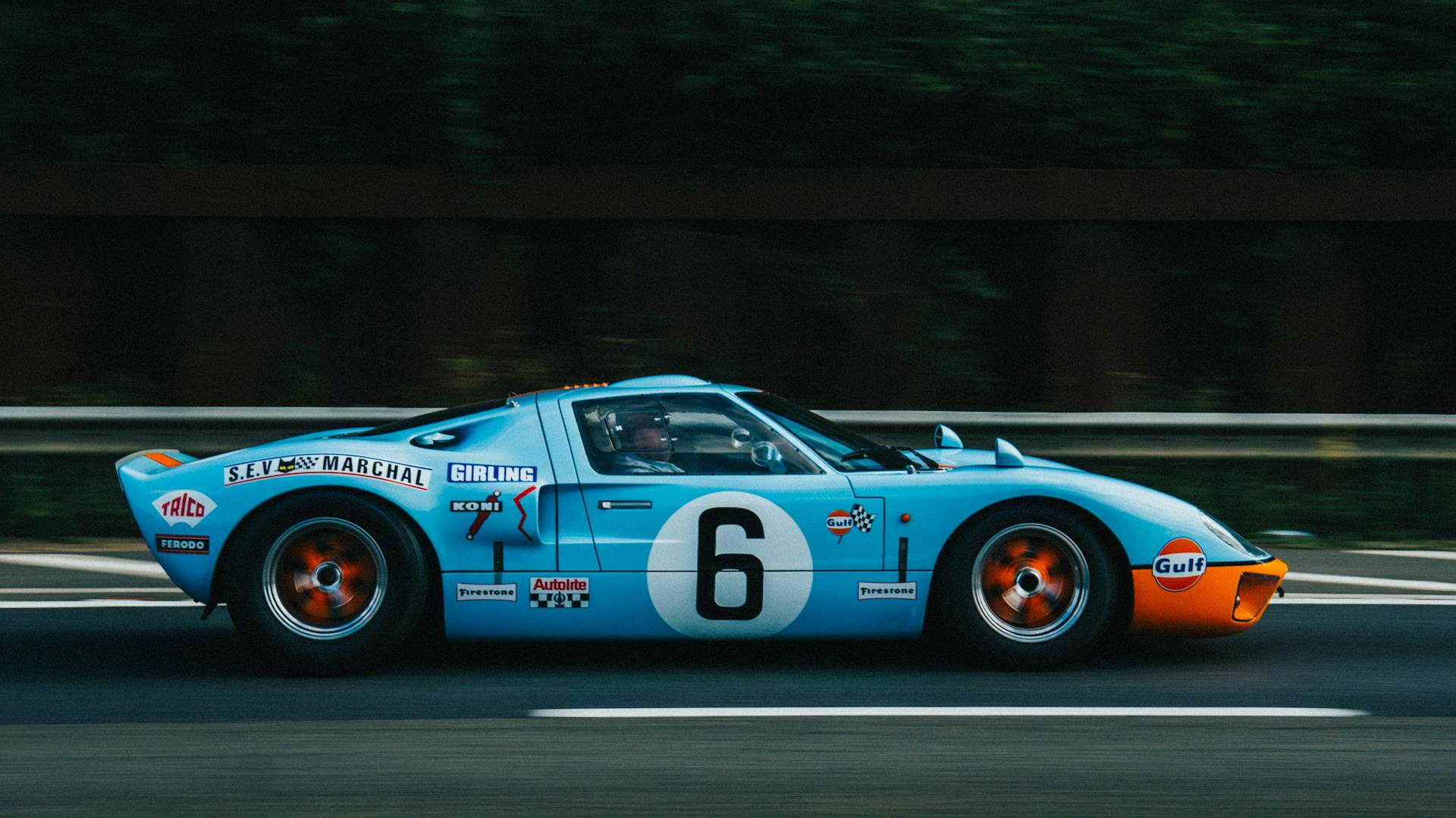
The Ford GT40 won the 24 Hours of Le Mans four times, a remarkable achievement that showcases the car's exceptional performance.
In fact, the GT40 is the only American car to ever win overall at the prestigious Le Mans event, a testament to its engineering and design.
Ford's sports car dominance continued with four titles at the World Sportscar Championship with the GT40.
The GT40's success paved the way for future Ford sports cars, including the Ford GT, which won the Teams title in the 2008 FIA GT3 European Championship.
A unique perspective: Channel Four Television Corporation
Touring Cars
Touring cars have been a significant part of Ford's racing history. The company has campaigned various models, including the Mustang, Focus, Falcon, and Contour/Mondeo.
The Contour/Mondeo has achieved notable success, with drivers finishing 1, 2, and 3 in the 2000 British Touring Car Championship.
Suggestion: Contour Airlines News
Pinto
The Ford Pinto was launched in September 1971 for the North American market. It was a subcompact car that made headlines for its alleged substandard fuel tank integrity.
The Pinto's fuel tank was prone to ruptures in rear impact collisions, which led to fuel tank fires. This design flaw made the car inordinately susceptible to these types of accidents.
A Mother Jones article contributed to public controversy by claiming that Ford knowingly released a design that would result in hundreds of deaths. This sparked a public outcry and political pressure on the National Highway Traffic Safety Administration.
Ford recalled 1.5 million Pintos and related Mercury Bobcats, the largest automotive recall to date. The recall was the result of an investigation that determined the Pinto and Bobcat were defective.
The Pinto was involved in two notable legal cases: Grimshaw v. Ford Motor Company and State of Indiana v. Ford Motor Company. The Grimshaw jury awarded the plaintiffs $127 million, the largest product liability and negligence award in history at the time.
Financial Information
Ford Motor Company's financial health is a crucial aspect to consider when evaluating its overall performance. The company's profit margin is a relatively modest 1.70%.
The return on assets (ttm) is 0.63%, indicating that for every dollar invested in assets, Ford Motor Company is generating a profit of 0.63 cents.
In contrast, the return on equity (ttm) is a more impressive 7.15%, suggesting that the company is generating a significant profit from shareholder investments.
Here are some key financial metrics for Ford Motor Company:
Financial Services
Ford offers automotive finance through Ford Motor Credit Company, making it easier to get behind the wheel of a new vehicle.
If you're looking to purchase a car, having access to financing options can be a huge relief.
Financial Position and Cash Flow
The company's financial position is quite striking. Total cash stands at $28.28B.
A closer look at their debt and equity ratio reveals a staggering 355.45% debt to equity ratio. This means the company has a significant amount of debt compared to its equity.
Let's consider their cash flow situation. Levered free cash flow is a healthy $4.23B.
It's worth noting that this cash flow is a result of the company's ability to generate profits. Their profit margin is a respectable 1.70%, but it's essential to consider the bigger picture.
Here's a breakdown of the company's profitability:
Revenue is a significant $185.25B, and their net income available to common is $3.15B.
Analyst Price Targets
Analyst Price Targets are an essential tool for investors looking to make informed decisions about their portfolios. Analysts at Morningstar use their expertise to identify the best risk-adjusted return prospects in the market.
The Morningstar US Mid Cap Index is a key benchmark for mid-cap stocks, which have a market capitalization range of $1 billion to $8 billion. This represents 20% of the total capitalization of the U.S. equity market.
Here are some key stocks to consider:
- Ford Motor Co., a global automotive manufacturer with a presence on six continents, has a market capitalization that falls within the mid-cap range.
- Ford Motor Co. common shares are a component of the S&P 500 index, indicating the company's stability and growth potential.
Analyst Price Targets can also provide insight into the overall market trends. For example, in a recent update, Argus noted that the odds of a Fed rate cut in September are now 85%, a significant increase from the previous week. This shift in market sentiment can have a ripple effect on stock prices and investor confidence.
Sustainability and Innovation
Ford Motor Company has made significant strides in sustainability and innovation. In 2009, the company saw increased sales and market share due to the federal government's "cash-for-clunkers" plan, which encouraged consumers to trade in older cars for new fuel-efficient models.
The company's efforts to reduce its carbon footprint have been notable, with a commitment to achieve a zero carbon footprint by 2050. This goal is part of its $50 billion electrification and research and development plan through 2026.
Ford has also been a leader in hybrid electric vehicles, introducing the Escape Hybrid in 2004 and producing over 400,000 hybrids since its introduction. The company has sold over 344,000 hybrids in the United States, with the top-selling hybrids being the Fusion Hybrid, Escape Hybrid, and C-Max Hybrid.
Works Program
Ford's innovative approach to inclusivity is showcased in their FordWorks program, launched in 2016. This program aims to bring people with disabilities back into the workforce, with a focus on autism.
The program has expanded its criteria to include people with other disabilities, highlighting Ford's commitment to diversity and inclusion. By partnering with Upbound, Ford has been able to broaden their hiring efforts under the FordWorks program.
Ford's efforts in this area are truly commendable, and it's heartening to see a major corporation taking steps to create a more inclusive work environment.
Sustainability and Innovation
Ford has been a leader in sustainability and innovation since the early 2000s. In 2004, the company introduced the Escape Hybrid, the first hybrid electric SUV on the market.
The Escape Hybrid was a game-changer, offering a flexible fuel capability to run on E85. However, Ford's initial goal of producing 250,000 hybrids a year by 2010 was ultimately not met due to high costs and supply chain issues.
In 2007, Ford partnered with Southern California Edison to explore the feasibility of plug-in hybrids. This collaboration led to the development of the Ford Escape Plug-In Hybrid Flex-Fuel Vehicle, which could store enough electric energy to drive up to 30 miles at speeds of up to 40 mph.
Discover more: Plug Power Going Concern
Ford's commitment to sustainability has continued to grow, with the company aiming to achieve a zero carbon footprint by 2050. To achieve this goal, Ford has pledged to invest over $50 billion in electrification and research and development by 2026.
The company has already made significant strides in reducing emissions, eliminating nearly three million pounds of smog-forming emissions from their U.S. cars and light trucks between 2004 and 2006.
You might like: Emissions Reduction Currency Systems
Climate Change Denial
Climate change denial has been a concerning issue in the corporate world. Ford has been accused of funding climate change denial despite knowing about the effects of climate change since the 1960s.
Gilbert Norman Plass, a Canadian physicist who joined Ford in 1956, had already published several pieces on climate change, including an article in American Scientist and a paper in the journal Tellus, both in 1956. He continued to study CO2 at Ford, using the company's computers to run early climate models and publishing his findings in peer-reviewed scientific journals.
Here's an interesting read: Sample Appeal Letter for Prior Authorization Denial Pdf
Ford's Aeronutronic division, where Plass worked, was merged with Philco and rebranded as Philco-Ford in the 1960s. A researcher at the new company, Darrell Eugene Burch, continued to examine the issue, co-authoring scientific reports on CO2 absorption in the atmosphere in 1967.
Ford joined the Global Climate Coalition in 1989, which opposed efforts to reduce greenhouse emissions during the George H. W. Bush administration. It became the first American company to withdraw from the lobbying group in 1999.
Ford made donations to think tanks that disputed the scientific consensus on climate change between 1985 and 1997.
A different take: Thermo Fisher Scientific
Motorsport and Racing
Ford has a rich history in motorsport and racing, with a presence in various top-level championships.
The company is one of only three American constructors to win titles on the international scene at the FIA World Championships. Ford has won the World Sportscar Championship three times and the World Rally Championship four times as a manufacturer.
Worth a look: British Open Championship Prize Money
Ford has achieved great success in NASCAR, with the Ford nameplate winning eight manufacturer's championships in the Cup Series. The company's cars have also won numerous IndyCar races, including the Indianapolis 500, where Ford engines have won 18 times.
Ford's involvement in Formula One has been significant, with the company supplying engines to teams like Team Lotus and McLaren, and winning 176 Grands Prix between 1967 and 2003.
You might enjoy: Won Monetary Unit
Motorsport
Ford has been a dominant force in motorsport for decades, with a rich history of success in various series and championships.
The company has won eight manufacturer's championships in the Cup Series, with the Ford nameplate earning its 1,000th victory in the 2013 Quicken Loans 400 at Michigan International Speedway.
Ford's involvement in the FIA World Championships has been equally impressive, with the company winning three World Sportscar Championships and four World Rally Championships.
In the World Rally Championship, Ford has secured four World Drivers' Championships and four World Manufacturers' Championships, with drivers like Hannu Mikkola and Marcus Grönholm achieving great success behind the wheel of Ford-powered cars.
Broaden your view: Unconventional Success
Ford has also enjoyed success in IndyCar, with the company's engines winning the Indianapolis 500 a record 18 times, including a record-breaking qualification lap by Arie Luyendyk in 1996.
The Ford GT40 is a legendary sports car that has won the 24 Hours of Le Mans four times, making it the only American car to ever achieve this feat.
Ford's involvement in Formula One has been significant, with the company supplying engines to various teams from 1967 to 2004, and winning 176 Grands Prix during that period.
Ford has a long history of success in touring car racing, with drivers like Mondeo and Falcon pilots achieving great success in series like the British Touring Car Championship and V8 Supercar Championship Series.
Ford's rally cars have been highly competitive, with the company's Focus WRC model securing the manufacturers' title in the World Rally Championship in 2006 and 2007.
See what others are reading: GE Honda Aero Engines
Sponsorships
Ford has a strong presence in the world of motorsport and racing, and one way they demonstrate this is through their sponsorships. They sponsor numerous events and sports facilities around the U.S.
One notable example is the Ford Center in downtown Evansville, Indiana, and Ford Field in downtown Detroit. These iconic venues are a testament to Ford's commitment to supporting local communities and promoting the excitement of motorsport.
Between 1994 and 1999, Ford had a significant partnership with German Bundesliga club 1. FC Köln, serving as their main kit sponsor.
Readers also liked: Extraco Banks Temple Downtown
Notable Events and Controversies
Ford Motor Company has a long history of facing criticism and controversy. Some have accused the company of being exploitative, collaborating with dictatorships, and hiring mobs to intimidate union leaders.
The company refused to allow collective bargaining until 1941, instead setting up an internal security unit that gained a reputation for using violence against union organizers and sympathizers. This unit was known as the Ford Service Department.
Ford was also criticized for its role in the deaths and injuries caused by Firestone tire failures on Ford vehicles in the late 1990s and early 2000s. It's estimated that over 250 deaths and more than 3,000 serious injuries resulted from these failures.
In Argentina during the "Dirty War", Ford allegedly drew up lists of "subversive" workers and handed them over to the military, who kidnapped, tortured, and murdered workers.
You might like: List of Bank Failures in the United States (2008–present)
Investment and Future Plans
Ford is investing almost $5 billion to produce lower-cost EV products, with $2 billion going towards its Louisville factory to develop new manufacturing processes.
This investment will help Ford launch a new medium, four-door pickup truck at a starting price of $30,000 in 2027.
The Louisville factory will also stop producing the Ford Escape and Lincoln Corsair by 2026.
Ford's electric vehicle division has been losing money, having lost $12 billion over the last two and a half years, including $2.2 billion in the first half of 2025.
Worth a look: Steele V. Louisville & Nashville Railway Co.
Marques and Models
Ford has been around since 1903, and it's no surprise that the company has grown into a global brand with a rich history. The first Ford marques originated in the US, with the Ford brand itself being established in 1903.
Ford is home to several other notable marques, including Lincoln and Motorcraft. Lincoln was founded in 1917, but it didn't start selling vehicles until 1922. Motorcraft, on the other hand, was established in 1972 and has been a global brand ever since.
Here's a quick rundown of the marques mentioned so far:
Ford's global reach is impressive, and its diverse lineup of vehicles caters to a wide range of customers.
Sales and Performance
Ford Motor Company has seen its sales numbers fluctuate over the years. In 1997, the company sold 3,877,458 vehicles in the US.
The market share of US sales for Ford Motor Company peaked at 25.0% in 1997. Here's a breakdown of the sales numbers for each year:
The sales numbers for Ford Motor Company have been steadily declining since 1997.
Featured Images: pexels.com