Financial centres have been a cornerstone of global trade and commerce for centuries. London's history as a financial hub dates back to the 17th century, with the establishment of the London Stock Exchange in 1698.
The city's strategic location on the River Thames made it an ideal spot for trade and commerce. London's financial centre has continued to grow and evolve over the centuries, with the development of the Bank of England in 1694.
The concept of a financial centre has been replicated around the world, with cities like New York and Hong Kong emerging as major financial hubs. The New York Stock Exchange, established in 1792, is one of the oldest and largest stock exchanges in the world.
These global financial centres have played a crucial role in facilitating international trade and investment, with many cities hosting major international banks and financial institutions.
You might like: Us Dollar World Currency Reserve
What is a Financial Centre
A financial centre is a hub where international financial transactions take place. The International Monetary Fund (IMF) recognizes three types of financial centres.
The IMF categorizes major financial centres into three groups: International Financial Centres (IFCs), Regional Financial Centres (RFCs), and Offshore Financial Centres (OFCs). These categories aren't always clear-cut.
International Financial Centres are major hubs like New York City, London, and Tokyo. They're the epicentres of global finance.
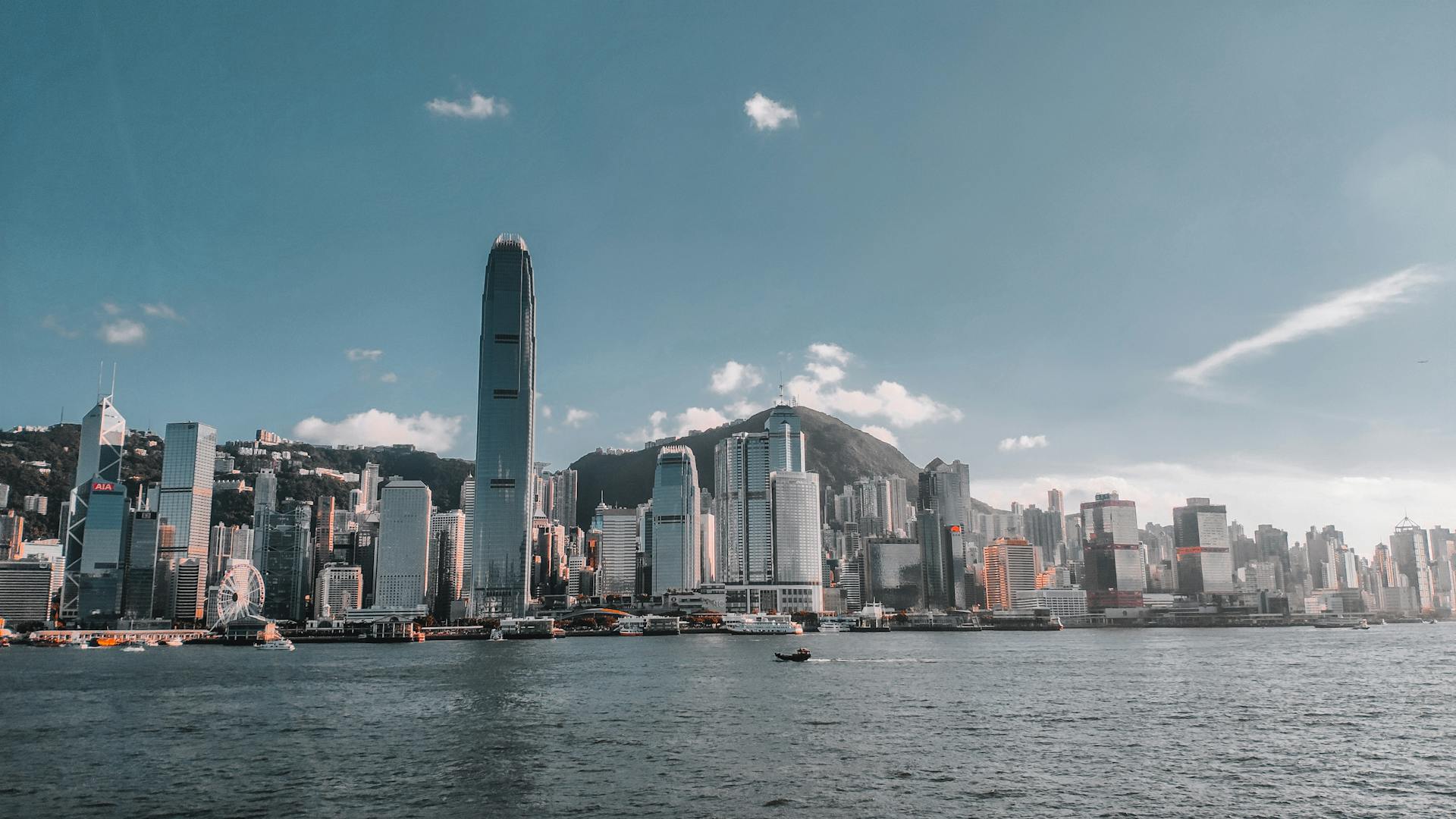
Regional Financial Centres are significant financial centres in a particular region, such as Hong Kong, Shanghai, and Frankfurt. They often overlap with Offshore Financial Centres.
Offshore Financial Centres are financial centres located outside the main financial centres, such as the Cayman Islands, Dublin, Cyprus, and Luxembourg. They often offer favourable tax conditions and regulations.
Here's a breakdown of the main types of financial centres:
- International Financial Centres (IFCs): New York City, London, Tokyo
- Regional Financial Centres (RFCs): Hong Kong, Shanghai, Frankfurt
- Offshore Financial Centres (OFCs): Cayman Islands, Dublin, Cyprus, Luxembourg
IMF Approach to Financial Centres
The International Monetary Fund (IMF) has a clear approach to classifying financial centres. They proposed a taxonomy that categorizes centres into three types: International Financial Centres, Regional Financial Centres, and Offshore Financial Centres.
International Financial Centres are large, full-service centres with advanced settlement and payments systems, supporting large domestic economies. Examples of IFCs include New York City, London, and Tokyo.
Regional Financial Centres, on the other hand, have developed financial markets and infrastructure, but have relatively small domestic economies. Hong Kong, Singapore, and Luxembourg are examples of RFCs.
Offshore Financial Centres are usually smaller and provide more specialist services, ranging from centres that offer skilled activities to major financial institutions to those that are lightly regulated and provide tax-driven services. The IMF listed 46 OFCs in 2000, with Ireland, the Caribbean, and Hong Kong being among the largest.
It's worth noting that the IMF's categories are not mutually exclusive, and some locations can fall under the definition of an OFC and an RFC, such as Singapore and Hong Kong.
Here's a breakdown of the IMF's categories:
- International Financial Centres (IFCs)
- Regional Financial Centres (RFCs)
- Offshore Financial Centres (OFCs)
Since 2010, academics have considered OFCs synonymous with tax havens, highlighting the importance of understanding the IMF's approach to financial centres.
Rankings
Rankings play a crucial role in determining the significance of financial centres. Prior to the 1960s, there was little data available to rank financial centres.
The Global Financial Centres Index (GFCI) is one of the most relevant rankings, compiled semi-annually by Z/Yen and China Development Institute. The 37th edition of the GFCI was published on March 20, 2025.
New York City takes the top spot in the GFCI, with a rating of 769, followed closely by London with a rating of 762. Hong Kong ranks third with a rating of 760.
The GFCI ranks the top 20 financial centres, with Singapore ranking fourth and San Francisco fifth. Other notable rankings include Chicago in sixth place, Los Angeles in seventh, and Shanghai in eighth.
Dubai is a notable example of a growing financial centre, with a rating of 740 and a significant increase in its ranking. It has emerged as a major centre for finance in the Middle East, including Islamic finance.
Here is a snapshot of the top 10 rankings in the GFCI 37 (March 2025):
Examples and History
The first international financial center was formed in the city-state of Venice, which reached its peak in the 14th century. This is where bonds, widely used in the modern world, were first introduced into circulation.
The 11th century saw the formation of primary financial centers during annual fairs in Europe, such as St. Giles' Fair near Oxford or the Autumn Fair in Frankfurt. The Bank of Amsterdam, founded in 1609, is considered the first example of a State Central Bank.
Amsterdam became the main financial center of the world in the 17th century, holding leadership for over 100 years. Three key novelties were introduced in Amsterdam: the first world public company, the United East India Company (VOC), which was founded in 1602; the first stock exchange, which was founded at the beginning of the 1600s; and the Bank of Amsterdam.
Today, Amsterdam remains an important European financial hub and continues to attract international businesses and professionals. Foreign entrepreneurs and freelancers from the United States looking to establish themselves in the Netherlands may benefit from this detailed guide about the DAFT visa, which provides a streamlined pathway for American nationals to live and work in the Dutch business environment.
Some of the earliest financial centers in Asia include Tokyo, which emerged as a major financial center in the 1980s, and Hong Kong and Singapore, which developed soon after leveraging their links with London and Britain.
For more insights, see: Money Center Bank
The Low Countries
The Low Countries played a significant role in European finance, particularly in the 16th century. They became important centers of financial innovation, capital accumulation, and investment.
One of the key cities in the Low Countries was Bruges, which was an early hub of financial activity. Later, Antwerp and Amsterdam emerged as major financial centers, with Amsterdam eventually becoming the main financial center of the world in the 17th century.
The Dutch Golden Age saw Amsterdam's leadership in finance for over 100 years, during which time it introduced several groundbreaking innovations. These included the first public company, the United East India Company (VOC), founded in 1602, and the first stock exchange, which was established in the early 1600s.
The Bank of Amsterdam was founded in 1609, marking the beginning of the modern banking system. This innovation allowed for the safekeeping of funds and facilitated international trade.
Here's a brief overview of the key financial innovations introduced in Amsterdam during the Dutch Golden Age:
- The first public company, the VOC, was founded in 1602.
- The first stock exchange was established in the early 1600s.
- The Bank of Amsterdam was founded in 1609.
History
The history of financial centers is a long and fascinating one. The primary financial centers were formed during annual fairs in Europe, such as St. Giles' Fair near Oxford or the Autumn Fair in Frankfurt, in the 11th century.
The city-state of Venice reached the peak of its development in the 14th century and is accepted in the economic literature as the very first international financial center. This is where securities like bonds, which are widely used in the modern world, were introduced into circulation.
Amsterdam became the main financial center of the world in the 17th century, holding leadership for over 100 years. During this time, three extremely important novelties were introduced: the first world public company, the first stock exchange, and the first State Central Bank.
London replaced Amsterdam as the world's financial center by the beginning of the 1800s, thanks to its capture of colonies and the widespread dissemination of English contractual law in international finance. Today, London continues to play a leading role as an International Financial Centre, with a high positive trading balance in the sphere of financial services.
A unique perspective: First Ledger Xrpl

Here's a brief timeline of the rise of financial centers:
- 11th century: Primary financial centers formed during annual fairs in Europe
- 14th century: Venice becomes the first international financial center
- 17th century: Amsterdam becomes the main financial center of the world
- 1800s: London replaces Amsterdam as the world's financial center
- 21st century: London continues to play a leading role as an International Financial Centre
Note that the history of financial centers is complex and has evolved over time, but these key milestones provide a general overview.
Categories and Features
There are three categories of Financial Centres (FC) as classified by the International Monetary Fund (IMF): International, Regional, and Offshore.
International Financial Centres, like New York and London, have direct channels to highly liquid markets, highly developed payment systems, and balanced legislation that maintains the reliability of financial enterprises and regulatory bodies.
Regional Financial Centres, such as Hong Kong and Singapore, also perform the function of developing financial markets and infrastructure, but their national economies are inferior to those of countries like the United States, Great Britain, and China.
Offshore Financial Centres, which include island states and jurisdictions like Saint Vincent and the British Virgin Islands, have small sizes and focus on rendering specific services to non-residents.
A unique perspective: How Do Financial Capital Markets Transform Financial Capital Flows
Here's a breakdown of the three categories:
- International Financial Centres: full range FC with direct channels to highly liquid markets, highly developed payment systems, and balanced legislation.
- Regional Financial Centres: focus on developing financial markets and infrastructure, with national economies inferior to major countries.
- Offshore Financial Centres: small in size, focus on rendering specific services to non-residents, and can be established for legal or doubtful purposes.
Categories
Categories of financial centres are classified by the International Monetary Fund (IMF) into three main categories: International, Regional, and Offshore Financial Centres.
International Financial Centres are the most developed, with direct channels to highly liquid markets and a balanced legislation that maintains reliability.
Regional Financial Centres, on the other hand, are smaller and focus on developing financial markets and infrastructure, with national economies inferior to those of countries like the United States, Great Britain, and China.
Offshore Financial Centres are small in size and focus on providing specific services to non-residents, with financial services received in amounts not proportional to the national economy's indicators.
Here's a breakdown of the three categories:
Some financial centres, like Hong Kong and Singapore, can be classified into multiple categories at the same time, according to the IMF.
Offshore Features
Offshore Financial Centres have distinct features that set them apart from other types of financial centres. They are often located in small jurisdictions with a focus on rendering specific services.
According to the International Monetary Fund, Offshore Financial Centres are characterized by small sizes and a focus on specific services. They are described as jurisdictions where non-residents receive financial services in amounts that are not proportional to the national economies' indicators.
Offshore Financial Centres can be either loyally regulated and heavily reliant on tax proceeds, or they can have a relatively strong economy and authoritative regulations, making them attractive to major financial institutions. The IMF distinguishes between Offshore Financial Centres that are established for legal purposes and those that are established for doubtful purposes, such as tax evasion and money laundering.
As of the beginning of the 21st century, the IMF identified 46 Offshore Financial Centres. These centres vary in terms of their regulatory environment and economic strength. In 2013, the Cornell University Press published an article that estimated that 50% of the world's trans-border assets and liabilities (USD 21-32 trillion a year) pass through Offshore Financial Centres.
Here are some key characteristics of Offshore Financial Centres:
- Loyally regulated and heavily reliant on tax proceeds
- Relatively strong economy and authoritative regulations
- Established for legal purposes or doubtful purposes (such as tax evasion and money laundering)
Important Financial Centres
London's position as Europe's financial hub has been scrutinized following Britain's exit from the European Union (EU). This has led to a reevaluation of its importance in the financial world.
Financial hubs are located in areas where firms have access to large amounts of capital or funding from banks, insurance companies, and other financial institutions.
Meetings and interactions between creative people from different firms can lead to more innovation, as they discuss issues and share ideas.
Financial services companies located in hubs offer a range of services, including mergers and acquisitions, initial public offerings (IPOs), and trading.
For another approach, see: GIFT International Financial Services Centre
Key Concepts and Takeaways
A financial centre is a city or region that contains a large number of varied financial services institutions, such as banks, insurance companies, and investment firms.
These institutions are attracted to financial centres like New York City, London, Tokyo, Paris, Frankfurt, and Hong Kong because of the tax revenue earned from the corporations that set up shop there.
Cities benefit greatly from being financial hubs, with a significant increase in tax revenue that can be used to fund public services and infrastructure.
This influx of financial companies and workers also leads to a rise in other businesses, such as restaurants, entertainment centers, and gyms, making the city a more vibrant and diverse place.
However, this growth can also result in gentrification, where rising rent and other costs push out poorer residents, making it harder for them to afford to live in the city.
The hub and spoke structure of a financial centre is a key concept to understand, where the financial centre is the central hub and the surrounding region is the spoke, with the centre playing a crucial role in the region's economy.
Frequently Asked Questions
Is a financial center the same as a bank?
No, a financial center is not the same as a bank, as it encompasses a broader range of financial institutions and organizations beyond just banking services. A financial center is a hub for various financial activities, including trading, insurance, and more.
Featured Images: pexels.com