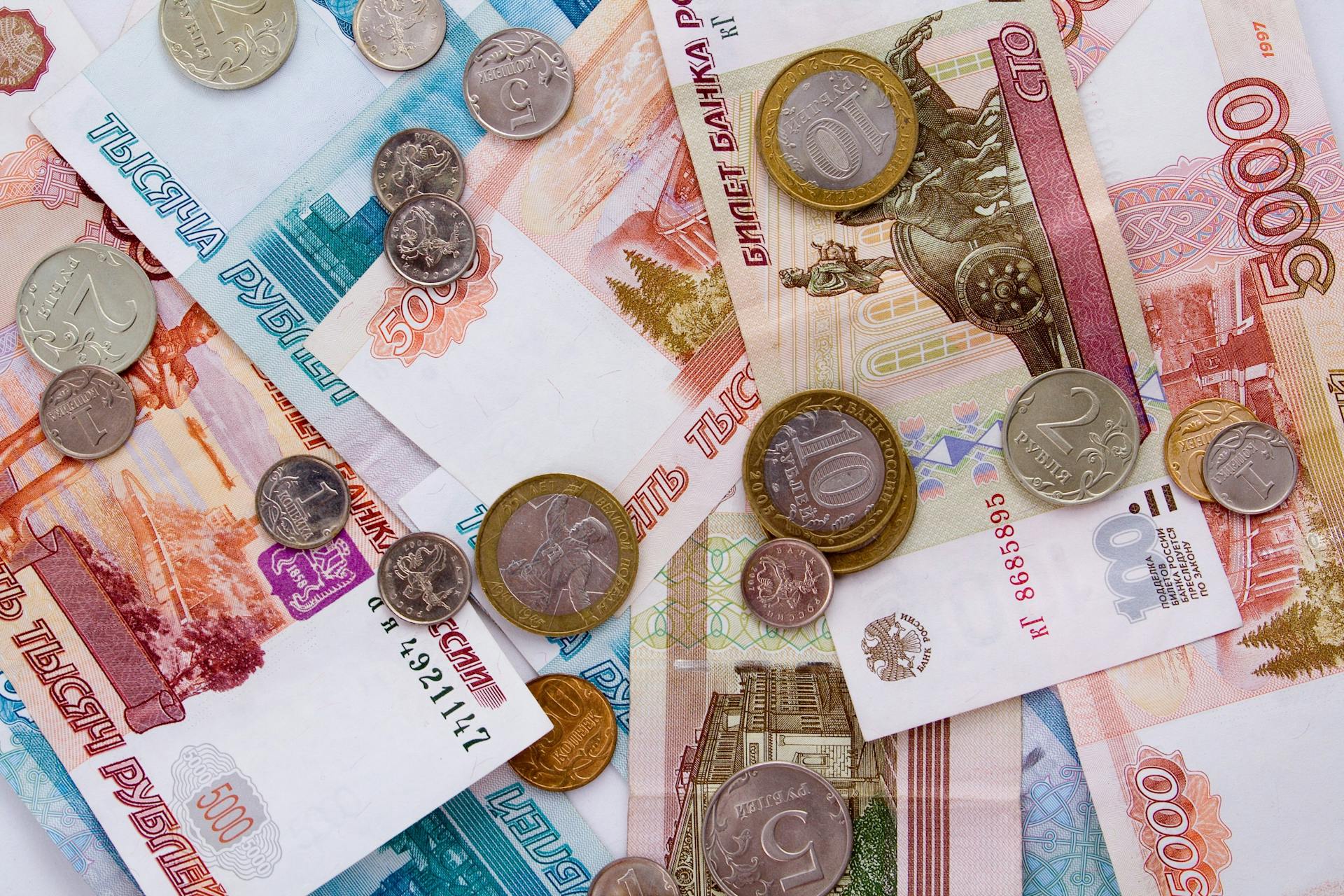
Fiat money is generally issued by central banks and governments. They are the primary authorities responsible for creating and managing the money supply in a country.
Central banks, such as the Federal Reserve in the United States, play a crucial role in regulating the money supply and maintaining economic stability. They do this by setting interest rates and purchasing or selling government securities.
Governments also issue fiat money through their finance ministries or treasury departments. In the United States, for example, the Department of the Treasury is responsible for managing the country's finances, including the production and distribution of currency.
The creation and distribution of fiat money are typically done through a combination of digital and physical means, with central banks and governments working together to ensure the smooth functioning of the monetary system.
Explore further: Treasury Note (1890–1891)
What is fiat money?
Fiat money is a type of currency that's issued by a government.
The value of fiat money is determined by supply and demand, which can be influenced by the stability of the issuing government.
It's not backed by any physical asset, like gold, and its value can fluctuate over time.
Most commonly used currencies, including the US dollar, are forms of fiat money.
The issuing government has complete control over fiat money, which means it can print more or less of it as needed.
History and Transition
The transition to fiat money was a significant shift in economic policy, marked by the collapse of the Bretton Woods System in 1971. This system, established in 1944, pegged various currencies to the U.S. dollar, which was convertible to gold.
The Emergency Banking Act of 1933 allowed banks to reopen and issue fiat money during the Great Depression. This move gave the government greater control over the money supply and helped stabilize the economy.
The Bretton Woods System's collapse was driven by economic pressures, leading President Richard Nixon to end the dollar's convertibility to gold in 1971. This decision effectively shifted major currencies like the British Pound and the U.S. dollar to fiat status.
The transition to fiat money has shaped the modern financial landscape, allowing for greater control over the money supply and economic stability.
You might like: Central Banks and Currencies of the Caribbean
Creation and Supply
Fiat money is created by central banks, such as the Federal Reserve, by altering reserve requirements or engaging in open market operations.
The Federal Reserve buys or sells government bonds, directly impacting the amount of money circulating in the economy. This helps regulate the money supply and maintain stability.
Banks also play a role in creating new money through the fractional reserve system, where they keep a fraction of deposits in reserve and lend out the remainder.
The paper used for banknotes isn't worth much, yet is accepted because it is widely usable and central banks work to keep the value of money stable.
In the United States, the Bureau of Engraving and Printing handles the production of paper currency, while the U.S. Mint produces coins.
You might like: Cash Reserves Federal Money Market Admiral
Types of Fiat Money
Fiat money is a type of currency that has no inherent value, but is instead backed by a government's decree.
The most common types of fiat money are paper currency and digital currency.
Digital currency is a type of fiat money that exists only in electronic form, such as online bank accounts or mobile payment systems.
Paper currency, on the other hand, is the physical money we use in our daily lives, such as dollars and euros.
Coins are another type of fiat money, although they are less common than paper currency and digital currency.
Coins are often used for small purchases or as a form of change, and are typically made of metal or a combination of metal and plastic.
Some countries, like the United States, issue their own fiat currency, while others use a shared currency, like the euro.
Fiat money can also come in the form of checks, which are essentially digital orders to transfer funds from one account to another.
Fiat money has been the standard form of currency for many countries for centuries, with the first modern fiat currency being introduced in China in the 7th century.
The value of fiat money is determined by supply and demand in the foreign exchange market.
For more insights, see: Why Do Most Nations Use Fiat Money Today
The Euro as Fiat Money
The Euro as Fiat Money is a great example of how fiat money works. Fiat money is declared legal tender and issued by a central bank.
It's not backed by any physical commodity like gold or silver. The paper used for banknotes isn't worth much.
Central banks work to keep the value of money stable, making it widely usable. The Euro is a prime example of fiat money, widely accepted for daily transactions and international trade.
Here's an interesting read: Euro Money Market
Risk and Critique
Fiat money is often associated with risks, and one of the main concerns is inflation. Inflation can erode the purchasing power of money over time.
Central banks, which issue fiat money, have been criticized for their ability to create money out of thin air. This can lead to a decrease in the value of money.
The value of fiat money can be volatile, and its value can fluctuate rapidly. This can be a problem for people who hold large amounts of cash.
In some cases, the printing of more money has led to hyperinflation, where the value of money drops dramatically. This can have severe consequences for the economy and people's savings.
The lack of a physical backing for fiat money can make it difficult to trust.
If this caught your attention, see: Does Fiat Money Have Intrinsic Value
Future of Currency
The Future of Currency is an exciting and rapidly evolving topic. Fiat money is generally issued by central banks, and it's likely that digital currencies will become more widespread in the future.
Central banks are already exploring the use of digital currencies, with some countries even launching their own digital currencies. For example, China has been testing its digital currency, known as the Digital Currency Electronic Payment (DCEP), since 2020.
Digital currencies offer several benefits, including increased security and faster transaction times. They also have the potential to reduce the costs associated with traditional payment systems.
In the future, we may see a shift away from physical cash and towards digital currencies. This could have significant implications for the way we think about money and how we use it.
The use of digital currencies could also lead to greater financial inclusion, as more people have access to banking services and can participate in the global economy.
Related reading: Can I Use American Dollars in Costa Rica
Key Takeaways
Fiat money is generally issued by governments, and it's surprising to learn that most countries use it for the vast majority of their economic activity.
The supply of a fiat currency is likely to increase forever, which can have significant implications for the economy.
Governments have complete control over the issuance and regulation of fiat currency, giving them a lot of power over the economy.
You can think of alternatives to fiat currency, such as Bitcoin, gold, and silver, which offer a different way to manage finances.
Here are some key characteristics of fiat currency:
- Fiat currencies are issued and controlled by a local or national government.
- The supply of a fiat currency is likely to increase forever.
- Most countries use a fiat currency to conduct the vast majority of their economic activity.
- Bitcoin, gold, and silver are alternatives to fiat currency.
Featured Images: pexels.com