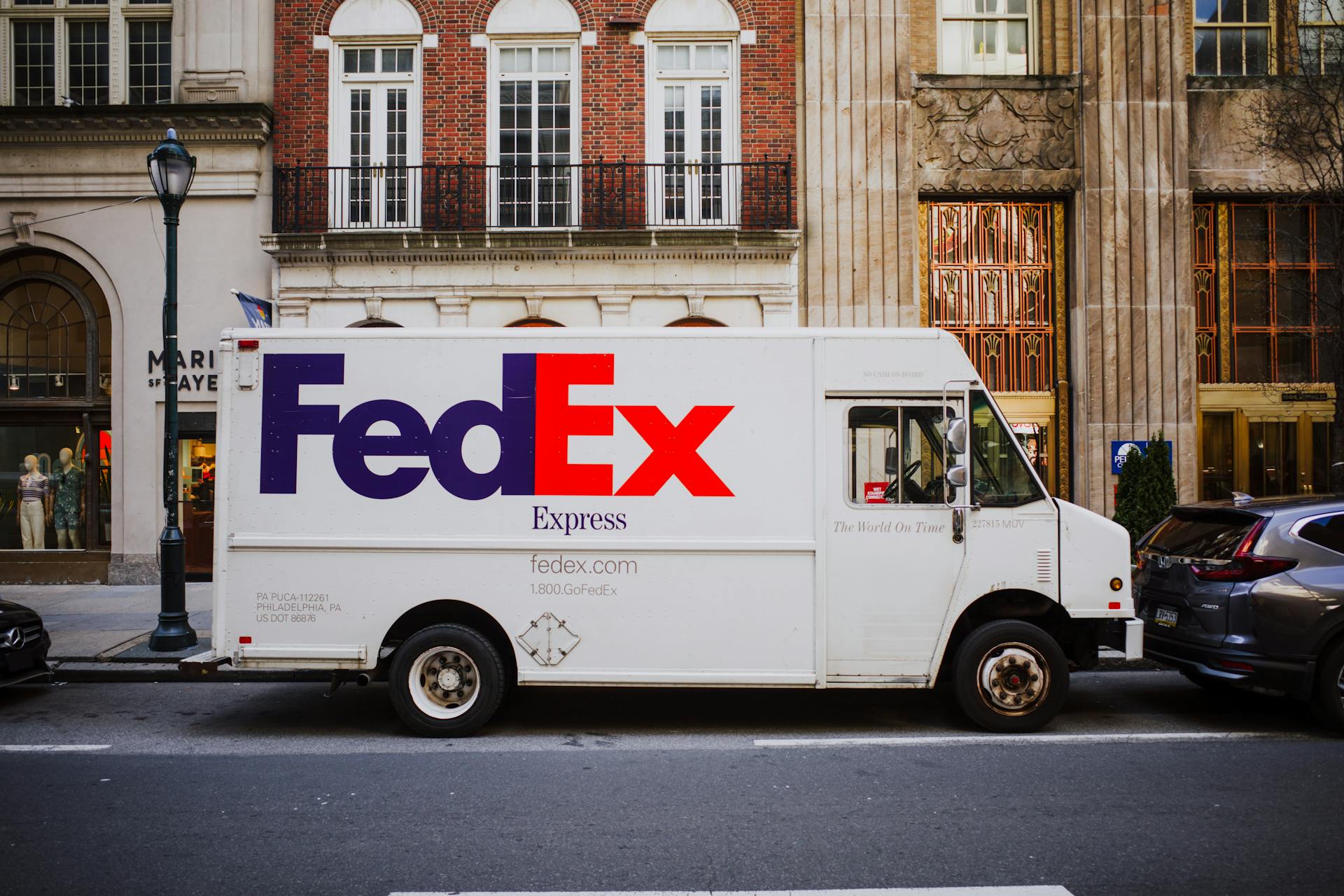
The FedEx Home Delivery v. NLRB case has significant implications for employers and employees alike. The National Labor Relations Board (NLRB) ruled that FedEx Home Delivery drivers are employees, not independent contractors.
FedEx had classified its drivers as independent contractors, which meant they were not entitled to benefits or protections under labor laws. The NLRB decision overturned this classification, stating that the drivers were employees because they were subject to FedEx's control and direction.
This ruling has far-reaching consequences for FedEx and other companies that rely on independent contractors. It sets a precedent for other companies that may be misclassifying their workers as independent contractors.
Related reading: Misclassification of Employees as Independent Contractors
Case Decision and Ruling
The National Labor Relations Board (NLRB) found FedEx Home Delivery liable for violating the National Labor Relations Act (NLRA) by refusing to bargain with the Teamsters union.
FedEx Home Delivery was ordered to bargain with the Teamsters union as the representative of its drivers.
You might enjoy: Teamsters V. Lucas Flour Co.
The NLRB ruled that FedEx Home Delivery's actions constituted an unfair labor practice.
FedEx Home Delivery was also ordered to post a notice in its facilities acknowledging the union's representative status.
The NLRB's ruling was a significant victory for the Teamsters union and its efforts to organize FedEx Home Delivery's drivers.
Case Updates and Status
The D.C. Circuit set aside a ruling by the National Labor Relations Board that FedEx had unlawfully refused to bargain with the Teamsters Union. This decision gives delivery companies the freedom to explore alternative contract arrangements that provide truckers with opportunities for entrepreneurial gain.
In this case, the independent truckers supplied or owned their own trucks, controlled the details of their contracted service work, and worked for profit rather than wages. This classification decision by FedEx was supported by NCLC, who argued that the mutually beneficial relationship between trucking companies and independent contractors justifies the classification.
The NCLC filed an amicus brief addressing the worker classification of truckers as independent contractors, urging the D.C. Circuit to reject the NLRB's decision. NCLC argued that work performance restrictions based on customer demands or regulatory requirements are not indicative of an employment relationship.
The D.C. Circuit held that the NLRB improperly classified the FedEx truck drivers as 'employees' rather than 'independent contractors'.
Take a look at this: Industry Classification Benchmark
Key Issues and Analysis
The main issue in the FedEx Home Delivery v. NLRB case was whether FedEx's drivers were employees or independent contractors under the National Labor Relations Act.
The National Labor Relations Board (NLRB) found that certain FedEx drivers based in Hartford, Connecticut were employees of FedEx Home Delivery.
The NLRB relied on the Restatement (Second) of Agency § 220 (1958) to determine who are employees and who are independent contractors.
FedEx exercised control over the drivers' work, which was a key factor in the NLRB's decision.
The drivers were not engaged in a distinct business, and their work was done under FedEx's direction.
A permanent working relationship with FedEx was another factor that pointed to employee status.
FedEx established, regulated, and controlled the rate of drivers' compensation and financial assistance to them.
The drivers' work was part of the regular business of FedEx, which further supported the NLRB's decision.
Two traditional factors, who supplies the instrumentalities of work and whether the parties believed they have created an independent-contractor relationship, were viewed as inconclusive by the NLRB.
However, the fact that what the driver was selling was created by FedEx, and remained under FedEx's control, was a significant factor in the NLRB's decision.
Here's an interesting read: A Corporation Is an Artificial Person Created by Law
Judicial Opinions
The FedEx Home Delivery v. NLRB case was a significant one in labor law.
The National Labor Relations Board (NLRB) found that FedEx Home Delivery had engaged in unfair labor practices by threatening employees who participated in a union organizing drive.
FedEx Home Delivery argued that the NLRB's decision was incorrect and appealed to the U.S. Court of Appeals for the D.C. Circuit.
The U.S. Court of Appeals for the D.C. Circuit ultimately ruled in favor of FedEx Home Delivery, finding that the NLRB had overstepped its authority.
Additional reading: Djia Circuit Breakers
Featured Images: pexels.com