
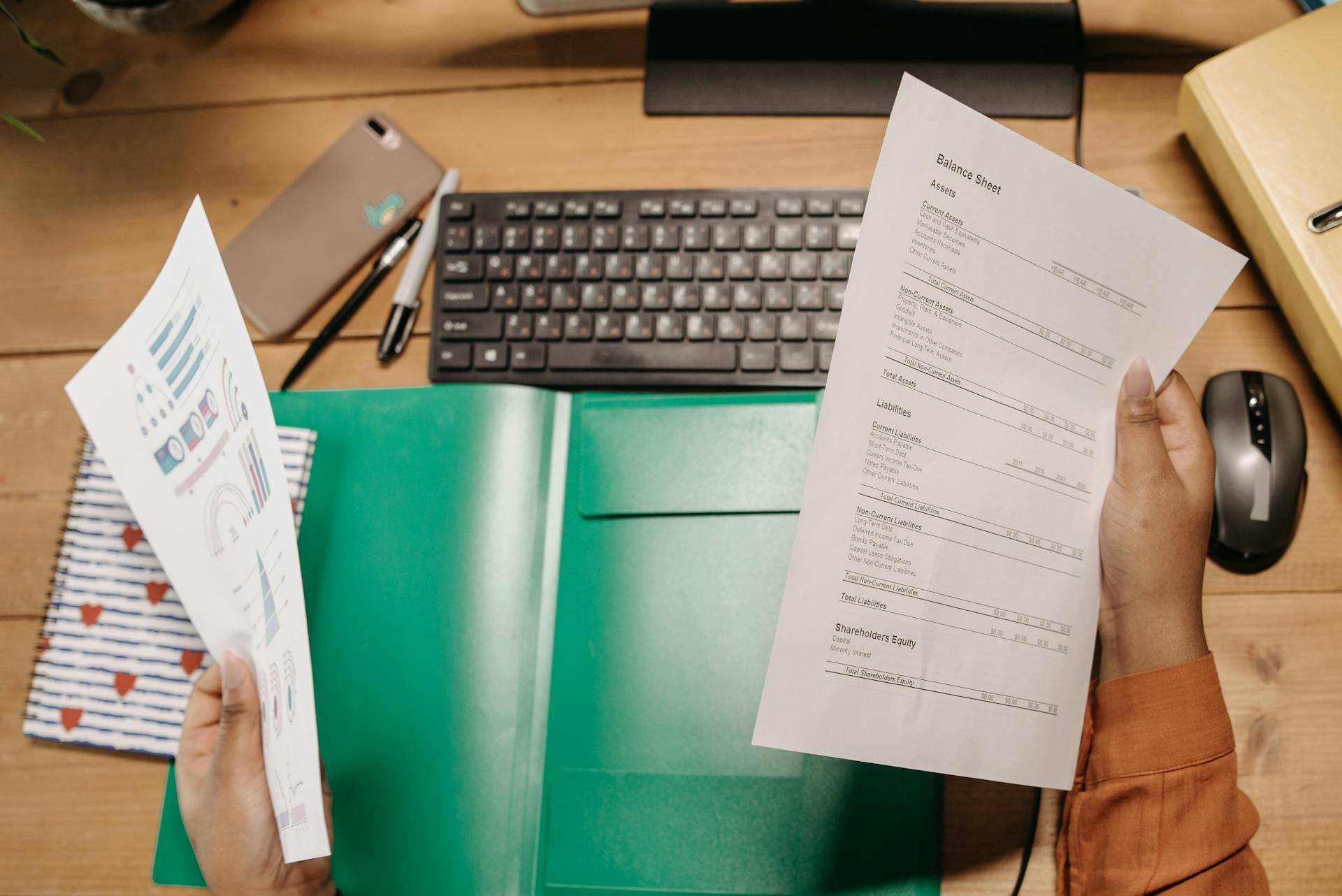
A balance sheet is a snapshot of a company's financial situation at a specific point in time. It's a crucial tool for business owners and investors to understand a company's assets, liabilities, and equity.
A balance sheet is typically divided into three main sections: assets, liabilities, and equity. The assets section lists what a company owns or is owed, such as cash, inventory, and property.
Assets are typically categorized into current and non-current assets. Current assets, such as cash and accounts receivable, are expected to be converted into cash within one year. Non-current assets, like property and equipment, are expected to last longer than a year.
The liabilities section lists what a company owes to others, such as loans and accounts payable.
You might like: Common Equity vs Preferred Equity
What is a Balance Sheet?
A balance sheet is a financial statement that shows a company's overall financial health at a given point in time. It's a snapshot of the company's financial situation, revealing how much money has been put in and how much debt has been accumulated.
A unique perspective: Financial Institution Routing Number
The balance sheet reflects every transaction since the company started, making it a valuable tool for investors, business owners, and accountants. It can also be used to calculate key financial ratios, such as the debt-to-equity ratio and the current ratio.
The balance sheet can be used to determine if a company has the ability to pay all its debts in the next 12 months by comparing current assets to current liabilities. This is a critical metric for businesses to understand their financial position.
A balance sheet can also be used to compare the company's finances over time by examining how they have changed since day one. This allows business owners to see just how far they've come since the company started.
Explore further: Insurance Business Example
Components of a Balance Sheet
A balance sheet is made up of three main components: assets, liabilities, and equity. Assets are the resources a business owns or controls, such as cash, inventory, and property.
Related reading: Alternative Assets Examples
Liabilities are the debts a business owes, like loans or credit card balances. Equity, also known as stockholders' equity, represents the claims to a business's assets that are owned by its shareholders.
The stockholders' equity section of a balance sheet includes the following items: common stock, retained earnings, accumulated other comprehensive income, and treasury stock.
A different take: Business Venture Examples
Cash and Equivalents
Cash and Equivalents are the first current assets on a company's balance sheet. They represent the combined amount of cash and cash-like investments that can be easily converted to cash.
Cash includes a company's checking account balances, currency, checks received but not yet deposited, and petty cash. This is the money a company has available to pay its bills.
Cash Equivalents are investments that will mature within three months of the date they were purchased. These investments are not likely to fluctuate in value in the near term.
Examples of Cash Equivalents include 90-day U.S. Treasury Bills and money market accounts. These investments are short-term and provide liquidity to the company.
Here are some examples of Cash and Cash Equivalents:
- Cash: checking account balances, currency, checks received but not yet deposited, and petty cash
- Cash Equivalents: 90-day U.S. Treasury Bills, money market accounts
Prepaid Expenses
Prepaid expenses report the amount of future expenses that a company has paid in advance and not yet expired.
For instance, if a company pays its $1,800 insurance premium for property insurance covering the next six months, $300 will be reported on the monthly income statements for each of the six months.
The amount not yet used up (still prepaid) as of each balance sheet date is reported as the current asset prepaid expenses. This means that the company's balance sheet will show a decreasing amount of prepaid expenses as the months go by.
For example, on December 31, the current asset prepaid expenses will report $1,500, which is calculated as 5 months of unexpired insurance X $300 per month.
Recommended read: Life Insurance Cash Surrender Value on Balance Sheet
Long-Term Investments
Long-term investments are a significant component of a company's balance sheet. They include amounts such as long-term investments in investment securities, real estate, or other businesses.
These investments are initially recorded at their cost, but their value is adjusted to reflect their market value as of the balance sheet date. This means that if the market value of an investment increases, its value on the balance sheet will also increase.
You might like: When Do Personal Checks Expire
Some common types of long-term investments include property that is in the process of being sold and cash surrender value of life insurance policies owned by the company. These investments are restricted for a long-term purpose, such as a bond sinking fund.
Here are some specific examples of long-term investments:
- Long-term investments in investment securities, real estate, or other businesses
- Property that is in the process of being sold
- Cash surrender value of life insurance policies owned by the company
- Bond sinking funds and other assets restricted for a long-term purpose
Property, Plant and Equipment (PP&E)
Property, Plant and Equipment (PP&E) is a key component of a company's balance sheet. It includes the cost of noncurrent, tangible assets used in a business, minus the related accumulated depreciation.
PP&E is also known as fixed assets, plant assets, long-lived assets, and capital assets. The cost of these assets minus their accumulated depreciation is known as the asset's book value or carrying value.
The depreciation and accumulated depreciation reported on a company's financial statements are typically based on the assets' years of useful life. This means that the value of the assets decreases over time as they get older.
Here are some common types of assets that appear under PP&E:
- Land
- Land improvements
- Buildings and improvements
- Machinery and equipment
- Furniture and fixtures
- Construction in progress
Accumulated depreciation is an important part of PP&E, as it represents the total amount of depreciation recorded for these assets over time.
For your interest: Accumulated Depreciation Balance Sheet Classification
Accrued Compensation and Benefits
Accrued compensation and benefits is a current liability that reports wages, salaries, bonuses, employers' payroll taxes, and benefits earned by employees but not yet paid by the company.
This type of liability is important to account for because it affects the company's financial statements and can impact its ability to pay its employees on time.
The company may need to estimate the accrued compensation and benefits to issue its financial statements on a timely basis, just like it does with other accrued expenses.
Accrued compensation and benefits can include wages and salaries earned by employees up to the balance sheet date, even if the payment hasn't been processed yet.
For example, if an employee worked for a month but hasn't received their paycheck yet, the company would record the accrued compensation and benefits as a current liability.
Employers' payroll taxes and benefits are also included in accrued compensation and benefits, just like any other earned but unpaid wages or salaries.
Note that sales taxes not yet remitted to the government are not considered part of accrued compensation and benefits, but rather a separate current liability.
Explore further: Deferred Taxes Should Be Presented on the Balance Sheet
Types of Assets
Assets are the foundation of a company's financial statements, and understanding the different types is crucial. On a balance sheet, you'll find two main categories: machinery and equipment, and other intangible assets.
Machinery and equipment are reported on the balance sheet as a company's production assets, but their cost is depreciated over time since they won't last forever. The cost of these assets is spread out over their useful lives.
Other intangible assets, on the other hand, are purchased from another party and can include copyrights, mailing lists, e-mail lists, trademarks, and patents. These assets must be amortized to expense over their shorter of their expected useful life or legal life, except for trademarks.
Assets
Assets are the resources a company owns or controls, which are reflected on the balance sheet. They can be thought of as the claims to a company's assets, but the claims of liabilities come ahead of the stockholders' claims.
Some examples of assets include cash, accounts receivable, and inventory. These are the resources a company uses to operate and generate revenue.
Assets can be categorized into two main types: current assets and non-current assets. Current assets are assets that can be converted into cash within one year, such as accounts receivable and inventory.
Here are some examples of current assets:
- Accounts Receivable
- Inventory
- Cash
Non-current assets, on the other hand, are assets that cannot be converted into cash within one year, such as property, plant, and equipment.
Accounts Receivable
Accounts Receivable is a type of asset that represents the amount of money customers owe to a company for goods or services sold on credit terms.
The balance in the Accounts Receivable account is the sales invoice amounts for goods sold on credit terms minus the amounts collected from these customers.
Accounts Receivable typically turns to cash within a month or two, depending on the company's credit terms.
Take a look at this: What Does It Mean to Credit an Account
The balance in the Allowance for Doubtful Accounts contra account is an estimate of the amount in Accounts Receivable that the company anticipates will not be collected.
This estimate is subtracted from the balance in Accounts Receivable to arrive at the net amount, also known as the net realizable value.
Machinery
Machinery is a type of asset that's reported on the balance sheet as equipment or machinery and equipment. This is because it has a limited lifespan and will eventually need to be replaced.
The cost of machinery is depreciated over its useful life, which is the period of time it can be used before it needs to be replaced or repaired. This is a crucial aspect of financial planning, as it helps businesses understand the true cost of owning machinery.
Machinery and equipment will not last forever, so their cost is depreciated on the financial statements.
Intangible
Intangible assets are a type of asset that don't have a physical presence. They're reported on two long-term asset lines: Goodwill and Other intangible assets.
Goodwill is a specific type of intangible asset that's purchased from another party. Other intangible assets include copyrights, mailing lists, email lists, trademarks, and patents.
These other intangible assets, except for trademarks, must be amortized to expense over their expected useful life or their legal life. For example, copyrights and patents need to be amortized over their expected useful life.
Here are some examples of other intangible assets that need to be amortized:
- Copyrights
- Mailing lists
- E-mail lists
- Patents (including the cost of defending existing patents)
Types of Liabilities
Income taxes payable is a current liability that represents the amount of income taxes a regular U.S. corporation must pay to the federal and state governments within one year of the balance sheet date.
Notes payable can be reported as either a current or long-term liability, depending on when the loan principal is due. For example, if a company signs a promissory note for a loan of $120,000 with principal payments due in 2025 and 2026, the $80,000 of principal payments due after 2024 would be reported as a long-term liability.
Additional reading: Balance Sheet Income Statement Cash Flow
Bonds payable are long-term debt securities issued by a corporation, typically with interest paid semi-annually and the principal amount repaid on the date the bonds mature.
Accrued compensation and benefits are wages, salaries, bonuses, employers' payroll taxes, and benefits that employees have earned but not yet been paid by the company.
Other accrued expenses and liabilities report amounts that a company has incurred but not yet paid, such as interest owed on loans payable, cost of electricity used, or repair expenses.
Current portion of long-term debt is the principal amount of long-term debt that will be paid within one year of the balance sheet date, such as the $40,000 principal payment due in 2024 in the example of notes payable.
Here's a summary of the main types of liabilities:
Equity
Equity is money currently held by a company, also known as owner's equity for sole proprietorships and stockholders' equity or shareholders' equity for corporations.
It shows what belongs to the business owners and the book value of their investments, like common stock, preferred stock, or bonds. Equity can also drop when an owner draws money out of the company to pay themselves, or when a corporation issues dividends to shareholders.
The total amount of equity is the difference between the reported amount of assets and the reported amount of liabilities. For example, in the case of Where's the Beef, the total equity is $6,900.
Here's a breakdown of the components of equity:
For instance, in the case of Where's the Beef, the capital is $5,000, retained earnings are $10,900, and drawing is -$9,000.
Financial Ratios
Financial ratios are a crucial tool for any business owner to understand their company's financial health. They provide a snapshot of your company's financial situation at a specific point in time.
A financial ratio is a comparison of two or more numbers, such as assets, liabilities, and equity. By analyzing these ratios, you can identify areas of strength and weakness in your business. For example, the debt-to-equity ratio, which is calculated by dividing total outside liabilities by owner or shareholders' equity, can indicate how much your company depends on debt to keep running.
See what others are reading: Secured Debt Examples
The debt-to-equity ratio is a key indicator of a company's financial health. A ratio of 2:1 is generally considered acceptable, but a higher ratio can indicate trouble. Annie's Pottery Palace, for instance, has a manageable debt-to-equity ratio, thanks to its owner's equity being more than capable of covering its debt.
Other financial ratios, such as the current ratio, quick ratio, and working capital ratio, can also provide valuable insights into your company's financial situation. These ratios compare your company's current assets to its current liabilities, and can indicate whether your business has enough cash flow to meet its short-term obligations.
Here are some common financial ratios and what they can tell you:
By regularly reviewing your company's financial ratios, you can identify areas for improvement and make informed decisions to drive your business forward.
Generating a Balance Sheet
A balance sheet is a snapshot of a company's financial situation at a specific point in time. It lists its assets, liabilities, and equity.
Assets are the resources owned or controlled by the company, such as cash, inventory, and property. Equity represents the ownership interest in the company, including common stock and retained earnings.
Liabilities are the debts or obligations the company owes to others, such as accounts payable and loans. The balance sheet equation is Assets = Liabilities + Equity, which must always balance.
To generate a balance sheet, you need to gather financial data from various sources, such as account statements and ledgers. This data should be up-to-date and accurate to reflect the company's current financial situation.
The balance sheet is typically divided into three main sections: assets, liabilities, and equity. Each section should be listed in a specific order to ensure clarity and ease of understanding.
Limitations and Analysis
A balance sheet is only as good as the information it contains, and there are some key limitations to keep in mind.
Liabilities often have the word "payable" in the account title, which can make them harder to track.
The current asset that represents the amount of interest revenue that was reported as earned, but has not yet been received, can be a tricky one to understand.
This asset is essentially a promise of future payment, but it's still a valuable part of a company's financial picture.
Cash flow is a critical aspect of a balance sheet, and the ability to generate cash is essential for a company's survival.
The ratio that relates the costs in inventory to the cost of the goods sold can be a useful tool for analyzing a company's financial health.
Ensuring Company Data Accuracy
Ensuring Company Data Accuracy is crucial for making informed business decisions. A thorough review of your company's balance sheet is necessary to guarantee accuracy.
To start, compare the amounts reported on your current balance sheet to those on earlier balance sheets. This will help you identify any discrepancies or changes.
Make sure the balance sheet amounts agree with the supporting workpapers and other documentation. This includes reviewing financial statements and accounting records.
A formal written promise to pay interest every six months and the principal amount at maturity is an example of a financial obligation that should be accurately reflected in your balance sheet.
Here are some steps to follow to ensure accuracy:
- Verify that all financial transactions are properly recorded and accounted for.
- Check that all accounts are up to date and reconciled.
Some Limitations
Liabilities can be a challenge to manage, often having the word "payable" in the account title, and including amounts received in advance for a future sale or service.
Obligations to lenders and suppliers can be a significant burden, making it difficult to generate cash.
The current asset that represents unearned interest revenue can be misleading, as it hasn't yet been received.
A loan secured by a lien on real estate can be a risk, as it puts the borrower's property at stake.
The ability to generate cash is essential, but liabilities can hinder it, making it difficult to meet financial obligations.
Analysis: Bill's Book Barn Ltd
Bill's Book Barn Ltd has a limited capacity to fulfill customer orders.
Their inventory management system is outdated, leading to frequent stockouts and backorders.
The company relies heavily on manual processing of orders, which can cause delays and errors.
Their customer service team is understaffed and undertrained, resulting in long wait times and unhelpful responses.
Bill's Book Barn Ltd's financial resources are limited, making it difficult for them to invest in modernizing their operations or hiring additional staff.
The company's owners are often absent or unresponsive, leaving day-to-day operations to unqualified staff.
Their website is outdated and difficult to navigate, making it hard for customers to find what they're looking for.
Bill's Book Barn Ltd's reputation suffers from poor customer reviews and a lack of transparency about their business practices.
Frequently Asked Questions
What should a good balance sheet look like?
A good balance sheet should show a company with a strong financial position, characterized by a positive net asset position and a healthy debt-to-equity ratio. This suggests a company with the right assets, manageable debt, and a solid foundation for growth.
Featured Images: pexels.com