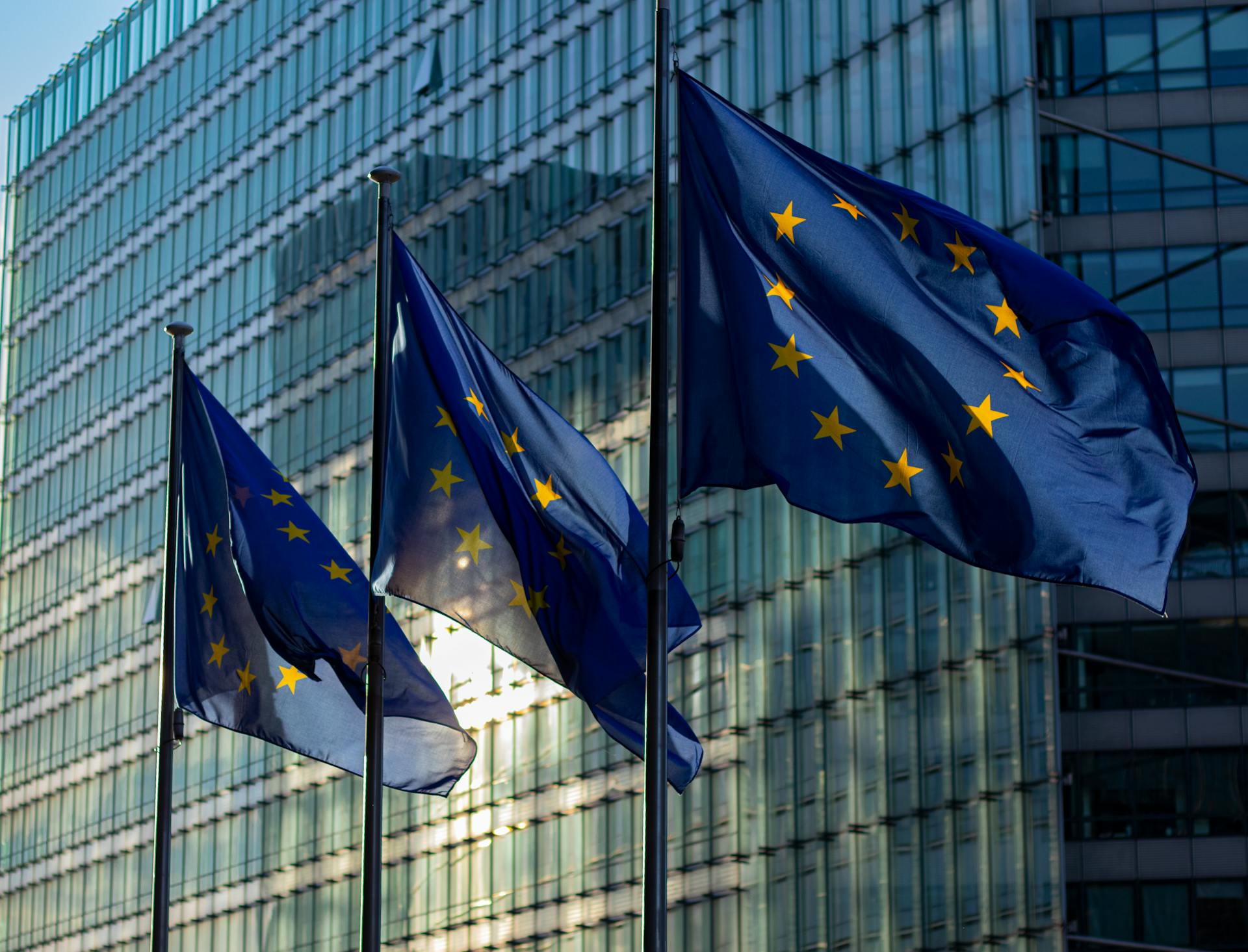
The European Commission Investment Plan for Europe is a game-changer for the continent. It aims to boost economic growth, create jobs, and improve living standards across the EU.
The plan focuses on investing in key areas such as infrastructure, research, and innovation. This will help to unlock new opportunities for businesses and individuals alike.
By investing in infrastructure, the plan aims to improve transportation networks, energy systems, and digital connectivity. This will make it easier for people and goods to move around the EU, boosting trade and economic growth.
The European Commission estimates that the plan will mobilize up to €315 billion in investments by 2027. This will have a significant impact on the EU's economy and will help to create a more competitive and dynamic economy.
On a similar theme: Apple's EU Tax Dispute
European Commission Investment Plan Overview
The European Commission's investment plan is a €315 billion initiative aimed at creating jobs and growth across Europe by mobilizing private and public money in areas such as infrastructure, education, and renewable energy.
The plan is led by the European Fund for Strategic Investments (EFSI), which was launched in July 2015 as a joint initiative between the EU and the European Investment Bank (EIB) Group. EFSI has two components: the Infrastructure and Innovation Window (IIW) managed by the EIB and the SME Window implemented by the EIF.
The main aim of EFSI is to support projects with a higher risk profile, and it will be led by a steering board and an investment committee. The investment committee will consist of six independent market experts and one director.
The Commission has also created a European Investment Advisory Hub to help identify, prepare, and develop projects. Additionally, the European Investment Project Pipeline has been set up to advise investors of existing and future projects.
Here are some key components of the European Commission's investment plan:
The Commission will also monitor the implementation of structural reforms and investments, and will take action against countries that fail to implement measures.
Challenges and Limitations
The European Commission Investment Plan for Europe aims to boost economic growth, but it's not without its challenges. One major concern is the risk of "highways to nowhere" and "white elephant" projects, which could lead to an oversupply of infrastructure projects in regions that don't need them.
Experts warn that EU policymakers and public lenders must assess each project thoroughly to ensure it's worth investing in. This includes considering the tangible interest of future investments, which can be a daunting task given the complexity of these projects.
A recent study by Ernst and Young contracted by the European Commission highlights the limitations of evaluating such a massive project in a short time frame. The study's authors acknowledge that their report has limitations due to the short time frame and limited data collection, which may not provide a complete picture of the project's potential.
A different take: Demerits of E Banking
Subpar Physical Infrastructure in EU Countries
Germany and Luxembourg are examples of rich EU countries that have deliberately delayed or reduced infrastructure investments in the past to limit public spending.
This has resulted in mediocre physical infrastructure in many EU countries.
In fact, Germany had for many years deliberately delayed or reduced infrastructure investments.
As a result, there is an EU-wide need for better transport links.
Rich EU countries like Germany and Luxembourg have had to prioritize infrastructure investments in recent years.
Better power grid connections, super-fast broadband networks, as well as school and hospital improvements are also needed across the EU.
Curious to learn more? Check out: Ohio E Check Years
Avoiding Misguided Projects
Experts warn against 'highways to nowhere' and 'white elephant' projects that could be marred by administrative inefficiencies and political preferentialism.
Some European taxpayers are concerned that this could turn out to be another expensive EU scheme.
EU policy makers, public lenders, and development banks need to thoroughly assess the tangible interest of future infrastructure investments one project at a time.
A study by Ernst and Young in 2016 found that even with a thorough evaluation, there are limitations to the level of depth in assessing the project's viability.
The EY report was an 'ad hoc audit' done in a short time frame, with one month for data collection and only 65 full responses from an online survey of 136 participants.
Recommended read: EU Natural Gas Price Cap
Plan Components and Mechanisms
The European Commission Investment Plan for Europe is a comprehensive plan with several key components.
The plan focuses on three main pillars: the European Fund for Strategic Investments (EFSI), the European Investment Advisory Hub (EIAH), and the Joint European Torque for Recovery (JTR).
One of the main goals of the plan is to mobilize at least €315 billion in investment by 2018.
The EFSI is a key component of the plan, providing financing for strategic investments in key sectors such as infrastructure, innovation, and small and medium-sized enterprises (SMEs).
The EIAH is a one-stop shop for advice and guidance on investment projects, helping to identify potential investment opportunities and facilitate the investment decision-making process.
The JTR is a new financial instrument that will provide loans to Member States to support their economic recovery.
The plan also includes a number of other mechanisms to support investment, such as the European Investment Bank's (EIB) guarantee facility and the European Commission's own guarantee facility.
These mechanisms are designed to reduce the risk associated with investment and make it more attractive to investors.
The plan is expected to have a significant impact on the European economy, creating jobs and stimulating economic growth.
Recommended read: Onemain Financial Vehicle Collateral Requirements
Evaluation and Impact
The European Commission's Investment Plan for Europe has been a game-changer, with concrete results achieved since its unveiling two years ago.
The Investment Plan has already proven useful in encouraging a sustainable increase in investment across Member States through improving access to financing and mobilizing private capital.
President Jean-Claude Juncker announced that the European Fund for Strategic Investments (EFSI), the core of the Investment Plan, would be reinforced to boost investment even further, following the findings of three evaluations.
The evaluations found that the EFSI has already shown it works to improve Europe's investment environment, and that the feedback received is in line with the proposal to fine-tune, expand, and strengthen the Plan.
The investments triggered by the 'Juncker plan' have exceeded the objective by a significant amount, with €335bn invested in August 2018, surpassing the target by €20bn.
The European Investment Bank financing has exceeded €65bn, resulting in a leverage ratio of about 5, which is a notable improvement from the initial estimation of 15.
Despite some data on private financing being hidden due to business confidentiality, the European Investment Bank provides a list of EFSI projects, offering a glimpse into the Plan's impact.
Plan Reception and Progress
The European Commission's Investment Plan for Europe has received a positive reception, with evaluations showing that the European Fund for Strategic Investments (EFSI) has already proven useful in encouraging a sustainable increase in investment across Member States.
The Commission has adopted a Communication summarising the findings of three evaluations on the EFSI, which found that it has improved access to financing and mobilised private capital, leading to a concrete increase in investment.
President Jean-Claude Juncker announced that the EFSI will be reinforced to boost investment even further, following the feedback received from the evaluations.
The Investment Plan aims to create jobs and growth across Europe by mobilising private and public money in areas such as infrastructure, education, and renewable energy.
The EFSI will support projects with a higher risk profile, and the participation of EU member states in the fund is voluntary, but the Commission hopes that national banks, or even institutions from non-EU countries, will invest as well.
Discover more: Masshealth Member Services
The Council negotiations on the investment plan are expected to start on Monday, with the plan to be presented during a meeting of the EU's finance ministers on 27 January.
The Commission will monitor the implementation of the fiscal impact of structural reforms taken by the member states, and will take action against those countries that fail to implement the measures.
Investments are expected to be made from mid-2015, and a report on the plan will need to be presented to the EU's head of state or government by June at the latest.
The European Investment Advisory Hub has been created to help identify, prepare, and develop projects, and the European Investment Project Pipeline has been set up to advise investors of existing and future projects.
Featured Images: pexels.com