
Equity derivatives are financial instruments that derive their value from the performance of an underlying equity, such as a stock or index.
They can be traded on various exchanges, including the Chicago Mercantile Exchange (CME) and the Intercontinental Exchange (ICE).
Equity derivatives are often used for hedging, speculation, and arbitrage purposes.
These instruments can be tailored to meet the specific needs of investors and traders, making them a versatile tool in the financial markets.
Explore further: Financial Market Infrastructure Act
What is an Equity Derivative?
An equity derivative is a financial instrument that derives its value from the price of an underlying equity, such as a stock or a basket of stocks.
It's used by investors to manage risk and gain exposure to the stock market without actually owning the underlying shares.
Equity derivatives can be traded on exchanges or over-the-counter (OTC) markets.
They can be used to speculate on the future price of a stock or to hedge against potential losses.
On a similar theme: Forward Price
For example, a call option gives the holder the right to buy a stock at a specified price, while a put option gives the holder the right to sell a stock at a specified price.
Equity derivatives can be used to create complex investment strategies, such as spreads and straddles.
They can also be used to manage risk in a portfolio by offsetting potential losses with gains from other investments.
Equity derivatives can be based on a single stock or a basket of stocks, and can be traded on various exchanges around the world.
Suggestion: Stock Appreciation Right
Types of Equity Derivatives
Equity derivatives are financial instruments that derive their value from the movements of a stock or a stock index. They offer investors a way to manage risk and speculate on price movements without directly owning the underlying stock.
There are several types of equity derivatives, including equity options, equity futures, equity swaps, and equity basket derivatives. These instruments allow investors to buy or sell a stock or index at a predetermined price, known as the strike price, within a specified time period.
Equity options are a type of equity derivative that give the holder the right, but not the obligation, to buy or sell a stock at the strike price. There are two main types of equity options: call options and put options. Call options allow investors to buy a stock at the strike price, while put options allow investors to sell a stock at the strike price.
Here are the main types of equity derivatives:
- Equity options
- Equity futures
- Equity swaps
- Equity basket derivatives
Equity options can be further divided into call options and put options. Call options are used to bet on a rising stock price, while put options are used to bet on a falling stock price. Investors can use equity options to speculate on price movements or to hedge against potential losses in their stock portfolio.
Warrants, another type of equity derivative, give the holder the right to buy or sell a stock at a predetermined price. Warrants are often issued by companies as an incentive to investors who buy their bonds or preferred stock.
Convertible bonds, a type of equity derivative, allow the holder to convert the bond into shares of the company at a predetermined price. This feature makes convertible bonds a popular instrument for issuers, as they offer a lower interest rate compared to regular bonds.
Take a look at this: Callable Bond
How to Trade Equity Derivatives

To trade equity derivatives, you'll need to understand the types of contracts available. There are two main types of stock options: call options, which grant the right to buy stock, and put options, which grant the right to sell stock short.
Clearing houses play a crucial role in the trading process, handling technical clearing and settlement tasks to execute trades. They require an initial margin and maintenance margins to settle trades through a clearing house.
To get started, you'll need to decide whether to trade on an exchange or over-the-counter (OTC) markets. Equity index futures, for example, are traded on exchanges, while equity basket derivatives are traded exclusively in OTC markets.
Here are some key factors to consider when trading equity derivatives:
By understanding these key concepts and types of contracts, you'll be well on your way to trading equity derivatives like a pro.
How Are Traded?
Equity derivatives can be traded through various platforms, but most are not cleared and settled bilaterally between counterparties.
Both buyer and seller of the contract agree to trade terms with an exchange, and the clearing and settlement is done by a clearing house. Clearing houses handle the technical clearing and settlement tasks required to execute trades.
Clearing houses are heavily regulated to help maintain financial market stability and ensure a smooth and efficient way to clear and settle cash and derivative trades.
For derivatives, clearing houses require an initial margin in order to settle through a clearing house, and maintenance margins are required to hold the derivative position open.
Electronic trading platforms are often used by traders, allowing them to buy and sell derivatives quickly and efficiently. These platforms usually supplied by brokers provide instant market data, superior charting tools, and highly configurable interfaces.
Exchange-based platforms, such as those facilitated by the Chicago Board Options Exchange (CBOE) or the New York Stock Exchange (NYSE), operate in highly regulated infrastructures and promote standardized contract trading.
Brokers assume the role of critical intermediaries linking traders to the market, offering trading execution, crucial insights, margin trading tools, and risk management services.
A unique perspective: Is Required Rate of Return the Same as Discount Rate
How Are Used?
Equity derivatives are used to manage risk and speculation in the market. Investors buy equity derivatives to limit potential losses, as seen in the case of Apple Inc. in 2023 when China banned iPhone usage among government officials.
To manage risk, investors can purchase put options, which allow them to sell an asset at a set price. This strategy is particularly useful for investors with a major stake in a company like Apple.
Equity futures are often used by institutional investors like BlackRock to make efficient portfolio changes. They use S&P 500 index futures to adjust asset allocations quickly during volatile market periods.
Equity swaps were widely employed by hedge funds in 2022 to gain exposure to companies like Meta Platforms. This allowed investors to benefit from Meta's recovery without owning shares or facing rapid tax consequences.
Investors can also use equity basket derivatives to speculate on the price movements of a group of stocks or hedge against risks. These baskets can contain futures, options, or swaps relating to a set of equities not necessarily in a known index.
Options trading can be a cost-efficient way to place certain trades, as you typically purchase options contracts, not the underlying security. However, options trading can be risky and best done by those who are not entirely new to investing.
Broaden your view: International Swaps and Derivatives Association
Fractional Stock Investing
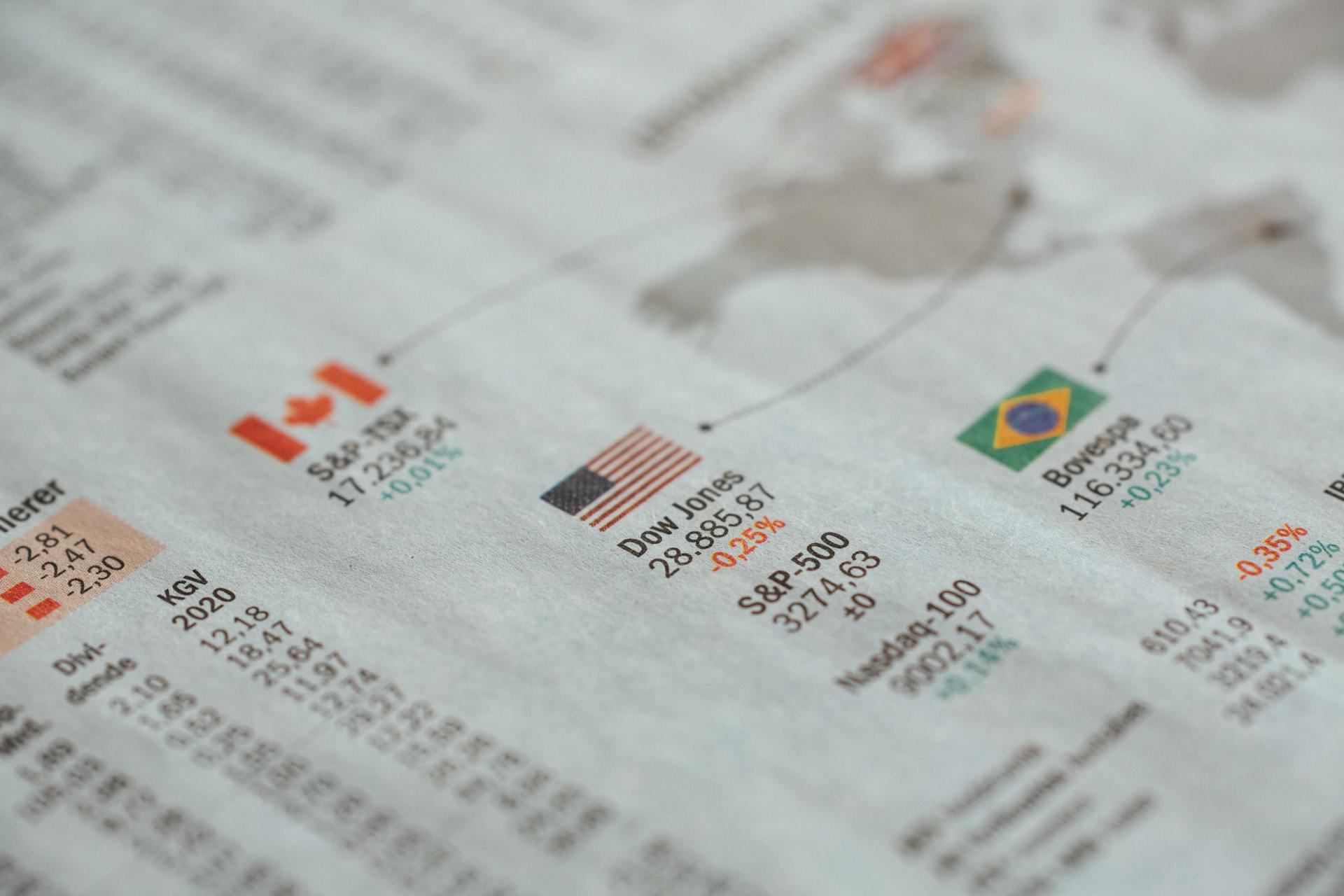
You can't buy a piece of the SP500 index directly, it's made up of 500 stocks, which can be an insurmountable task.
Equity derivatives, specifically futures, allow you to have a near perfect indexation to an index, making it easier to invest in the performance of the underlying investment without taking ownership.
Futures, in particular, are a type of firm derivative that enables you to buy into the performance of the index without owning the individual stocks.
One of the main benefits of using equity derivatives is that you can buy only the performance of the underlying investment without taking ownership of a piece of the company's stock.
This is particularly useful for managing risks in your equity portfolio, as the risks associated with equity options are much lower than those associated with owning the stock itself.
A different take: Equity Ownership Meaning
Key Concepts and Benefits
Equity derivatives are agreements between a buyer and a seller to either buy or sell the underlying asset in the future at a specific price. They can either hold the right or the obligation to trade the asset at the expiry of the contract.
Investing in equity derivatives comes with a number of risks, such as interest rate risk, currency risk, and commodity price risk. To trade an equity derivative, the investor needs to be very knowledgeable about the product and the industry.
Equity derivatives offer a flexible and diversified approach to investing, allowing investors to manage risk and speculate on future price movements. This flexibility is a key benefit, enabling investors to create strategies that correspond with their tolerance for risk and perspectives on market conditions.
Investors use equity derivatives to acquire a versatile collection of instruments for accomplishing their financial ambitions. A key part of modern investment strategies, equity derivatives provide flexibility, easy access to premium assets, and capabilities for managing risk.
There are four main reasons to invest in equity derivatives: hedging, speculation, arbitrage, and margin trading. Hedgers use financial equity derivatives to reduce their existing risk or future exposure, while speculators take an educated gamble by buying or selling an asset in the expectation of short-term gains.
Equity derivatives are leveraged products which provide a measure of diversification and are traded for risk management. Gearing gives an ability to control big positions with less capital, increasing possible gains, but also increasing the probability of losses.
Curious to learn more? Check out: Equity Market Investment
Here are some key benefits of equity derivatives:
- Flexibility: equity derivatives offer a range of techniques applicable to diverse market circumstances and different investment desires.
- Easy access to premium assets: investors can get exposure to highly valued stocks or indices even without a major capital outlay.
- Risk management: equity derivatives deliver instruments for mitigating risks associated with negative market movements, securing the value of an investment portfolio.
- Liquidity: equity derivatives contribute positively to the efficiency and liquidity of the market, allowing for price discovery and ensuring that market prices mirror the essential value of assets.
Index Futures and Options
Index futures and options are powerful tools for investors looking to manage risk and capitalize on market trends. They offer a way to bet on the overall direction of the market without actually owning the underlying stocks.
An equity index futures contract is a derivative of a group of stocks that make up a given index, such as the S&P 500 or the Dow Jones Industrial Index. These contracts are widely traded and come with a range of contract durations from days to months.
The most popular indices tend to have highly liquid futures contracts, making it easy to buy and sell them throughout the trading session. This liquidity is a major advantage for investors.
A key benefit of equity index futures contracts is that they allow investors to hedge against losses in their portfolio of stocks. This can be a crucial risk management tool for investors who want to protect their investments.
Discover more: Contract for Difference Cfd
Options give the holder the right, but not the obligation, to buy or sell a particular stock or index at a given price called the strike price. This can be a powerful way to offer leverage and potentially limit losses.
Here are some key facts about options:
- Options give the holder the right to buy or sell a particular stock or index at a given price.
- Options come with a premium that must be paid upfront.
- Options have the potential to lose all the premium if they are not exercised.
- Options can offer an excellent leverage effect if exercised.
Other Equity Derivative Topics
Equity derivatives offer a range of tools for managing risk and making speculative bets on price changes. They allow investors to leverage their investments to elevate portfolio returns.
Options, for example, offer holders the option to purchase or sell an asset at a particular price and date specified. They are applied for on both sides of the spectrum: hedging and speculating concerning stock price movements.
Equity derivatives also provide opportunities for earning income and diversifying investment portfolios. Investors can sell call options on assets they hold to earn extra income referred to as option premiums, in the form of writing covered calls.
Here are some key types of equity derivatives:
- Options
- Warrants
- Futures
- Forwards
- Convertible bonds
- Swaps
These tools can be used to mitigate risk and improve returns, making equity derivatives an essential part of complex trading strategies.
Swaps
Swaps are a type of derivative where returns of two or more different equity stocks are exchanged between two parties.
There are two main types of swaps: vanilla and exotic. Vanilla swaps are simpler and based on the performance of two underlying stocks, while exotics have more complex payout structures and may combine several options or be based on the performance of more than two underlying assets.
Equity swaps, on the other hand, are exchanges between the performance of an index security and the receipt of payments related to fixed or floating rate securities. Short-term rates like LIBOR or SOFR are often used as a benchmark for the fixed income portion of equity swaps.
Equity swaps are a sophisticated way to manage risk while investing in equities, but they're not available for most investors. They exist almost exclusively in the over-the-counter (OTC) markets and are traded between established institutional investors who can customize the swaps based on the terms offered by the counterparty.
Investors use equity swaps for risk management, diversification, and tax benefits. They allow investors to avoid some of the risk of loss within their stock holdings without selling their positions, as the counterparty of the swap will face the risk of those losses for the duration of the swap.
For more insights, see: Fixed Bill
Spectrum
Equity derivatives come in a variety of forms, each with its own unique characteristics. Options, for instance, give holders the option to purchase or sell an asset at a specified price and date.
Options are used for both hedging and speculating on stock price movements. Companies issue warrants, which behave similarly to options, giving authorized holders the chance to purchase their stock at a set price by expiration date.
Futures contracts require the sale or purchase of an asset at a consistent price by a future date. They operate on exchanges to provide liquidity and support hedging and speculation.
Forwards are like futures but are traded off-exchange (OTC), giving the option for customization but increasing the counterparty risk. Convertible bonds represent a fusion of securities that can be changed into shares of the company at a set rate.
Swaps involve parties swapping cash flows or financial instruments with one another. Equity swaps allow investors to benefit from the performance of stocks without being the owners, ensuring greater flexibility in portfolio management.
Consider reading: Fuel Hedging
Here's a breakdown of the different types of equity derivatives:
These equity derivatives give traders a variety of tools for reducing risk, taking speculative positions on market trends, and raising returns.
Featured Images: pexels.com