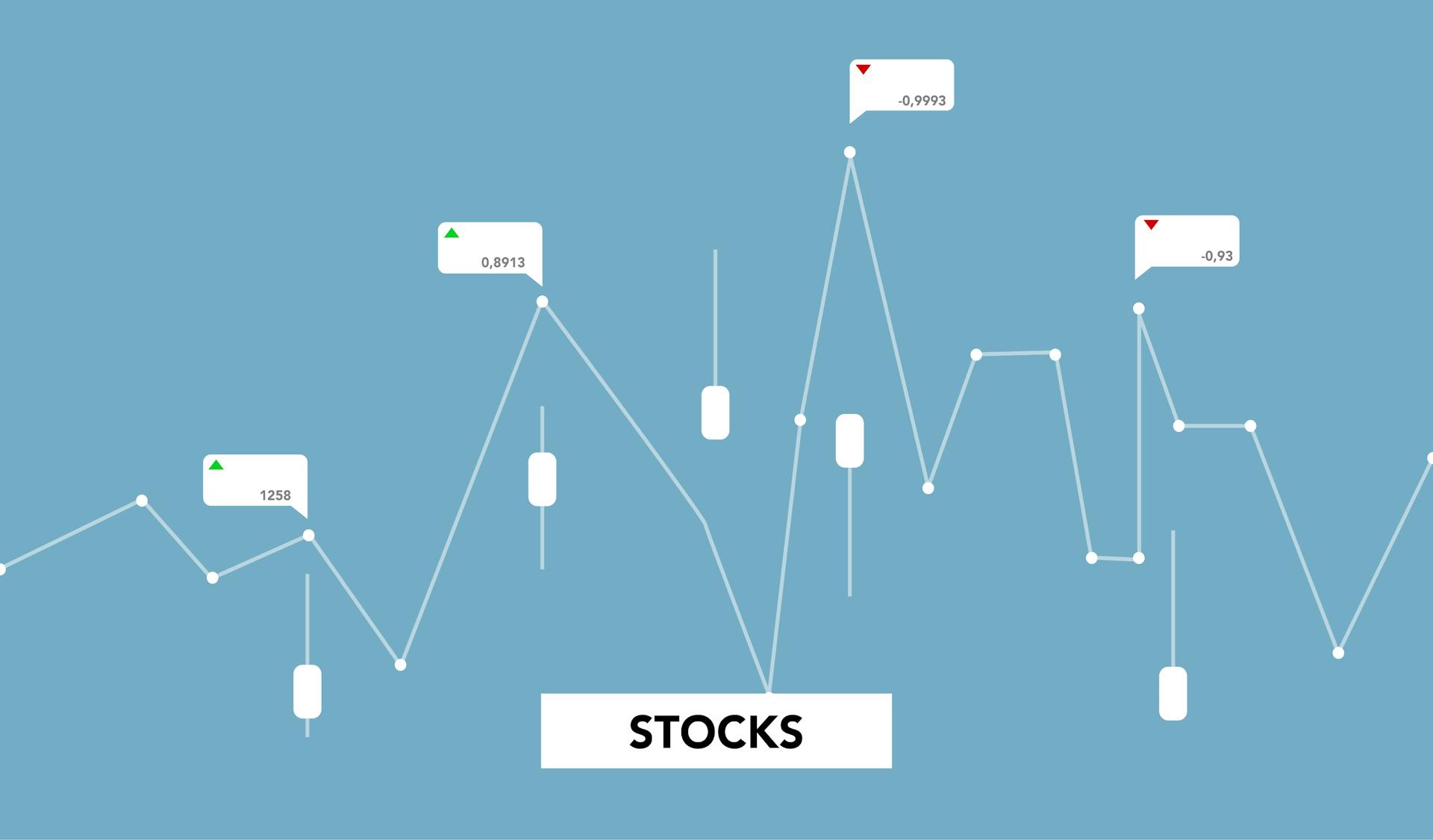
A Doji candlestick is a unique pattern that appears when the open and close prices are equal. This can happen when the market is indecisive and can't decide on a direction.
The Doji pattern is often considered a neutral signal, but it can also be a sign of a reversal. In an uptrend, a Doji can indicate a potential reversal to the downside, while in a downtrend, it can signal a reversal to the upside.
The presence of a Doji can be a sign that the market is taking a break from its current trend. This can be a good opportunity for traders to reassess their positions and make adjustments.
A Doji can also be a sign of a potential trend reversal, especially if it appears after a long period of trending.
For your interest: Doji Candlestick Patterns
What Is a Doji?
A Doji is a type of candlestick pattern that appears on a price chart.
It's formed when the open and close prices are equal, resulting in a single candlestick with a small or no body.
This pattern can occur at the end of a trend or during a consolidation phase.
Dojis are often seen as a sign of indecision in the market, where buyers and sellers can't agree on a price.
They can also indicate a potential reversal of the current trend.
In a Doji, the open and close prices are the same, but the high and low prices can vary greatly.
This variation in high and low prices can make the Doji appear in different forms, such as a long-legged Doji or a gravestone Doji.
Dojis can be a warning sign that the current trend is about to change direction.
They can also be a signal to take a closer look at the market and adjust your trading strategy accordingly.
In the context of trading, Dojis are often used as a technical analysis tool to make informed decisions.
By understanding the characteristics of a Doji, you can better navigate the markets and make more informed trading decisions.
Dojis can be a powerful tool in your trading arsenal, but it's essential to use them in conjunction with other technical and fundamental analysis.
Key Concepts
Doji is a neutral indicator that provides little information, making it unreliable for spotting price reversals. However, it can be a sign of indecision on the side of both buyers and sellers.
A doji is created when the open and close for a stock are virtually the same, resembling a candlestick on a chart. This is because the word doji comes from the Japanese phrase meaning "the same thing."
Doji formations come in three major types: gravestone, long-legged, and dragonfly. These types are determined by where the open/close line falls.
A doji represents a standoff between buyers and sellers, resulting in the price going nowhere. This can be a time of consolidation, where the price is stabilizing before potentially breaking out.
Here are the three main types of doji formations:
- Gravestone: a doji with a long lower shadow
- Long-legged: a doji with long upper and lower shadows
- Dragonfly: a doji with a long upper shadow
Market Sentiment
A doji formation is generally a sign of indecision, meaning neither bulls nor bears can successfully take over. This is because the open and close prices of a doji candlestick are roughly equal, indicating a lack of clear direction in the market.
To read doji candlestick patterns, you need to identify the type of doji, which can vary in shape depending on the context. The three main steps to reading doji candlestick patterns are identifying the doji pattern, analyzing the context, and confirming the analysis.
Doji patterns can be classified into different types, including the dragonfly doji, which is seen as a bullish reversal pattern, and the gravestone doji, which is read as a bearish reversal. The context in which a doji appears is also crucial, as doji that appear at the end of uptrends are considered bearish trend reversals, while those that appear at the end of downtrends are bullish trend reversals.
Here are the common types of doji candlestick patterns:
Ultimately, the market sentiment indicated by a doji depends on the overall context and the type of doji pattern. By analyzing the doji pattern and the context in which it appears, you can make more informed trading decisions.
Types of Doji
Doji patterns are neutral, indicating indecision in the market. They form when the opening and closing prices are virtually equal.
There are several types of doji patterns, including the Long-Legged Doji, which reflects a great amount of indecision about the future direction of the underlying asset. This type of doji is characterized by a long upper or lower shadow.
The Gravestone and Dragonfly Doji patterns are also types of doji patterns. The Gravestone Doji is formed when the opening and closing price of the underlying asset are equal and occur at the low of the day, while the Dragonfly Doji is formed when the opening and closing price of the underlying asset are equal and occur at the high of the day.
Gravestone
A Gravestone Doji is a type of Doji pattern that forms when the open, low, and close prices are close to each other, with a long upper shadow. This pattern is often seen as a bearish reversal signal, indicating that the present trend is reaching its limit and is likely to change direction.
The Gravestone Doji has a distinct shape, with a long upper shadow and a small or almost absent lower shadow. This is in contrast to other Doji patterns, such as the Dragonfly Doji, which has a long lower shadow.
A Gravestone Doji forms when the buyers initially drive prices higher, but then the sellers resurface and push prices back to the opening level and the session low. This pattern is commonly seen at the end of an uptrend and is a warning that the present trend is reaching its limit and is likely to change direction.
Here are some key characteristics of a Gravestone Doji:
- Long upper shadow
- Small or almost absent lower shadow
- Open, low, and close prices are close to each other
The Gravestone Doji is a strong signal in an uptrend, warning of bearish activity at the levels achieved. Traders should be prepared to exit deals, and further confirmation is required before taking action on a trade.
Types of Doji
A doji is a key trend reversal indicator, particularly true when there is a high trading volume following an extended move in either direction.
There are several types of doji, each with its own unique characteristics.
A neutral doji forms when the opening and closing prices are virtually equal, making it a neutral pattern on its own.
A long-legged doji reflects a great amount of indecision about the future direction of the underlying asset.
A gravestone doji is formed when the opening and closing price of the underlying asset are equal and occur at the low of the day, with a long upper shadow suggesting that the direction of the trend may be nearing a major turning point.
A dragonfly doji is formed when the opening and closing price of the underlying asset are equal and occur at the high of the day, with a long lower shadow suggesting that the direction of the trend may be nearing a major turning point.
Here are the main types of doji:
The long-legged doji is a type of candlestick pattern that signals to traders a point of indecision about the future direction of a security's price.
A long-legged doji has long upper and lower shadows and roughly the same opening and closing prices, signaling indecision and potentially a trend reversal.
4. Standard
A standard doji is a doji pattern that doesn't signify anything on its own. It's always interpreted depending on the patterns that come before and after it.
Standard dojis resemble a plus sign or a cross sign with upper and lower shadows of varying lengths. The length of the upper and lower shadows depends on the high and low price of the security for the day.
A standard doji can appear at the end of an uptrend or downtrend, and its significance is determined by the patterns that follow it. In the case of a downtrend, the standard doji can stand for a bearish trend reversal.
Traders look at the price activity leading up to the doji to determine what this candlestick represents. A standard doji within an uptrend can be part of the uptrend's continuation.
The doji candle pattern should only be used as a starting point for trades, and confirmation is necessary to determine the trend's direction. Waiting for the next candlestick to break above or below its high or low is the best course of action for trading the doji.
A fresh viewpoint: Price Action Candlestick Patterns
5. 4-Price
The 4-Price doji is a unique pattern that indicates indecision in the market. It's a horizontal line with the open, high, low, and close prices all equal.
A 4-Price doji is characterized by a single horizontal line with no vertical line as part of the pattern. This makes it easy to spot.
The 4-Price doji reflects a lull in the market when it's extremely quiet. It's a sign that the market is uncertain and waiting for a trend to confirm.
Investors and traders usually wait for the patterns that follow a 4-Price doji before deciding on a trading strategy.
6. Neutral
A neutral doji is a type of doji pattern where the opening and closing prices are the same, and there's a wide gap between the high and low prices. This is often a sign of indecision between buyers and sellers.
The upper and lower shadows of a neutral doji are equal in length, showing that the price moved to a high and then back down to a low at about the same length before closing at the same price as the opening price.
Neutral dojis can appear anywhere on a price chart, in an uptrend or a downtrend. They can also signal trend reversals, but this isn't always the case.
To analyze a neutral doji accurately, investors and traders study the context in which it appears. For example, if a neutral doji appears at the end of a bearish trend, it may indicate a reversal to a bullish trend.
Here are some key characteristics of neutral dojis:
- The opening and closing prices are the same.
- The upper and lower shadows are equal in length.
- The price moved to a high and then back down to a low at about the same length before closing.
Neutral dojis are often used as a pause in an active trend. If a neutral doji appears in this context, it may indicate that the trend will continue.
A Star
The doji star is a significant formation that occurs after a significant price decline, characterized by a small or nonexistent body and long upper and lower shadows.
It suggests a potential trend reversal or indecision in the market, making it a crucial pattern to recognize.
A doji star at support or resistance levels can carry more significance, indicating a potential turning point in the market.
Look for confirmation from the following candlestick to determine whether the reversal will occur, as a doji star is just a signal, not a guarantee.
It's essential to consider the context and follow up with further analysis to make an informed trading decision.
Explore further: Morning Star (candlestick Pattern)
Technical Analysis
Technical analysis is a crucial aspect of reading doji candlestick patterns. To accurately interpret a doji, you need to identify the type of doji pattern it is, which can be a gravestone, dragonfly, or 4-price doji.
A doji occurs when the open and close prices are nearly the same or equal, resulting in a small real body or no real body at all. It appears as a cross or a plus sign.
To confirm the analysis, you must analyze the patterns that follow the doji candlestick pattern. The context in which the doji appears is also crucial, as doji candlesticks that appear at the end of uptrends are considered to signal bearish trend reversals and those that appear at the end of downtrends are bullish trend reversals.
Here are some key questions to consider when analyzing a doji candlestick pattern:
- What is occurring on the candlestick chart before the Doji pattern forms?
- Is the price moving higher overall in an uptrend?
- Is the price moving lower within an overall uptrend (known as a pullback)?
- Is the price in a downtrend? Is the price in a pullback within an overall downtrend?
- Is the price moving sideways or in a triangle pattern?
- Is the Doji pattern near support or resistance?
Spinning Top Differences
Spinning tops show that buying and selling pressures are essentially equal. This is similar to dojis, but with a key difference.
A spinning top's body is larger than a doji's body, where the open and close are relatively close. This is a crucial distinction to make when analyzing charts.
To be classified as a doji, a candle's body generally must make up no less than 5% of the total candle's size range. This is a specific rule to follow when identifying dojis.
Spinning tops have bigger bodies than dojis, which means their bodies make up more than 5% of the total candle's size range. This is the main difference between the two.
Spinning tops signal weakness in the current trend but not necessarily a reversal. This is an important consideration when using spinning tops as a technical analysis tool.
A spinning top can be a sign of indecision in the market, but it's not always a clear indicator of a trend reversal. This is why it's essential to look at other indicators, such as Bollinger Bands, to determine the context.
For another approach, see: Candlestick Patterns Spinning Top
Technical Analysis Basics
A doji candlestick pattern occurs when the open and close prices are nearly the same or equal, resulting in a small real body or no real body at all.
To identify a doji pattern, look for a cross or plus sign shape in the price chart.
The context in which the doji appears is crucial in understanding its meaning. A doji at the end of an uptrend signals a bearish trend reversal, while a doji at the end of a downtrend signals a bullish trend reversal.
Doji patterns can be classified into different types, including the gravestone, dragonfly, and 4-price doji.
To confirm the analysis of a doji pattern, look for the patterns that follow it. If the next two patterns show an uptrend, the bullish reversal can be confirmed.
Doji patterns can be used in isolation, but they are more reliable when used along with other technical indicators.
The following table summarizes the different types of doji patterns and their meanings:
Doji patterns can be used to signal potential trading opportunities, but they should be used in conjunction with other technical analysis indicators.
A doji candlestick chart occurs when the opening and closing prices for a security are just about identical.
To use a doji candlestick in trading, look for it to appear near levels of support or resistance.
The Dragonfly Doji shows the rejection of lower prices and can be used as a potential bullish bias.
The Doji indicator is mostly used in patterns and is a neutral pattern itself, providing little information about price reversals when used alone.
A Double Doji strategy can be used to take advantage of the strong directional move that unfolds after the period of indecision.
Trading Strategies
To trade with doji candlestick patterns, you need to identify the doji pattern on the price chart, which is a candlestick in which the open and close prices either coincide or fall very close to one another.
The second step is to confirm the signals predicted by the doji patterns using other technical indicators, such as stochastic indicators, which study and compare the closing prices of a security over a time period to predict overbought and oversold levels.
A single doji is usually a good indication of indecision, but two or three dojis (one after the other) present an even greater indication that often results in a strong breakout.
The Double Doji strategy looks to take advantage of the strong directional move that unfolds after the period of indecision, and traders can wait until the market moves higher or lower, immediately after the Double/Triple Doji.
Here are some key considerations when trading with doji candlestick patterns:
- What is occurring on the candlestick chart before the Doji pattern forms?
- Is the price moving higher overall in an uptrend?
- Is the price moving lower within an overall uptrend (known as a pullback)?
- Is the price in a downtrend? Is the price in a pullback within an overall downtrend?
- Is the price moving sideways or in a triangle pattern?
- Is the Doji pattern near support or resistance?
By considering these factors and using technical indicators, you can increase your chances of success when trading with doji candlestick patterns.
Using Doji with Indicators
A Doji candle chart occurs when the opening and closing prices for a security are just about identical. This can signal investor indecision about a cryptocurrency asset.
The Doji star pattern can appear at the bottom of an existing downtrend, suggesting that neither buyers nor sellers are in control and that the trend could reverse.
Traders should look for supporting signals that the trend may reverse before executing a trade. The chart below makes use of the stochastic indicator, which shows that the market is currently in the overbought territory – adding to the bullish bias.
The Doji pattern can be used in conjunction with indicators to confirm potential reversals. This can be a powerful tool for traders looking to make informed decisions about their investments.
Here are some key points to keep in mind when using Doji with indicators:
- The Doji pattern can appear in various forms, including a "gravestone", "dragonfly", and "long-legged" doji.
- The stochastic indicator can be used to confirm the Doji pattern and provide additional insights into market sentiment.
- Traders should look for supporting signals before executing a trade, as the Doji pattern alone is not a guarantee of a reversal.
The Bottom Line
A Doji is a type of candlestick pattern that can indicate indecision in the market.
Dojis are formed when the opening and closing prices are equal, resulting in a small or zero body.
This pattern can be a sign of a trend reversal or continuation, depending on the context of the chart.
Dojis can be classified into three main types: Gravestone Doji, Dragonfly Doji, and Long-Legged Doji.
The Gravestone Doji is formed when the opening price is higher than the closing price, while the Dragonfly Doji is formed when the opening price is lower than the closing price.
The Long-Legged Doji is a variation of the traditional Doji, characterized by long wicks extending from the body.
Dojis are often considered a neutral pattern, but they can also indicate a potential breakout or continuation of the trend.
In a Doji, the body is usually small or zero, while the wicks can be long or short, depending on the type of Doji.
The presence of a Doji can be a sign of a market correction or a temporary pause in the trend.
Dojis can be used as a standalone trading signal or in combination with other technical indicators.
In conclusion, Dojis are a versatile and useful tool for traders and investors, providing valuable insights into market sentiment and potential price movements.
Featured Images: pexels.com