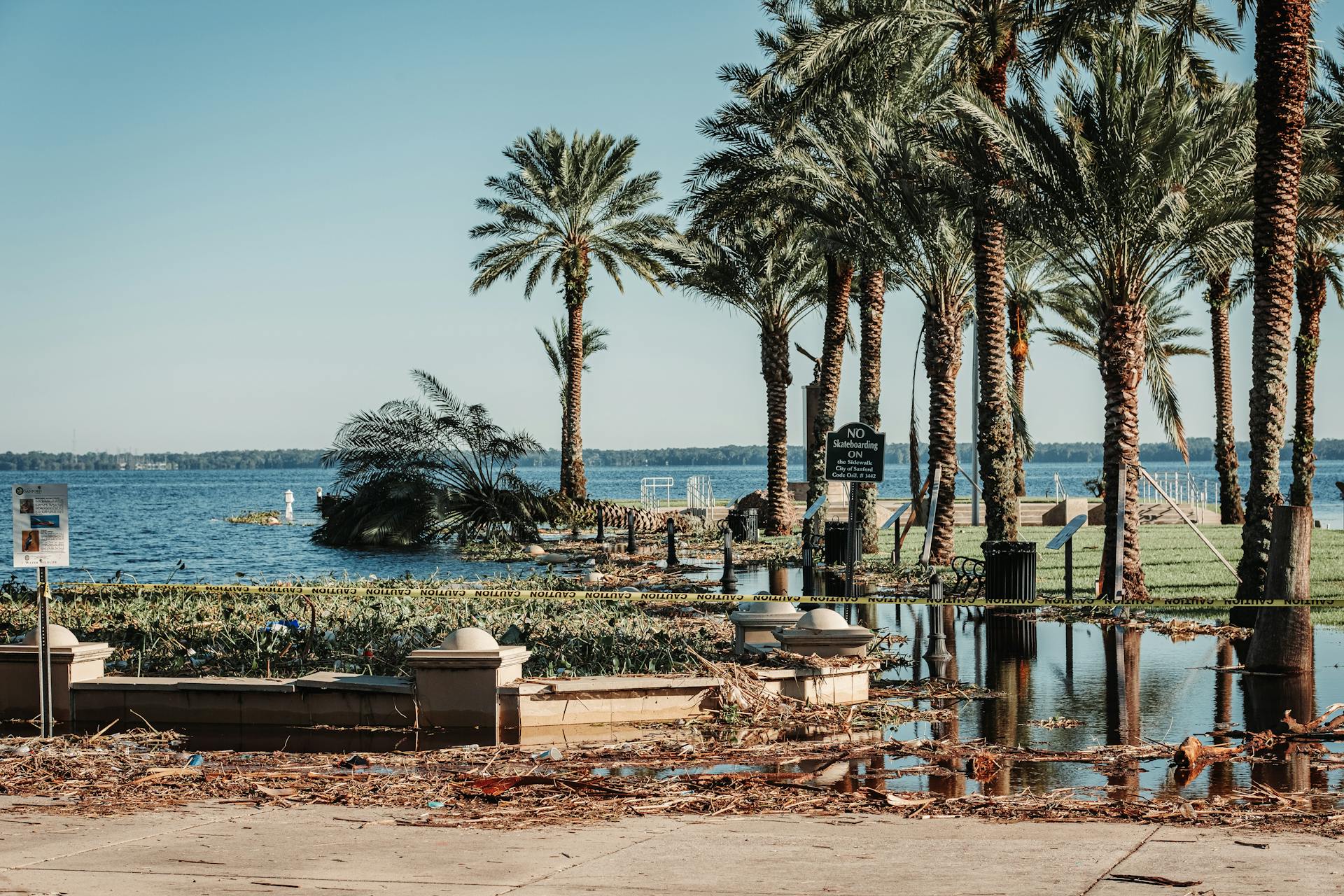
Hurricane damage is a serious concern for homeowners in hurricane-prone areas, and it's essential to understand what your home insurance covers. Typically, standard homeowners policies cover damage caused by windstorms, including hurricanes.
The National Flood Insurance Program (NFIP) is a government-backed program that provides flood insurance, which is usually not included in standard home insurance policies. This means that if your home is flooded during a hurricane, you may need to purchase a separate flood insurance policy.
Most home insurance policies have a deductible, which is the amount you must pay out-of-pocket before your insurance coverage kicks in. For hurricane damage, the deductible is usually higher than the standard deductible, often ranging from 5% to 10% of the policy's total coverage.
Hurricane damage can be extensive, and it's crucial to know what's covered and what's not.
Readers also liked: Garage Keepers Liability Coverage
How Home Insurance Works
Home insurance can be a lifesaver in the face of hurricane damage. Your policy can protect against damage to your home's structure.
If a hurricane causes damage to your home's structure, dwelling coverage may pay for repairs up to your policy's limits. This means that if a strong wind blows off your roof, your insurance can help cover the cost of replacing it.
Your personal belongings are also protected in the event of a hurricane. Personal property coverage may pay to repair or replace damaged items, up to the limits of your policy. This could include furniture, electronics, and other valuables.
If you're unable to live in your home due to damage from a hurricane, your policy's loss of use coverage may pay for a hotel, meals, and living expenses above what you'd normally spend. This can help you get back on your feet while your home is being repaired.
Here's a breakdown of how your policy may cover hurricane damage:
- Dwelling coverage: pays for repairs to your home's structure up to policy limits
- Personal property coverage: pays to repair or replace damaged personal belongings up to policy limits
- Loss of use coverage: pays for temporary living expenses if you're unable to live in your home
Hurricane Damage Coverage
Home insurance can protect against hurricane damage in various ways, including covering repairs to your home's structure, personal belongings, and temporary living expenses if your home becomes uninhabitable.
Standard homeowners insurance policies typically cover wind damage caused by hurricanes, but not flood damage. Flood damage requires separate flood insurance, which can be purchased through the National Flood Insurance Program (NFIP) or private insurers.
The NFIP offers coverage limits of $250,000 for the structure of your home and $100,000 for personal belongings, but higher limits may be available through private flood insurance.
Windstorm insurance is often necessary in high-risk coastal areas, where standard policies may exclude wind damage from hurricanes. This type of insurance can be purchased from private insurers or state-run programs.
It's essential to review your policy specifics to understand what's covered and what's not, as some policies may have separate windstorm or hurricane deductibles.
Here's a breakdown of what's typically covered under a standard homeowners insurance policy:
- Wind damage to your home's structure and personal belongings
- Temporary living expenses if your home becomes uninhabitable (loss of use coverage)
- Not covered:
+ Flood damage
+ Storm surge damage
Filing a Claim
Filing a claim is the next step after a hurricane hits. Contact your insurer through their emergency hotline, website, or mobile app as soon as possible.
Report your claim with your policy number ready, and write down the claim number and representative's name for reference. This will help you keep track of the process.
Both the Louisiana Department of Insurance (LDI) and the Texas Department of Insurance (TDI) offer guidelines to follow, so be sure to check with them for specific advice.
Steps to Take
Filing a claim after a hurricane can be overwhelming, but taking the right steps can make a big difference.
Contact your insurer as soon as possible.
Report your claim through their emergency hotline, website, or mobile app.
Have your policy number ready to make the process smoother.
Write down the claim number and representative's name for reference, as advised by the Louisiana Department of Insurance (LDI).
Debris Removal
Debris removal can be a costly aspect of recovering from a hurricane. Hurricanes can leave a significant amount of debris, which can be expensive to remove.
Standard policies may offer some debris removal coverage, but it might not be enough. Some homeowners insurance policies include debris removal as part of their standard coverage, but limits are often low.
Intriguing read: When Is Liability Coverage Included in a Homeowners Policy

You can purchase an additional endorsement to increase debris removal limits. Coverage limits can range from a low $500 to as high as $10,000 or more.
After Hurricane Michael, homeowners in Florida faced massive cleanup costs. Those with additional debris removal endorsements were able to claim higher amounts, easing their financial burden during the recovery process.
A large amount of debris can be expensive to remove, but that cost usually isn’t covered under your basic policy. Make sure you ask your insurance agent about possible endorsements to add or increase debris removal coverage.
Additional reading: What Are the Three Main Types of Property Insurance Coverage
Policy Exclusions and Limitations
Standard homeowners insurance policies typically cover wind damage caused by hurricanes, but flood damage is not covered and requires separate flood insurance. This can be purchased through the National Flood Insurance Program (NFIP) or private insurers.
Some insurers in hurricane-prone areas have separate windstorm or hurricane deductibles, which can range from 1% to 5% of your home's value. This can be a significant out-of-pocket cost, so it's essential to understand these details.
Flood damage, mold remediation (unless directly caused by a covered peril), sewer backup, and damage to detached structures or outdoor items not documented are all commonly excluded from hurricane coverage. Make sure to review your policy and ask your insurance agent to walk you through the exclusions before the next storm hits.
Here are some key exclusions to be aware of:
- Flood damage (without a flood policy)
- Mold remediation, unless directly caused by a covered peril
- Sewer backup
- Detached structures or outdoor items not documented
- Living expenses during repairs if not specifically included in your policy
Limits
Standard homeowners insurance covers a lot, but not everything. Make sure to review your policy and consider additional coverage options if you live in a hurricane-prone area.
In high-risk areas, windstorm insurance may come with a separate deductible that's a percentage of your dwelling coverage, ranging from 1% to 5% or even higher.
Your policy may include a "named storm" deductible, commonly referred to as a "hurricane deductible", which will apply once a storm has reached a certain strength.
A hurricane deductible is the out-of-pocket expense you're responsible for when your home is damaged by wind from a hurricane. This is separate from your standard, or all other perils, deductible.
For another approach, see: Does House Insurance Cover Storm Damage
Hurricane deductibles can be a flat amount, but sometimes they're tied to the value of the insured property, making the cost to you much higher than a standard home insurance deductible.
If your hurricane deductible is 2% of your dwelling coverage, you'll pay a specified percentage instead of a flat amount, depending on your policy.
Here's a breakdown of the conditions that may trigger a hurricane deductible:
- A storm is officially designated a hurricane by the National Hurricane Center of the National Weather Service.
- There are hurricane warnings, actual hurricane conditions, and the storm has to make landfall as a hurricane.
- Other triggering events occur, which may vary depending on your state and policy language.
In most cases, standard homeowners insurance policies cover some hurricane damage, but there are important exceptions.
What's Excluded from a Policy?
When buying a homeowners insurance policy, it's essential to know what's excluded from coverage. Flood damage, for example, is not covered under standard policies, unless you have a separate flood policy.
Flood damage is not the only thing excluded from coverage. Other exclusions include mold remediation, unless directly caused by a covered peril, and sewer backup. These types of damage can be costly and time-consuming to repair.
Detached structures or outdoor items not documented are also not covered. This means if you have a shed or a fence that's not listed on your policy, you may not be able to claim damages if it's destroyed.
Living expenses during repairs are not always covered either. You'll need to check your policy specifically to see if this is included.
Here's a summary of common exclusions:
- Flood damage (without a flood policy)
- Mold remediation, unless directly caused by a covered peril
- Sewer backup
- Detached structures or outdoor items not documented
- Living expenses during repairs if not specifically included in your policy
Prevent Before It Happens
Preparing for hurricane season is key to minimizing damage to your home.
Trim or remove damaged trees to prevent branches from breaking and causing further damage. This is especially important if you live in an area with a history of hurricane-related tree damage.
Secure and reinforce windows, exterior doors, and garage doors to prevent them from shattering or blowing open. Make sure they're sturdy enough to withstand strong winds.
Clear and secure rain gutters to ensure water can flow freely and doesn't accumulate, causing damage to your home's foundation.
Purchasing a portable generator is a good idea, but make sure to store it away from moisture and at least 20 feet away from your house. Never run a portable generator inside, as it can be hazardous.
On a similar theme: Does Homeowners Insurance Cover Accidents Away from Home
Understanding Your Policy
Most homeowners insurance policies cover wind-related damage to your home's exterior, such as shingles blown off your roof.
If wind-driven rain enters your home through broken windows or doors, the resulting interior damage is typically covered.
Your policy usually provides for temporary living expenses if your home becomes uninhabitable.
Flood damage is not covered by standard homeowners insurance, so you'll need separate flood insurance.
Here are the key things to know about what your policy covers:
Special deductibles, such as hurricane deductibles, may apply in hurricane-prone areas. These deductibles are usually a percentage (2% to 5%) of your home's insured value, not a flat dollar amount.
How Are Deductibles Calculated
Hurricane deductibles are calculated based on a percentage of the coverage on the main structure. This percentage can vary, but common rates are 2%, 5%, or 10%.
For example, if your home's replacement value is $400,000, a 2% deductible would be $8,000, a 5% deductible would be $20,000, and a 10% deductible would be $40,000.
Why Understanding Protection Matters
Understanding your homeowners insurance is crucial to being prepared for hurricane damage. Knowing what's covered and what's not can save you from financial headaches.
Most homeowners insurance policies cover wind-related damage to your home's exterior, such as shingles blown off your roof. Wind-driven rain entering your home through broken windows or doors is also typically covered.
If your home becomes uninhabitable due to hurricane damage, your policy usually provides for temporary living expenses. This can include costs like renting a new place to live while your home is being repaired.
However, standard homeowners insurance policies do not cover flood damage. You'll need separate flood insurance to protect against this type of damage.
In hurricane-prone areas, policies often include a hurricane deductible, which is a percentage of your home's insured value. This means you'll need to pay a larger deductible when filing a claim for hurricane damage.
Here's a quick rundown of what's covered and what's not:
Understanding your policy and what's covered can help you avoid financial surprises when hurricane damage strikes. It's worth taking the time to review your policy and ask questions if you're unsure about what's covered.
FAQs
Hurricane damage can be a huge financial burden, but does home insurance cover it? Let's break down the basics.
Home insurance typically covers damage from wind-borne debris, but not flooding. This is a crucial distinction, as hurricanes often cause both types of damage.
You'll need to check your policy to see if it includes wind damage coverage. Some policies may have a separate deductible for wind damage, which can be higher than the standard deductible.
Most home insurance policies don't cover damage from storm surges or tsunamis, but some may offer optional coverage for these events.
If you live in a high-risk flood area, you may need to purchase a separate flood insurance policy to cover damage from hurricanes.
Hurricane damage can be unpredictable, but with the right insurance coverage, you can be better prepared for the unexpected.
Consider reading: Will Homeowners Insurance Cover Wind Damage to Roof
Featured Images: pexels.com