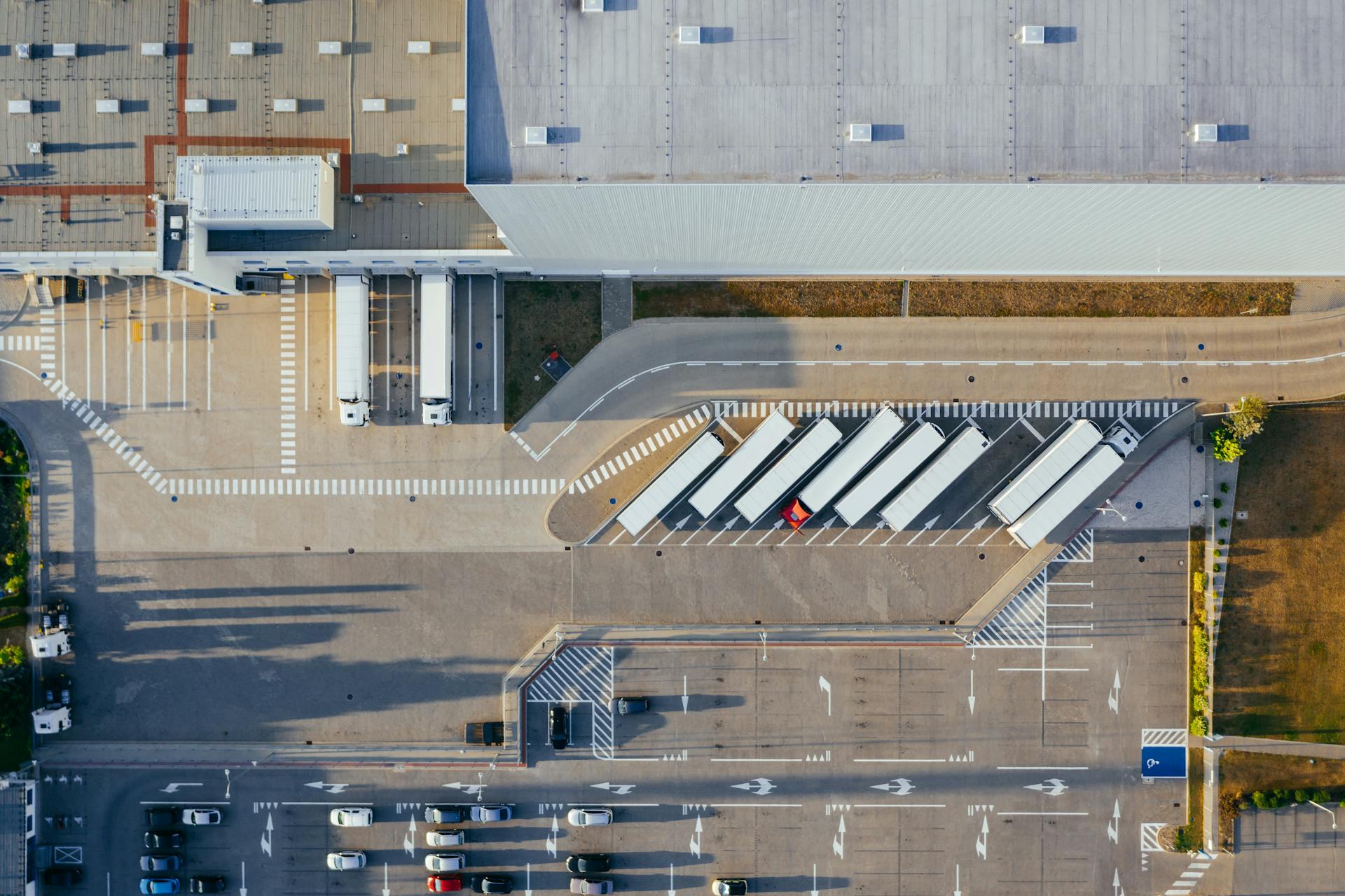
A distribution center is a critical component of any supply chain, serving as the hub where products are stored, processed, and shipped to customers. It's essentially a warehouse on steroids, designed to efficiently manage the flow of goods.
Distribution centers can be located near major transportation hubs, such as ports or airports, to streamline the shipping process. This strategic placement can reduce transportation costs and lead times.
In a typical distribution center, products are received, inventoried, and then shipped to customers through various channels, including online retailers, brick-and-mortar stores, or directly to consumers.
What Is a Distribution Center?
A distribution center is a type of warehouse that receives, stores, and distributes products to customers.
It's typically located near major transportation hubs, such as ports, airports, and railway stations, and major highways to facilitate the movement of goods.
Distribution centers handle the movement of large volumes of goods on a daily basis, which is different from storage warehouses that hold long-term goods for longer periods of time.
Benefits and Advantages
Using a distribution center can be a game-changer for businesses, offering numerous benefits and advantages. One of the primary benefits is cost savings, which can be achieved through reduced shipping costs and bulk discounts.
By consolidating shipments from multiple suppliers, distribution centers can significantly lower transportation costs. This is due to the massive scale of the distribution center, which enables them to take advantage of economies of scale.
Distribution centers also provide better customer service by ensuring timely delivery of goods. Trained personnel manage the flow of goods, reducing the risk of stockouts and ensuring that businesses always have enough inventory on hand to meet customer demand.
With a distribution center, businesses can split inventory across multiple locations, reducing shipping costs and speeding up transit times. This is especially beneficial for ecommerce stores with a growing distribution network.
Distribution centers vary in their strengths, but almost all offer benefits in key areas such as cost savings and customer service. By leveraging these benefits, businesses can improve their overall operations and stay competitive in the market.
Related reading: SITE Centers
Organization and Planning
A distribution center's organization is crucial to its efficiency. The three main areas are the receiving dock, the storage area, and the shipping dock. In small organizations, these areas can be combined, but in large centers, separating them simplifies the process.
Dedicated dock doors for each store in the shipping area are common in many distribution centers. The receiving area can also be specialized based on the handling characteristics of freight being received or the type of vehicle delivering the product.
A simple distribution center serving many clients of a specific theme or type of service may include various roles and departments. These can be more complicated in centers that service both large and small clients.
To maximize efficiency, a distribution center's planning is crucial. Consideration must be given to the weight-bearing capacity of the ceiling joists if a conveyor system is suspended from the ceiling. The placement of columns is also important, especially as it relates to the flue space between pallet rack frames.
Broaden your view: Does Insurance Cover Birthing Centers
Other planning considerations include attention to slotting, product replenishment, storage media, and power requirements. This helps ensure that the distribution center operates smoothly and efficiently.
Here is a breakdown of the main areas in a distribution center:
- Goods in (or goods inward): Contains specialized container unloading equipment and workers
- Bulk: Controls and ships larger orders or orders that contain only full cartons/boxes
- Break-bulk: A lower-capacity version of the bulk department, used for smaller orders
- Export: Controls orders leaving the country of the distribution center
- Quality assurance: Performs periodic checks of random samples of stock to check quality
- Administration
- Packing and production: Used to pack items in specific unit quantities and packaging styles
- Transportation: Arranges and coordinates shipments in and out of the distribution center
- Dedicated product departments: Divisions based on handling characteristics or storage characteristics
Storage and Inventory Management
Storage and inventory management are crucial components of a distribution center's operation. A well-established warehouse receiving process can make the inventory management and fulfillment cycle easier, more cost-effective, and more efficient.
Distribution centers use various storage systems, including pallet racks, shelving, and automated storage and retrieval systems, to optimize their storage space. Pallet racking is a system of storage racks that use pallets to store products vertically, making it ideal for facilities with high ceilings.
There are several types of storage used in distribution centers, each with its own advantages and disadvantages. Here are some of the most common types of storage:
Distribution centers operated by 3PLs help you avoid understocking (and overstocking) using inventory management software and other inventory automation tools.
Storage Locations & Containers
Intermodal containers, also known as shipping containers, are used for efficient transportation of goods, with standards specifying their volume and dimensions for easy handling.
Pallets are one of the most commonly used means to store and move product in a distribution center. They can be stored on the floor, stacked, or stored in pallet racking.
Bulk Box are large single boxes usually connected or attached to a pallet, making them ideal for storing bulky items.
Cases and Cartons are boxes usually containing many items, with a distinction made between the terms "carton" and "case" in distribution centers. Goods are received and stored in cartons, while goods are shipped in cases.
Totes are reusable containers used to hold and transport goods, making them an eco-friendly option for businesses.
Here are some common types of storage containers used in distribution centers:
- Intermodal containers (shipping containers)
- Pallets
- Bulk Box
- Cases and Cartons
- Totes
Distribution centers use a variety of storage containers to optimize their storage space and efficiency. By choosing the right container for the job, businesses can reduce storage costs and improve their overall supply chain.
Returns Management
Returns management can significantly improve your bottom line by increasing customer satisfaction by 12% and decreasing logistics costs by 4%.
Having a great returns management process in place is essential, especially if you're using a warehouse to store your products. You'll need to implement your own system to process returns and have your staff put items back on shelves quickly.
Using a distribution center can be a game-changer for returns management, as it gives you the option to lean on a distribution partner or 3PL partner to handle returns for you.
ShipBob, for example, simplifies returns management with direct integrations to leading returns platforms, making it easier to manage returns and get items back on shelves quickly.
You might like: Investment Returns
Shipping and Logistics
Shipping and logistics are crucial components of a distribution center's operations. A distribution center typically partners with major shipping carriers that pick up orders daily, enabling orders to be shipped as soon as possible.
Distribution centers use transportation management software to coordinate the shipment of goods to customers, selecting the most efficient mode of transportation and arranging for the goods to be picked up and delivered to their destination. They work closely with carriers, such as trucking companies and freight forwarders, to ensure timely and safe delivery.
By strategically locating distribution centers near major transportation hubs, businesses can reduce transit times between manufacturers or suppliers and end customers. This leads to increased customer satisfaction and loyalty.
Here are some key differences between warehouses and distribution centers:
- Warehouses are mainly used for storing products until they are needed, whereas distribution centers store products and perform product mixing, cross-docking, order fulfillment, and packaging.
- Warehouses store products for longer periods of time, whereas distribution centers have a faster flow rate through storage to the store or customer.
- Distribution centers are considered the bridge between suppliers and consumers, whereas warehouses are more focused on storing items.
- Orders for retail and warehouses often pass through a distribution center, not a warehouse.
- Operations at warehouses are less intricate than at a distribution center, with fewer functions handled.
Shipping Management
Shipping Management is a crucial part of the logistics process, and it's essential to understand how it works.
Distribution centers partner with major shipping carriers to pick up orders daily, enabling fast shipping times. They use transportation management software to coordinate the shipment of goods to customers.
A tech-enabled 3PL streamlines the shipping process to reduce shipping costs and speed up last-mile delivery. They offer direct integrations with ecommerce platforms to send orders automatically to the nearest distribution center.
Distribution centers are strategically located near major transportation hubs, which allows for faster delivery times. By using a distribution center, businesses can reduce the transit time between the manufacturer or supplier and the end customer.
A tech-enabled distribution center managed by a 3PL optimizes the warehouse picking process by automatically assigning similar orders with inventory in the same area of the warehouse. This process creates a more efficient workflow by improving speed and order accuracy.
Once shipped, order tracking info is pushed back to the ecommerce store and shared with the customer. This ensures that customers are informed about the status of their orders.
Distribution centers work closely with carriers, such as trucking companies and freight forwarders, to ensure that goods are delivered on time and in good condition. This involves selecting the most efficient mode of transportation and arranging for the goods to be picked up and delivered to their destination.
Faster delivery times can lead to increased customer satisfaction and loyalty. By using a distribution center, businesses can reduce the transit time between the manufacturer or supplier and the end customer.
A fulfillment center, a type of distribution center, specializes in order fulfillment for ecommerce companies. They receive orders, pick goods from storage, and package them for shipment.
Check this out: Dhl Ecommerce Distribution Center
Order Fulfillment
Order fulfillment is a crucial step in the shipping and logistics process. A tech-enabled 3PL can optimize the warehouse picking process, improving speed and order accuracy.
A well-established warehouse receiving process can make the inventory management and fulfillment cycle easier, more cost-effective, and more efficient. This involves several important steps, including having proper documentation.
Orders for retail and warehouses often pass through a distribution center, not a warehouse. This is because warehouses do not typically serve customers in the way a distribution center does.
A fulfillment center, specifically designed for order fulfillment, differs from standard distribution centers in several ways. They use detailed packaging processes to ensure goods are properly protected during transit and labeled with the correct shipping information.
Distribution centers use various storage systems, including pallet racks, shelving, and automated storage and retrieval systems, to optimize their storage space.
Here are some key differences between a warehouse and a distribution center:
- Warehouses are mainly used for storing products until they are needed.
- Distribution centers store products as well as perform product mixing, cross-docking, order fulfillment, and packaging.
- Warehouses store products for longer periods of time.
- Distribution centers have a faster flow rate through storage to the store or customer.
- Warehouses have fewer functions compared to distribution centers.
Challenges and Solutions
Distribution centers face several challenges in the modern business environment. Labor shortages and high turnover rates are just a couple of the issues they're up against.
To address labor shortages, many distribution centers are investing in advanced technology solutions, such as automated sorting systems and robotics. These technologies can help to streamline processes and improve accuracy.
Another challenge distribution centers face is the increasing demand for speed and accuracy. Customers expect faster delivery times and greater order accuracy, putting pressure on distribution centers to optimize their processes and reduce the risk of errors.
To meet this demand, many distribution centers are adopting new technology and automation. Investing in warehouse management systems (WMS) and transportation management systems (TMS) can help improve visibility and control over inventory, shipments, and delivery times, while also reducing costs and improving efficiency.
Suggestion: Owns Recovery Centers
Labor Shortages and High Turnover
Labor shortages and high turnover rates are a major challenge for distribution centers. One of the primary reasons for this is the rapid growth of e-commerce, which has led to an increase in demand for labor in the distribution industry.
Many companies are struggling to find qualified workers to fill these positions. Turnover rates in the industry are often high, leading to disruptions in operations and reduced efficiency.
Investing in employee training and development programs can help improve retention rates and attract new talent. This can be a game-changer for distribution centers looking to reduce turnover and improve productivity.
From our experience, good employees make or break a warehousing operation. We recommend visiting potential distribution centers and asking about their employee programs and average tenure to get a sense of their commitment to staff development.
Additional reading: Private Wealth Management Programs
Adoption of New Technology and Automation
The adoption of new technology and automation is a challenge that many distribution centers face. This is because technology is constantly advancing, and companies must stay up to date to remain competitive.
As customers' demands for speed and accuracy increase, distribution centers must find ways to meet these expectations. This can be achieved through the use of advanced technology solutions.
Automated sorting systems and robotics can help streamline processes and improve accuracy. They can also reduce the risk of human error.
Investing in warehouse management systems (WMS) and transportation management systems (TMS) can help improve visibility and control over inventory, shipments, and delivery times. These systems can also reduce costs and improve efficiency.
Many distribution centers are investing in these advanced technology solutions to stay ahead of the competition. By doing so, they can meet the demands of their customers and stay profitable.
Types and Specializations
Distribution centers come in all shapes and sizes, each with its own unique characteristics and specializations. A specialized distribution center is designed to handle specific types of products or serve a particular market niche.
Some distribution centers are tailored to meet the unique needs of their customers, requiring specialized equipment and facilities. For example, a pharmaceutical company may need a distribution center with special regulations and processes in place.
There are several types of storage used in distribution centers, including pallet racking, shelving, mezzanine storage, bin storage, and automated storage and retrieval systems (AS/RS). Each type of storage has its own advantages and disadvantages.
Here are some common types of storage containers used in distribution centers:
- Intermodal containers (shipping containers) are used for efficient transportation of goods.
- Pallets are one of the most commonly used means to store and move product in a distribution center.
- Bulk Box are large single boxes usually connected or attached to a pallet.
- Cases and Cartons are boxes usually containing many items.
- Totes are reusable containers used to hold and transport goods.
What Differentiates It From A Warehouse
A distribution center is not just a fancy name for a warehouse. In fact, there are key differences between the two. Let's dive into what differentiates a distribution center from a warehouse.
A distribution center is designed to store products for a short period of time, whereas a warehouse stores products on a long-term basis. This means that products sit in a distribution center for less time than in a warehouse.
Distribution centers are the bridge between suppliers and consumers, where products are packaged and sent out. In contrast, warehouses are more focused on storing items, with fewer functions compared to a distribution center.
Here are some key differences between the two:
- Warehouses store products for longer periods of time, while distribution centers have a faster flow rate through storage to the store or customer.
- Distribution centers handle order processing, transportation management, inventory and warehouse management, and more, whereas warehouses have fewer functions.
- Orders for retail and warehouses often pass through a distribution center, not a warehouse.
Overall, while both warehouses and distribution centers play a crucial role in the supply chain, they serve different purposes and have distinct characteristics.
Different Types of Distribution Centers
There are different types of distribution centers that cater to various business models.
A specialized distribution center is designed to handle specific types of products or serve a particular market niche. These centers are tailored to meet the unique needs of their customers. They often require specialized equipment and facilities.
Some examples of specialized distribution centers include pharmaceutical companies that need to adhere to special regulations and processes, and food distributors that require cold storage and other specialized processes.
Distribution centers can vary significantly in form and function, making it essential to choose the right one for your business.
Specialized Distribution Centers
Specialized Distribution Centers are designed to handle specific types of products or serve a particular market niche. They are tailored to meet the unique needs of their customers, and often require specialized equipment and facilities.
For example, a pharmaceutical company requires special regulations and processes, which can be met by a specialized distribution center. Similarly, a food distributor needs cold storage and other specialized processes to maintain product quality.
A specialized distribution center can be beneficial for businesses with specific product requirements, such as temperature-controlled products or hazardous materials. This type of center can provide the necessary infrastructure and expertise to handle these products safely and efficiently.
Here are some examples of specialized distribution centers:
- Pharmaceutical distribution centers
- Food distribution centers
- Temperature-controlled distribution centers
- Hazardous materials distribution centers
These centers can help businesses reduce costs and improve efficiency by streamlining their logistics and supply chain operations. By partnering with a specialized distribution center, businesses can focus on their core activities while leaving the logistics and distribution to experts.
Here's an interesting read: Amazon Logistics Center
Types of Storage Systems
Types of Storage Systems are crucial for efficient inventory management in distribution centers. There are several types of storage systems used in distribution centers.
Pallet racking is one of the most common types of storage, allowing for efficient use of vertical space. It's ideal for facilities with high ceilings and can be configured in many different ways to accommodate various pallet sizes and product types.
Shelving is a type of storage that uses shelves to store products horizontally. It's typically used for smaller items, such as boxes, tools, or parts, and can be adjusted to accommodate different sizes of products.
Mezzanine storage is a type of storage that utilizes an elevated platform to provide additional storage space above the ground level. It's often used in facilities with limited floor space and can be configured in many different ways, such as shelving, pallet racking, or bin storage.
Bin storage uses bins or containers to store products and is typically used for smaller items, such as parts or components. It allows for easy organization and retrieval of products and can be configured in many different ways, such as using mobile carts, static racks, or gravity flow systems.
Automated Storage and Retrieval Systems (AS/RS) use automated equipment such as cranes, conveyors, and robots to retrieve and store products. This type of storage system is often used in high-density facilities where space is at a premium and speed and accuracy are critical.
Shipping containers are another type of storage that can be used in distribution centers, especially for temporary or mobile storage needs. They're typically made of steel and are designed to be stacked and transported by ship, truck, or train.
Here are some common types of storage containers used in distribution centers:
Location Significance
The location of a distribution center can make all the difference in the success of its operations. A well-situated distribution center can optimize its supply chain operations and even grow a wider customer base.
Proximity to suppliers and customers is crucial, as it can reduce transportation costs and improve customer satisfaction. For example, a distribution center located in central Texas, like the one mentioned in Example 2, can take advantage of its proximity to suppliers and customers, making it a strong positive indicator in its service level.
Transportation infrastructure, such as highways, railways, ports, and airports, can also speed up the movement of goods. Many eCommerce brands utilize multiple distribution centers for their strategy, taking advantage of this infrastructure to get their products to customers quickly.
A distribution center's location should consider several factors, including availability of labor and local regulations and taxes. These factors can impact the cost and complexity of operating the facility.
Here are some key factors to consider when evaluating a distribution center's location:
- Proximity to suppliers and customers
- Transportation infrastructure (highways, railways, ports, and airports)
- Availability of labor
- Local regulations and taxes
By considering these factors, a distribution center can optimize its supply chain operations and stay competitive in the market.
Tools and Resources
If you're looking to optimize your distribution center, having the right tools and resources can make all the difference. A Warehouse Management System (WMS) can provide flexibility in managing your warehouse operations.
Investing in a WMS can be justified if you're facing the threat of tariffs, which can significantly impact your business.
To avoid common problems with WMS implementation, it's essential to be aware of the top 5 issues and how to overcome them.
Here are some key resources to consider:
- Warehouse Management Implementation with Flexibility
- How the Threat of Tariffs Can Justify Investing in a WMS
- Top 5 Problems of a WMS Implementation – And How to Avoid Them
Frequently Asked Questions
Is a distribution centre the same as a warehouse?
No, a distribution centre is not the same as a warehouse. While both store and manage goods, a distribution centre's primary function is order processing and fulfilment, making it a key hub for getting products to customers.
Featured Images: pexels.com