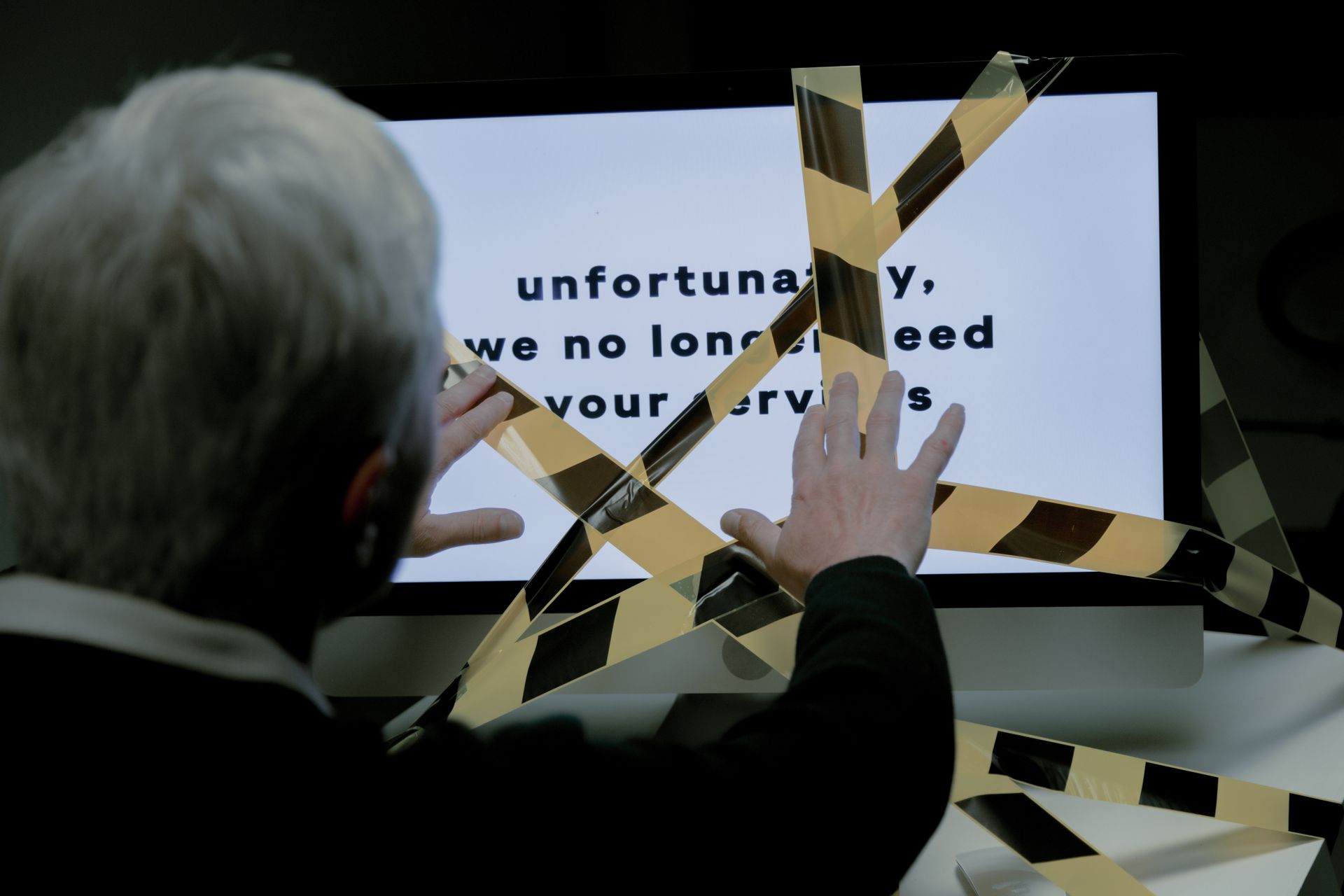
Dismissal in France can be a complex and sensitive topic. In France, the law protects employees from unfair dismissal, and employers must follow a specific procedure to terminate a contract.
Employers must have a valid reason for dismissal, such as redundancy, misconduct, or poor performance. The employer must also demonstrate that the reason for dismissal is not discriminatory.
French law requires employers to provide a minimum notice period, which can range from 2 weeks to 3 months, depending on the length of service. This allows employees to prepare for their departure and find new employment.
Employers must also pay a severance package, known as "indemnité de licenciement", which can be up to 20 weeks' salary in some cases.
Related reading: Weeks Notice
Types of Dismissal
In France, dismissal is a serious matter that requires a valid reason. A company can terminate an employee due to disciplinary reasons, such as misconduct, or non-disciplinary reasons, such as insufficient results.
A disciplinary reason can be broken down into various categories based on the gravity of the misconduct. This can impact the severance pay and notice period.
There are two main types of dismissal in France: dismissal for economic reasons and dismissal linked to the employee.
Here are the main reasons for dismissal for economic reasons:
- Serious economic difficulty
- Technological change
- Organisational change
- Liquidation of the company
These reasons can lead to redundancy, where the dismissed person may not be replaced.
Dismissal linked to the employee covers cases where the employee is unable to do their job properly, or there are serious differences with the employer or colleagues, or misconduct.
In cases where an employee is dismissed due to misconduct, the employer must carefully document the evidence-based reasons for the termination.
On a similar theme: How Do I Report Household Employee Wages to the Irs
Dismissal Process
The dismissal process in France can be complex, but it's essential to follow the correct procedures to avoid any issues. You'll need to send a formal letter to the employee, inviting them to a preliminary meeting via registered mail, so they acknowledge receipt.
The letter must inform the employee of their right to a third-party representative to assist them during the meeting. This is a crucial step in the process.
After the meeting, the employer may decide to proceed with the dismissal or stop the process. If they choose to proceed, they must send a registered letter to the employee outlining the reasons for the termination. The notice period begins the day the employee receives the letter.
The amount of notice required depends on the length of service with the company. Here's a summary of the notice periods:
A company can only use three reasons to lay off an employee: economic reasons, voluntary personal grounds, or involuntary personal grounds.
Dismissal Process
The dismissal process can be a complex and sensitive issue, but understanding the procedures can help you navigate it with confidence. In some cases, a preliminary meeting is required before termination can proceed.
This meeting must occur at least five calendar days after the employee receives the dismissal letter. The employer will explain their reasons for pursuing termination, and the employee can advocate on their behalf.
Expand your knowledge: Termination of Employment
In France, employers must follow specific dismissal procedures, which can only occur if no other solution can be reached. The first step is to send a formal letter to the employee inviting them to attend a preliminary meeting.
The letter must be sent via registered mail, so the employee is required to sign for it, acknowledging they received the letter. The letter must also inform the employee that they have the right to a third-party employee representative to assist them during the meeting.
After the meeting, the employer may either continue with the dismissal or stop the process. If the employer decides to proceed, they must send a registered letter to the employee outlining the reasons for the termination.
The notice period begins the day the employee receives the letter. The amount of notice required depends on the length of service with the company.
In some cases, the employee has the right to appeal if the termination decision proceeds.
Terminating an Employee
Terminating an employee in France is a serious matter that requires careful consideration and adherence to specific procedures. The employer must provide a valid reason for dismissal, which can be based on economic reasons, personal grounds, or a combination of both.
A valid reason for dismissal must meet three criteria: it must be based on real facts, precise and verifiable, and important enough to justify termination. Examples of valid reasons include serious economic difficulty, technological change, organisational change, or liquidation of the company.
The employer must also follow a specific procedure, which includes sending a formal letter to the employee inviting them to a preliminary meeting. This meeting must occur at least five calendar days after the employee receives the letter, and the employer must explain their reasons for pursuing termination.
The employee has the right to advocate on their behalf and contest the dismissal decision. If the employer decides to proceed with termination, they must send a registered letter to the employee outlining the reasons for the termination. The notice period begins the day the employee receives the letter, and the amount of notice required depends on the length of service with the company.
You might like: 401k Employment Termination
Here is a summary of the notice period requirements:
It's essential to note that the employer cannot impose taking remaining vacation days, and salary payment is due if the employee doesn't work at the request of the employer. Exceptions to the notice period apply if the employee committed a serious or gross misconduct.
The employer must also provide the employee with specific documents upon termination, including an attestation for the unemployment insurance, last payment confirmation, and work certificate.
Check this out: Ticket Dismissers Work
Termination Reasons
In France, employers can terminate employees for three main reasons: economic reasons, voluntary personal grounds, and involuntary personal grounds. There is no at-will employment in France, meaning an employee can't be let go without a concrete reason.
Employers can terminate employees during periods of economic difficulties, such as a need to preserve a competitive advantage or technological changes. In certain cases, employees might be classified as redundant and employers must follow additional requirements in the case of mass redundancies.
A company can terminate employees for voluntary personal grounds, such as severe evidence-based misconduct, like persistent absenteeism, harassment, or violence in the workplace. The employer must have a well-documented history of the employee's misconduct.
Employers can also terminate employees for involuntary personal grounds, such as poor performance or conflict with other employees. The employer must carefully document that efforts were made in good faith to help the employee correct any faults and that they were provided with guidance, tools, and time to improve.
To be considered a valid reason for termination, the reason must meet three criteria: it must be based on real facts, precise and verifiable, and important enough to justify the termination of the employment contract.
Here is a breakdown of the three valid reasons for termination in France:
- Economic reasons: serious economic difficulty, technological change, organisational change, or liquidation of the company.
- Voluntary personal grounds: severe evidence-based misconduct, such as persistent absenteeism, harassment, or violence in the workplace.
- Involuntary personal grounds: poor performance, conflict with other employees, or failure to perform the basic duties of the job.
Disciplinary
Disciplinary grounds can be a valid reason for termination in France. This type of reason is based on the behavior or actions of the employee.
In France, disciplinary grounds are defined as behavior that is inconsistent with the normal performance of the employment contract. This can include failure to comply with disciplinary rules, duty of discretion and loyalty, criticism, insults, violence, errors, or negligence committed in the course of duties.
The employer must provide proof of a real and serious cause for dismissal based on disciplinary grounds. This must meet three criteria: it must be based on real facts, precise and verifiable, and important enough to justify termination.
Examples of disciplinary grounds include:
- dismissal for disciplinary reason (e.g. in the event of employee misconduct)
- dismissal for non-disciplinary reasons (e.g. in the event of insufficient results)
A disciplinary reason can further be broken down based on the gravity of the misconduct, with an impact on severance pay and the notice period.
Here are some examples of disciplinary misconduct:
Valid Reasons for Terminating an Employee
In France, an employer can only terminate an employee for a valid reason, which must be based on a real and serious cause.
A valid reason for termination can be due to economic reasons, such as serious economic difficulty, technological change, or organizational change.
The employer must follow specific procedures, including sending a formal letter to the employee inviting them to attend a preliminary meeting, and providing a concrete reason for the termination.
The reason for termination must be based on real facts, precise and verifiable, and important enough to justify the termination of the employment contract.
Examples of valid reasons for termination include disciplinary reasons, such as misconduct, and non-disciplinary reasons, such as professional incompetence or inadequate performance.
However, certain grounds are prohibited, including discriminatory reasons, violation of fundamental freedom, and violation of protection linked to maternity or paternity.
To determine the type of termination, consider the following:
- Dismissal for economic reasons (redundancy) - the dismissed person may not be replaced.
- Dismissal linked to the employee - an employee dismissed will be replaced by another employee.
The employer must also provide a notice period, which varies based on the duration of the contract, and may be accompanied by a severance payment, depending on the length of service and the employee's average wage.
Individual
In France, individual dismissals follow a specific process. If an employer believes there's a valid ground for dismissal, they should send a letter giving the employee five working days' notice of a meeting.

The letter should set out the time and place of the meeting and the employee's right to be accompanied by a fellow employee or a third party. This is a crucial step in the dismissal process.
During the meeting, the employer should state why they intend to dismiss the employee and take note of the employee's explanations if the dismissal is based on performance or misconduct. It's essential to be transparent and fair in this process.
The employer must notify the employee of their decision and, if appropriate, specify the grounds for dismissal in a letter delivered by registered post. This letter cannot be sent less than 2 working days after the date of the preliminary interview.
If the employee requests additional information on their dismissal within 15 days, the employer has 15 days from receipt of the request to provide the information. This is an important step in ensuring the employee understands the reasons behind their dismissal.
Here are some key points to consider when making an individual dismissal in France:
- Consider the number of the employee's dependents (especially for single parents).
- Take into account the employee's length of service.
- Assess potential difficulties the employee may face in finding new employment (such as age or disability).
- Consider the employee's professional skills.
These factors can help the employer make a fair and informed decision when selecting employees for redundancy.
Termination Procedures
In France, terminating an employee is a complex process that requires careful consideration and adherence to specific procedures. There is no at-will employment in France, so an employer can't let an employee go without a concrete reason.
A company can only use three reasons to lay off an employee: economic reasons, voluntary personal grounds, and involuntary personal grounds. Economic reasons include periods of economic difficulties, technological changes, or a full company closure.
To terminate an employee, the employer must follow specific dismissal procedures, starting with a formal letter inviting the employee to attend a preliminary meeting. This letter must be sent via registered mail, and the employee must sign for it.
The employer must also carefully document efforts to help the employee correct any faults, such as putting the employee on a performance improvement plan (PIP). This documentation is crucial in case of involuntary personal grounds.
During the trial period, the employer is free to terminate the employment contract, but the termination must be related to the employee's skills for the job. In this case, no particular procedure is imposed, but a notice period must be respected.
See what others are reading: No Surprises Act Florida
Here are the steps to terminate an employee in France:
- Send a formal letter to the employee inviting them to attend a preliminary meeting
- Provide the employee with a work certificate and last payment confirmation
- Offer a severance indemnity, which cannot be less than the dismissal indemnity the employee would have received in case of dismissal
- Obtain homologation from the French Administration or authorisation from the Labor Inspector for a protected employee
A separation agreement, or "rupture conventionnelle", is the only method to terminate an employment contract by mutual agreement. This agreement must be done through a specific procedure and requires a Cerfa form to be filled out.
Curious to learn more? Check out: Can I Be Fired for Not Signing an Arbitration Agreement
Consequences and Remedies
If you're facing a wrongful termination in France, you have several options to seek remedies. You can request the nullity of the dismissal, reinstatement, or compensation for unfair dismissal.
The Labour Courts can award compensation for unfair dismissal, with minimum and maximum amounts fixed in a table. The amount depends on the employee's length of service and the company's size.
In cases of irregular dismissal, the Labour Court can award damages equal to a 1-month salary maximum. If the dismissal is considered grounded, the employee may receive a maximum of 1 month's salary in damages.
The employee's individual action to contest dismissal is time-barred after 12 months, whether the dismissal is for personal or economic reasons. This means you have a limited time to take action.
Worth a look: Unfair Dismissal
An employee can receive between one and five months' salaries in compensation for unfair dismissal, depending on their length of service and the company's size. For example, an employee with four years of seniority can receive between one and five months' salaries in a company of less than 11 employees.
Here's a breakdown of the minimum and maximum amounts of damages for unfair dismissal:
Please note that these amounts are subject to change and may not be up to date. It's essential to consult the French government's table of minimum and maximum indemnity claims for the most current information.
Financial Aspects
In France, dismissal laws are designed to protect employees, and the financial aspects of dismissal are no exception.
The minimum legal severance payment corresponds to 1/4 monthly salary per year of seniority, for the first 10 years, and 1/3 monthly salary per year of seniority, from the 11th year on.
For more insights, see: Employment Gap Year
Severance payments can be exempt from employer's contributions and payroll taxes within certain limits.
Employees who have held a position for more than 12 months are entitled to statutory compensation, which is one-fifth of the monthly salary (4.5 days), excluding one-time bonuses, per year of employment up to 10 years, 2⁄15 per year thereafter.
To benefit from a severance pay in France, the employee must have at least 8 months of uninterrupted seniority.
Here is a breakdown of the costs involved in terminating an employee in France, depending on the type and reason of the termination:
Special Cases
In some cases, termination costs can be lower or higher than usual. For instance, if an employee resigns, they are entitled to payment of remaining vacation days.
If you're considering a mutual termination, you may be able to negotiate a higher severance payment, but this depends on the individual circumstances. In France, employees must have at least 8 months of uninterrupted seniority to be eligible for a severance pay.
Here's a breakdown of the types of termination and their associated costs:
Collective
Collective cases are a fascinating area of study. In many societies, collective cases involve a group of people working together to achieve a common goal. This can be seen in cases where a group of individuals come together to address a social issue, such as a community organizing to clean up a polluted park.
For example, in the article, we saw how a group of residents in a small town came together to raise funds for a new community center. They organized events, collected donations, and worked together to make their vision a reality. The result was a beautiful community center that brought people together and provided a safe space for local children to play.
Collective cases often involve a sense of shared responsibility and mutual support. In the article, we saw how a group of friends started a cooperative business, working together to manage the daily operations and make decisions about the company's future. This type of collective ownership can be a powerful way to build community and promote social justice.
For your interest: Legal Working Age

In some cases, collective cases can also involve a sense of shared risk. For example, in the article, we saw how a group of farmers came together to start a community-supported agriculture program. They shared the costs and risks of farming, and worked together to ensure that everyone had access to fresh, locally grown produce. This type of collective risk-taking can be a powerful way to build resilience and promote sustainability.
A different take: Disparate Impact Cases
Employees with Special Protection
Employees with special protection against dismissal and redundancy have certain rights that are worth noting. They include employee representatives, union representatives, and employees serving in employment tribunals or bankruptcy courts.
These individuals are afforded special protection immediately prior to, during, and after their mandate, which can last up to 12 months.
Employee representatives and union representatives have a significant role in protecting employees' rights, and their special protection is a testament to this.
Redundancy, unfair dismissal, wrongful dismissal, and constructive dismissal are all areas where these protected employees may face challenges.
Here's a list of protected employees:
- Employee representatives
- Union representatives
- Employees serving in employment tribunals or bankruptcy courts
These protected employees have a unique set of circumstances that can impact their dismissal and redundancy rights.
Impact on Residence Rights

If you're a foreign employee in France, your residence rights can be affected by job loss. Nationals of non-EU and non-EEA countries, except for Switzerland, need a residence permit to live and work in France for more than three months.
Holders of a residence permit authorizing any professional activity won't be affected by employment contract termination, including those with a temporary or multi-year "private and family life" permit.
If you have a temporary residence permit for employees and lose your job, you can get it extended for one year if you present the France travail declaration from your employer.
You'll need to apply for a new work permit if you find a new job before your residence permit renewal date, but your employer can do this for you.
Holders of a "Talent" multi-year residence permit can get their permit renewed if they find a new job that meets the previous permit's conditions, but their employer must request the residence permit authentication first.
On a similar theme: Legal Work Contract

If you're unable to find a new job before your residence permit renewal date, you might not get it renewed, but if your resignation is considered legitimate and you qualify for unemployment benefits, your residence permit might be renewed for the duration of the benefit period.
Here's a summary of the key points:
Frequently Asked Questions
What are the rules for termination of employment in France?
In France, employers must have a valid reason to terminate employment, such as poor performance, disciplinary issues, or disability that cannot be accommodated. This reason must be genuine and serious, and employers must follow specific procedures to ensure a fair termination process.
Featured Images: pexels.com