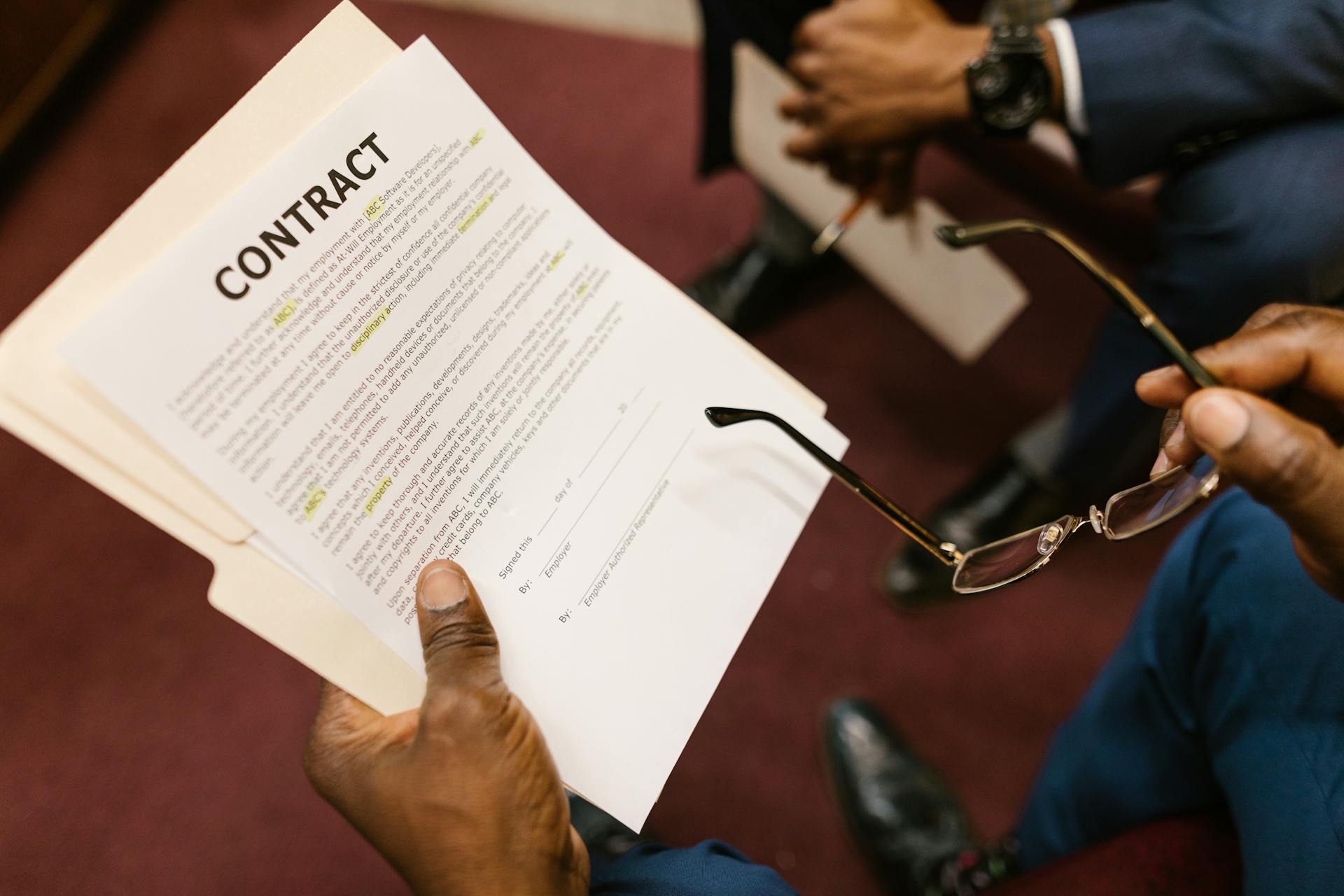
In everyday life, contracts are often formed without a single piece of paper or formal agreement. This is where implied and expressed contracts come into play.
An expressed contract is a formal agreement between two parties, where the terms and conditions are clearly stated. For example, a sales contract between a buyer and a seller, where the price, quantity, and delivery date are specified.
Expressed contracts are often written, but they can also be verbal. In fact, a verbal contract can be just as binding as a written one. For instance, a verbal agreement between a landlord and a tenant to rent an apartment.
Implied contracts, on the other hand, are formed when one party expects something in return for their services or actions. This can happen when a customer assumes that a service will be provided in exchange for payment. For example, a customer takes their car to a mechanic, assuming that the mechanic will fix the car and charge them for the service.
A fresh viewpoint: Implied Shares Outstanding
What Is a Contract?
A contract is a promise or agreement between two or more parties that is legally binding.
There are different types of contracts, but they all have one thing in common: they're a way for people to exchange something of value.
A contract can be as simple as buying a sandwich at a restaurant, where you're agreeing to pay for the food in exchange for receiving it.
Types of Contracts
Implied contracts are formed through unspoken words, but did you know that they're just as binding as written agreements? One key element is that the party providing the benefit does so with the expectation of payment or compensation.
To form an implied contract, one party must receive a benefit from the other. This benefit can be tangible or intangible, but it must be something of value.
The receiving party must have had the opportunity to reject the benefit but chose not to. This opportunity to reject is crucial in forming an implied contract.
These elements combine to create a contract as binding as any written agreement, even though it's not expressed in words.
Recommended read: Difference between Express Contract and Implied Contract
When is an Agreement Unenforceable?
An agreement can be unenforceable if one party manipulates or misrepresents information, forcing the other party to agree on terms.
Unconscionability is a key factor in determining whether an agreement is unenforceable. This occurs when one party takes advantage of the other's lack of knowledge or experience.
An illegal subject matter can also make an agreement unenforceable. If the contract contains illicit or prohibited activities, it will not be upheld by the law.
A mistake in the contract can also render it unenforceable. If both parties agree on something in error, the contract will not be valid.
Unexpected circumstances, such as natural disasters or other unforeseen events, can also make an agreement unenforceable. These events are sometimes referred to as "Acts of God" in contract language.
Here are the reasons an agreement can be unenforceable:
- Unconscionability
- Illegal subject matter
- Mistake
- Force majeure
Characteristics and Elements
Mutual assent is a key characteristic of a contract, where both parties act in a way that indicates they agree to the contract terms. This is evident in express contracts, where terms and conditions are explicitly stated and agreed upon.
For more insights, see: Contract Agreement Payment Terms
Express contracts are easier to enforce in legal disputes due to their clarity. They can be written documents or verbal agreements, and often require contract lifecycle management. A classic example is a lease agreement for an apartment.
Implied contracts, on the other hand, rely on non-verbal agreements and the reasonable expectations of the parties involved. These contracts can be challenging to prove in court without explicit terms.
The elements of an implied contract are crucial in determining its existence and enforceability. They include mutual agreement, legal obligation, unjust enrichment, and benefit and detriment.
Here are the key characteristics of express contracts:
- Clearly defined terms: Responsibilities, timelines, and conditions are explicitly stated
- Legally enforceable: Courts recognize and uphold these agreements
- Common in business: Used in employment, service, and rental agreements
In contrast, implied contracts rely on assumptions and are often inferred from behavior or the situation. This can make them harder to prove in court.
Formation and Creation
To form an implied contract, certain elements must be present. One of these elements is the benefit received, where one party must receive a benefit from the other.
Broaden your view: Elements of a Contract
The party providing the benefit does so with the expectation of payment or compensation. This expectation is a crucial part of creating an implied contract.
The receiving party had the opportunity to reject the benefit but chose not to. This decision to accept the benefit implies that they understand the expectation of payment or compensation.
These elements combine to create a contract as binding as any written agreement, even though it’s not expressed in words.
You might like: Payment Terms Contract
Real-Life Examples and Implications
Implied contracts are all around us, and they can be just as binding as written contracts. In fact, we've all entered into implied contracts without even realizing it.
For example, when you order a meal at a restaurant, you enter into an implied contract to pay for the food and services provided. This is the same for hiring a taxi, where you imply an agreement to pay the fare shown on the meter. Even emergency medical services can create an implied contract, where the medical team's treatment implies a contract that you, or your insurance, will pay for the services.
Implied contracts can also arise in business relationships, such as when a freelancer works regularly for a client without a written contract. In this case, it implies an agreement to be paid for their work based on previous payments for similar tasks.
In some cases, implied contracts can even be formed based on actions, circumstances, and the conduct of the parties involved. For instance, if a homeowner regularly pays a gardener for lawn maintenance without a formal agreement, it implies a contract for ongoing services and payment.
Here are some everyday examples of implied contracts:
• Restaurant dining: You pay for the meal and services provided
• Hiring a taxi: You pay the fare shown on the meter
• Emergency medical services: You or your insurance pay for the services
• Freelance work: You pay for the work based on previous payments for similar tasks
• Property maintenance: You pay for ongoing services and payment
These examples show how implied contracts are formed in various situations, and how they can be just as binding as written contracts.
You might like: Difference between Memorandum of Agreement and Contract
Legal Standing and Enforceability
Implied contracts can be enforceable in court, but it's a more challenging process than with express contracts. This is because courts often rely on circumstantial evidence, examining past interactions, industry norms, and fairness principles to determine if a contract existed.
To prove an implied contract, you'll need to demonstrate the mutual understanding and actions of the parties involved. This can be done by showing a clear indication of a mutual agreement and a legal obligation inferred from the parties' actions or circumstances.
Implied contracts gain enforceability when it's evident that the parties involved had an unspoken understanding that a contract existed between them. This aspect is crucial in situations where one party would face unjust enrichment without legal enforcement of the agreement.
Courts consider the conduct of the parties involved to determine if an implied contract exists. They examine actions, circumstances, and in some cases, past dealings to understand the mutual understanding between the parties.
A fresh viewpoint: Legal Construction Contract
Here are some key factors to consider when it comes to the enforceability of implied contracts:
In summary, implied contracts can be enforceable in court, but it's essential to demonstrate the mutual understanding and actions of the parties involved. By showing a clear indication of a mutual agreement and a legal obligation inferred from the parties' actions or circumstances, you can increase the chances of success in court.
Practical Tips and Considerations
Consent is key in implied contracts. A nod or a handshake can be interpreted as agreeing to a contract.
In everyday situations, we often unknowingly create contractual obligations. Accepting a service, like a haircut, implies agreement to pay for it.
Be mindful of your actions, as they can create contractual obligations. A customer sitting in a chair implies consent to pay for the service.
In practice, implied contracts are often formed in a matter of seconds. A hairdresser providing a service implies agreement to accept payment.
Pay attention to your surroundings and the actions of others. Understanding these dynamics can help you avoid misunderstandings and disputes.
You might like: Difference between Void Agreement and Voidable Contract
Business and Relationship Implications
Implied contracts play a crucial role in maintaining trust and fairness in business dealings, ensuring that parties can expect a basic level of fairness and reciprocity even in the absence of formal agreements.
Understanding implied contracts can help build strong business relationships by fostering an environment where trust and mutual understanding are valued.
Maintaining trust and fairness in business dealings is vital for long-term success, and implied contracts help achieve this by establishing a level of fairness and reciprocity.
Respecting the concept of implied contracts can help you build strong relationships with clients, partners, and colleagues, leading to a more harmonious and productive work environment.
Implied contracts can be just as binding as expressed contracts, and failing to uphold them can damage your reputation and relationships.
By understanding and respecting implied contracts, you can create a culture of trust and mutual understanding in your business, leading to stronger relationships and better outcomes.
Featured Images: pexels.com