Tesla's entry into the electric vehicle market was a significant turning point, but did they truly start the trend? The answer lies in the fact that Tesla's first car, the Tesla Roadster, was released in 2008, but electric vehicles existed long before that.
The first electric car was invented in the 1830s, with Robert Anderson creating a crude electric carriage. This early innovation was a precursor to the modern electric vehicles we see today.
Tesla's innovative approach to electric vehicles, however, was a game-changer. Their focus on performance, range, and style helped to shift public perception and make electric vehicles more desirable.
Explore further: Electric Car
Tesla's Early Years
Tesla Motors was founded in July 2003 by Martin Eberhard and Marc Tarpenning, who chose the name as a tribute to the inventor Nikola Tesla.
Eberhard and Tarpenning had backgrounds in technology, with Eberhard earning degrees in electrical engineering from the University of Illinois Urbana-Champaign and Tarpenning completing computer science studies at the University of California, Berkeley.
Their experience in producing e-readers at NuvoMedia, which they co-founded in the 1990s, laid the groundwork for their transition to electric vehicles.
The duo's vision for Tesla was to design a high-performance mainstream electric sports car that would challenge the common view that EVs were slow-moving and golf cart-like.
Tesla launched in 2003 and released its first car, the Roadster, in 2008, after focusing on research and development.
If this caught your attention, see: Tesla Electric Car Lease Deals
E-Readers to Tesla's Founding
Martin Eberhard and Marc Tarpenning founded Tesla Motors in July 2003, a tribute to the inventor Nikola Tesla. They chose the company name as a nod to the electrical engineer who inspired their venture.
Eberhard earned bachelor's and master's degrees in electrical engineering from the University of Illinois Urbana-Champaign. Tarpenning completed computer science studies at the University of California, Berkeley.
The duo met in the 1990s when they co-founded NuvoMedia, a company that produced the Rocket eBook, one of the first successful e-readers. They sold NuvoMedia to Gemstar-TV Guide for $187 million in 2000.
Eberhard's interest in sports cars, combined with concerns about climate change and America's dependence on foreign oil, led them to explore electric vehicles.
A unique perspective: Tesla Company Car Lease
Raising Capital
Eberhard and Tarpenning initially funded Tesla with their own money, but by 2004, they realized they needed significant external funding.
Government subsidies for electric carmakers were generous, but not enough to cover the costs of EV manufacturing.
Tesla raised $7.5 million in its Series A funding in 2004, with Elon Musk leading the round and investing $6.5 million.
Musk's investment guaranteed him the role of chair of the company's board, and his notoriety helped establish the company's credibility.
He provided further capital in additional funding rounds, eventually investing over $70 million.
Automotive manufacturing is capital-intensive, and EV manufacturing comes with significant technological and regulatory hurdles.
Tarpenning left Tesla in 2008, but Musk's continued investment helped bring the company's vision to life.
Expand your knowledge: Elon Musk's Tesla Removed from $400m Armored Ev Federal Contract
The First Electric Car
The first electric car was invented by Robert Anderson in 1832, a Scottish inventor who created a crude electric carriage powered by a non-rechargeable primary cell battery.
It was a significant innovation at the time, but it wasn't until the 1880s that electric cars started to gain popularity, with electric taxis operating in London and Paris.
The first electric car with a rechargeable battery was developed by French engineer Gustave Trouvé in 1881.
Trouvé's design was more practical and efficient, paving the way for the widespread adoption of electric vehicles.
However, it wasn't until the early 20th century that electric cars began to decline in popularity, as gasoline-powered cars became more affordable and convenient.
The first mass-produced electric car was the Morrison Electric, produced in the United States in 1899.
Tesla's Success and Impact
Tesla has the largest market capitalization of all automakers at over $1.1 trillion as of September 2025.
The company's success has inspired other automakers to reconsider their approach to building and marketing electric vehicles (EVs). For example, GM's new Ultium electric powertrains were likely influenced by Tesla's in-house technology development.
Tesla's minimalist interior design has also become an industry standard, saving manufacturers money and improving efficiency.
The Model S was a game-changer in the EV market, selling in far higher numbers than expected and paving the way for more affordable options like the Model 3 and Model Y.
Despite some reliability issues, Tesla's unique approach and attributes have made it a compelling choice for many consumers, as reflected in our owner satisfaction survey.
Mechanics often depend on Tesla to provide parts, highlighting the company's dominance in the EV market.
Tesla's success has also led to a shift in the industry, with other manufacturers adopting similar approaches to EV development and marketing.
Model S and Competition
The Model S was a game-changer in the electric vehicle (EV) market, but it wasn't the first EV on the scene. In 2008, Tesla launched the Roadster, a two-seater sports car that was the first production EV to use lithium-ion batteries.
The Model S, however, was a more practical and family-friendly option. It was released in 2012 and had a range of up to 265 miles on a single charge. This was a significant improvement over the Roadster's 245-mile range.
Competition in the EV market was limited at the time, but other manufacturers like Nissan and Chevrolet were starting to take notice. The Leaf, released in 2010, was one of the first mass-market EVs, and the Volt, released in 2011, was a plug-in hybrid that offered a range of up to 35 miles on electric power alone.
Nissan Leaf vs. Model S
The Nissan Leaf and Tesla Model S are two of the most popular electric vehicles on the market. The Model S has a significantly longer range, with a maximum of 373 miles, compared to the Leaf's 226 miles.
One key difference between the two cars is their charging time. The Model S can charge to 80% in just 45 minutes, while the Leaf takes around 30 minutes to charge to 80% using a DC Fast Charger.
The Model S also has a much faster acceleration, going from 0-60mph in just 2.5 seconds, whereas the Leaf takes around 7.4 seconds.
The Model S has a more expensive price tag, starting at around $79,000, while the Leaf starts at around $29,000.
The Model S
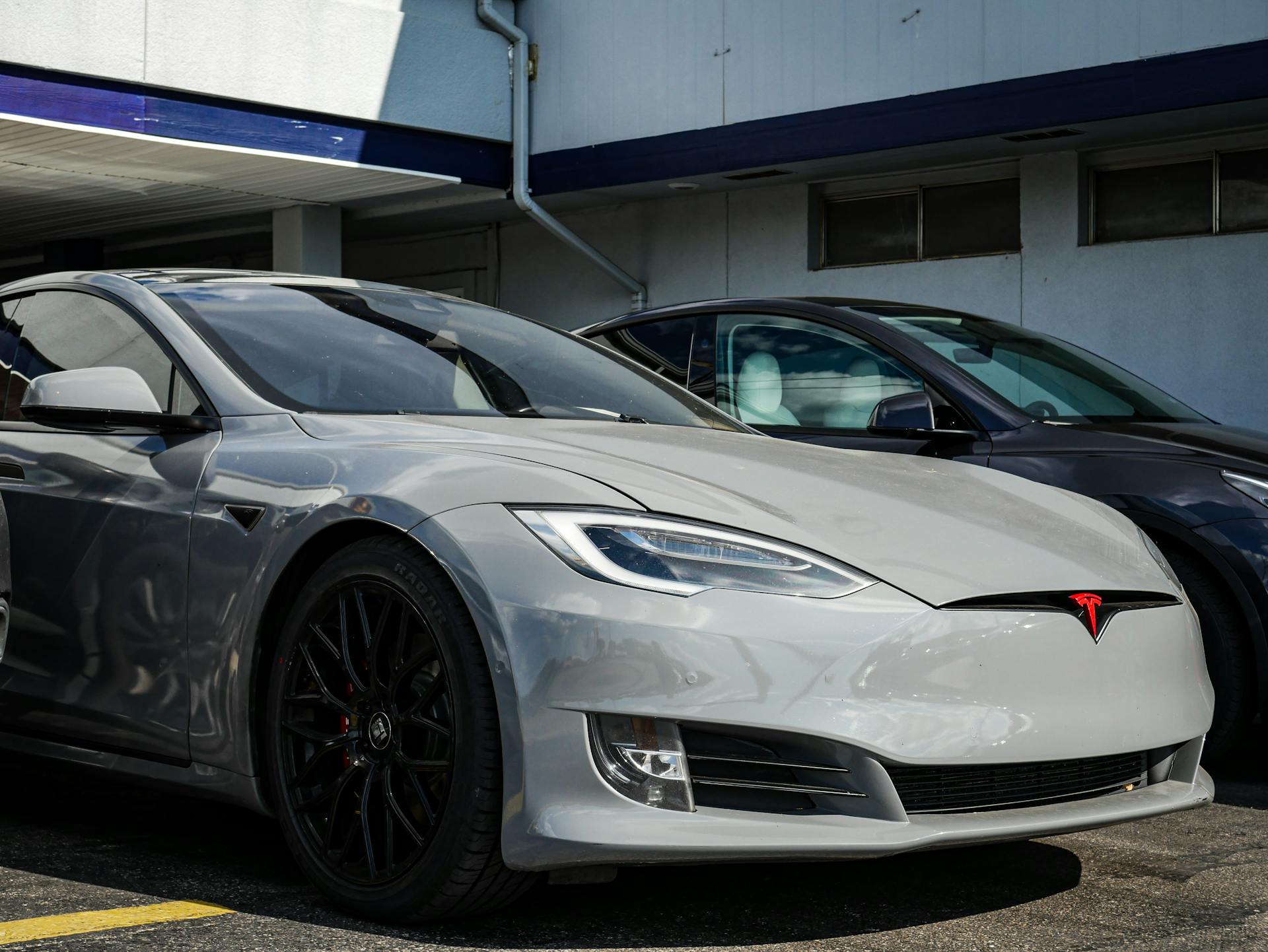
The Model S is a full-size luxury sedan produced by Tesla, Inc. It's one of the most popular electric vehicles on the market, known for its impressive range and performance.
The Model S has a range of up to 373 miles on a single charge, making it a great option for long road trips. Its 778 horsepower makes it one of the fastest accelerating cars on the road, going from 0-60mph in just 2.5 seconds.
The Model S is available in several trim levels, including the Long Range, Performance, and Plaid. The Long Range model has a range of up to 373 miles, while the Performance model has a range of up to 345 miles.
The Model S features a spacious interior with plenty of room for passengers and cargo. It also comes with a range of advanced technology features, including a large touchscreen display and Autopilot capabilities.
The Model S has a starting price of around $79,990, making it a more affordable option for those looking for a luxury electric vehicle.
Intriguing read: How Long Are Car Loans for on Used Cars
Performance and Features
The Model S was a game-changer in the electric vehicle (EV) market, offering a luxury car experience with a 200-mile range.
It outsold its competitors in its class, earning the highest Overall Score in our ratings. Our testers praised it for its innovation, world-class performance, and impressive attention to detail.
The instant acceleration from its electric motor allowed it to outrun similarly sized V8-powered sedans from BMW and Jaguar, sprinting from 0 to 60 in just 5.6 seconds.
This was a major advantage over other EVs, which often had limited range and charging options. The Tesla Supercharger network provided rapid charging speeds, making long road trips in an EV much more realistic and practical.
Featured Images: pexels.com