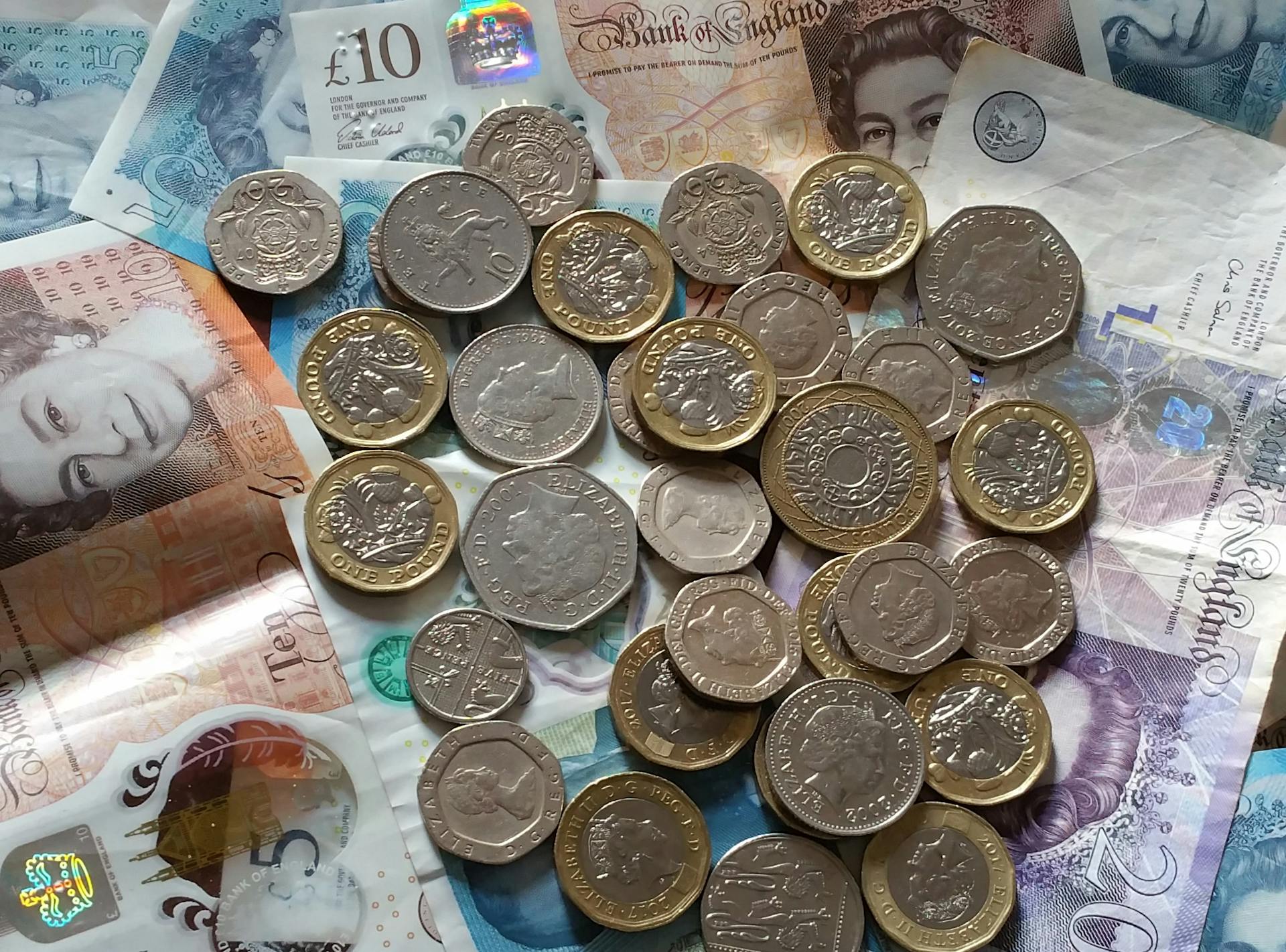
Decimalisation is a fascinating topic that has a significant impact on our daily lives. The UK's decision to decimalise its currency in 1971 was a major turning point in financial history.
The UK had a complex system of pounds, shillings, and pence, but decimalisation simplified it to a single unit, the pound. This change was a result of a long process that began in the 1960s.
The new decimal system was designed to be easier to understand and use, with 100 pence making up one pound. This change was also intended to bring the UK in line with other countries that had already adopted decimal currency.
The impact of decimalisation was immediate and far-reaching, with many businesses and individuals struggling to adapt to the new system.
On a similar theme: Why Does Us Currency Have Value
Preparing for Decimal Conversion
Preparing for Decimal Conversion was a massive undertaking, and it's fascinating to see how the British government and banks prepared for the changeover. The Decimal Currency Board was established in 1967 to oversee the transition, and its strategy was to minimize changes until D-Day, which was set for 15 February 1971.
The Board worked closely with the Royal Mint, the British Bankers' Association, and the Post Office to ensure a smooth transition. They published millions of booklets, devised conversion tables, and launched a publicity campaign to educate the public about the new currency. The first new coins, the 5p and 10p, were issued in April 1968 to help prepare the public for the changeover.
To facilitate the transition, the Decimal Currency Board also worked with retailers and businesses to ensure they were prepared for the changeover. The Royal Bank of Scotland, for example, was able to use its computerisation programme to save staff from two weeks of intensive overtime. NatWest, on the other hand, had to merge three different banks and prepare its legacy systems for the changeover, which presented even bigger challenges.
Here's a list of the key players involved in the Decimal Conversion:
- Decimal Currency Board
- Royal Mint
- British Bankers' Association
- Post Office
- Royal Bank of Scotland
- NatWest
The government even conceded that the sixpence could survive for at least two years after decimalisation due to public pressure, showing just how much of an impact the public had on the decision-making process.
RBS Preparations

The Royal Bank of Scotland's preparations for decimalisation were a massive undertaking, described by their staff newsletter as ‘the biggest single operation ever undertaken in the history of British banking’.
The bank had a head start due to its relatively advanced computerisation programme, which allowed it to undertake much of the branch-level work in the run-up to decimalisation, saving an estimated 6,300 branch staff from two weeks of intensive overtime.
Staff had to be trained to understand the new currency, and to be as confident with it as they had come to feel in years – or even decades – of processing the old currency.
To help with this task, the British Bankers' Association had issued a series of booklets and exercises, plus a quick-reference crib sheet for cashiers.
The Royal Bank of Scotland’s branches alone were issued with £1.75m of new coins in advance of D-Day, weighing a total of 625 tons.
On a similar theme: What Is Decimalisation
Sending these coins securely from the Royal Mint in South Wales to the bank’s offices all over Scotland was a logistical challenge.
The bank's staff had to be trained to work with the new currency, and they received extensive training to ensure they were confident and prepared for the changeover.
The bank even stayed open all night on D-Day to ensure that all payments were processed on time, and the head office canteen provided on-the-spot sustenance for the staff working through the night.
Decimalize
Decimalize is a process that involves changing from fractions to decimals, which was a significant task for the UK in 1971. The country was divided into pounds, shillings, and pence, but the British government decided to adopt a decimal system to simplify currency calculations.
The process of decimalization began in 1960 when the British Association for the Advancement of Science and the Association of British Chambers of Commerce co-published a report recommending the change. The Committee of Inquiry on Decimal Currency, also known as the Halsbury Committee, was established in 1961 to oversee the transition.
A different take: Currency for Bhutan
To facilitate the transition, the Decimal Currency Board was established by the Act of 1967, with the goal of minimizing the changes on Decimal Day, set for February 15, 1971. The Board worked closely with organizations such as the Royal Mint, the British Bankers' Association, and the Post Office to ensure a smooth transition.
The new decimal coins were designed by Christopher Ironside, and the first to be issued were the 5p and 10p pieces in April 1968. These coins were designed to be similar in size and value to the old shillings and florins, to help prepare the public for the changeover.
The Royal Bank of Scotland's staff newsletter described decimalization as 'the biggest single operation ever undertaken in the history of British banking.' The bank's computerization program helped prepare for the change, and staff had to be trained to understand the new currency.
Here's a list of the new decimal coins introduced in 1971:
- ½p
- 1p
- 2p
- 5p
- 10p
- 50p
The 50p coin was introduced in October 1969, and its unique shape, an equilateral curve heptagon, was designed to make it roll in vending machines. Despite initial concerns, the coin was a success and replaced the ten-shilling note.
The public was also given a chance to get familiar with the new coins through the sale of special souvenir sets of ½p, 1p, 2p, 5p, and 10p pieces from June 1968.
For your interest: The Coin of the Realm
Decimalisation Process

The decimalisation process was a monumental task that required careful planning and execution. Britain's first decimal coins were designed by the sculptor Christopher Ironside, who also designed the original decimal coins that were introduced in 1971.
The changeover to decimal currency was a complex process that involved changing the nation's coinage system from pounds, shillings, and pence to a decimal system. This meant that 12 pennies made a shilling, and 20 shillings made a pound.
Work on building a new Royal Mint began in August 1967, and the first phase was opened by Her Majesty The Queen in December 1968. This marked the beginning of a new era for the Royal Mint.
The decimalisation process was a gradual one, with the introduction of decimal coins in 1971 marking the beginning of a period of planning and changes for the Royal Mint. The process of designing the new coins actually began ten years earlier, in 1961.
A different take: Britain Decimalisation
Here are some key dates in the decimalisation process:
The decimalisation process was a significant change for Britain, and it marked the beginning of a new era for the nation's coinage system. The process of changing from a traditional system to a decimal system was a complex one, but it ultimately led to a more modern and efficient system.
Impact of Decimalisation
Decimalisation had a profound impact on Britain's currency and economy.
The changeover to decimal currency was a monumental task that required extensive planning and preparation, which began as early as August 1967 with the construction of a new Royal Mint.
The public and businesses of Britain needed all the necessary information to make the transition as smooth as possible, but the process of designing the new coins actually began ten years before the changeover in 1971.
Britain adopted decimal currency in 1971, but the first decimal coins were designed by Christopher Ironside and produced as early as 1968.
You might enjoy: Us Currency Gold Standard
The new decimal coins were a significant departure from the old coinage system of pounds, shillings, and pence, which had been in use for centuries.
The Royal Mint and Decimalisation worked together to ensure a seamless transition, with the Queen herself opening the first phase of the new building in December 1968.
The change to decimal currency was a momentous occasion, and the nation's coins were designed to reflect this new era.
Britain's first decimal coins were designed by Christopher Ironside, who also designed the decimal bronze coins that went into production in 1968.
The changeover to decimal currency was a complex process, but it ultimately led to a more efficient and simplified system.
Decimalisation in History
The UK's switch to a decimal currency system was a long time coming, with mathematicians and others advocating for it as early as the 16th century.
The process of decimalisation began in 1960 with a report recommending that Britain adopt a decimal currency. By 1966, the British government had set up the Committee of Inquiry on Decimal Currency, which reported in 1963 and led to the passage of the Decimal Currency Act in May 1969.
The changeover to decimal currency was a significant moment in British history, with the first decimal coins being designed by sculptor Christopher Ironside and introduced in 1971.
History of Decimalisation
Britain relied on a coinage system of pounds, shillings and pence for centuries. The public and businesses of Britain required all the necessary information to make the changeover to decimal currency as smooth as possible.
The changeover to decimal currency was a monumental task, with the public, businesses, and the government all playing a crucial role. The government proposed a five-year preparatory period before changing over in 1971.
The British government set up the Committee of Inquiry on Decimal Currency in 1961, which reported in 1963 and recommended that Britain adopt a decimal currency. The committee's recommendations were adopted in 1966.
A new decimal system was designed to make money calculations quicker, easier, and less liable to error. The greater simplicity of the decimal system was seen as an important aid to productivity.
The UK's first decimal coins were designed by Christopher Ironside, a sculptor who passed away in 1992. The first decimal coins were designed in 1968, but they didn't enter circulation until 1971.
The Royal Mint built a completely new facility in Llantrisant, South Wales, to produce the new decimal coins. The new facility was opened by Queen Elizabeth II in December 1968.
By August 1970, preparations for Decimal Day were well on course, with the majority of retailers and the public aware of the change.
Comes and Goes
The quiet revolution of decimalisation in the UK was a remarkable feat that went largely unnoticed by the public.
D Day, the day of the switch to decimal trading, was set for Monday 15 February 1971.
Banks, the Stock Exchange, and Post Offices all closed their doors on the preceding days to prepare for the change.
The public was well-prepared, with old and new prices prominently displayed and trained staff available to assist with any confusion.
Despite some initial criticism, the change was a huge success, with the old pennies and threepenny bits all but disappearing within a couple of weeks.
The transitional period was brought to an end on 31 August 1971, months ahead of schedule.
Decimalisation News
The Decimalisation News section has some fascinating facts to share. The Chancellor's statement on decimalisation was met with broad acceptance of the principle, but the choice of system sparked controversy.
Retail associations and consumer groups favoured ten shillings as the major unit, arguing it fit better with existing coins and offered greater protection against price rises. They wanted to retain the sixpence as a 5p piece and the half-crown as 25p.
The government's decision to keep the pound intact was fiercely challenged, but it maintained a familiar point of reference and was likely to be less disruptive to the business world.
Decimalisation Explained
Decimalisation, also known as decimalisation, refers to the process of changing a currency or system from a non-decimal to a decimal system.
The UK adopted decimal currency in 1971, with the first decimal coins designed by sculptor Christopher Ironside FSIA FRBS OBE.
The changeover to decimal currency was no small task, requiring a lot of planning and information to be made available to the public and businesses in Britain.
The Royal Mint began building a new facility in August 1967, with Her Majesty The Queen opening the first phase in December 1968.
The decimal bronze coins went into production soon after, marking a significant moment in the country's history.
Here's a quick look at the verb forms of decimalise:
As you can see, decimalisation is a process that involves changing a system or currency from a non-decimal to a decimal system, making it easier to understand and work with.
What is Decimalisation
Decimalisation is the process of changing from a system of pounds, shillings, and pence to a decimal system. This was a momentous day for the national currency in Britain, which was set for 15 February 1971.
The changeover to decimal currency was no small task, requiring all the necessary information to make the changeover as smooth as possible. Britain's first decimal coins were designed by the sculptor Christopher Ironside FSIA FRBS OBE, who died on 13 July 1992.
The process of designing the new coins actually began ten years earlier, in 1961. The UK adopted decimal currency in 1971, but the first decimal coins appeared in 1968.
To understand the concept of decimalisation, let's take a look at the verb "decimalize". According to the dictionary, it means to change from fractions to decimals, or to change to the decimal system. Here's a breakdown of the verb:
This table shows the different forms of the verb "decimalize", which can be useful for understanding the concept of decimalisation.
Decimal
Decimalisation was a momentous day for the national currency, marking the beginning of a period of planning and changes for The Royal Mint on 15 February 1971.
The UK's old coinage system of pounds, shillings, and pence was replaced with a decimal system, where one pound was made up of 100 new pence, making calculations much simpler.
The changeover to decimal currency was no small task, requiring all the necessary information to be made available to the public and businesses of Britain to make the transition as smooth as possible.
The first decimal coins were designed by Christopher Ironside FSIA FRBS OBE, a sculptor who passed away on 13 July 1992. His widow, Jean, shared her experiences of living through that momentous time.
Work began in August 1967 to build a completely new Royal Mint, which was opened in phases, with the first phase being opened by Her Majesty The Queen in December 1968.
The UK adopted decimal currency in 1971, but the process of designing the new coins actually began ten years earlier, with Ironside's original designs being created in the 1960s.
Here's a timeline of the key events leading up to decimalisation:
The change to a decimal system made calculations much simpler, and it's hard to imagine going back to the old system now.
Featured Images: pexels.com