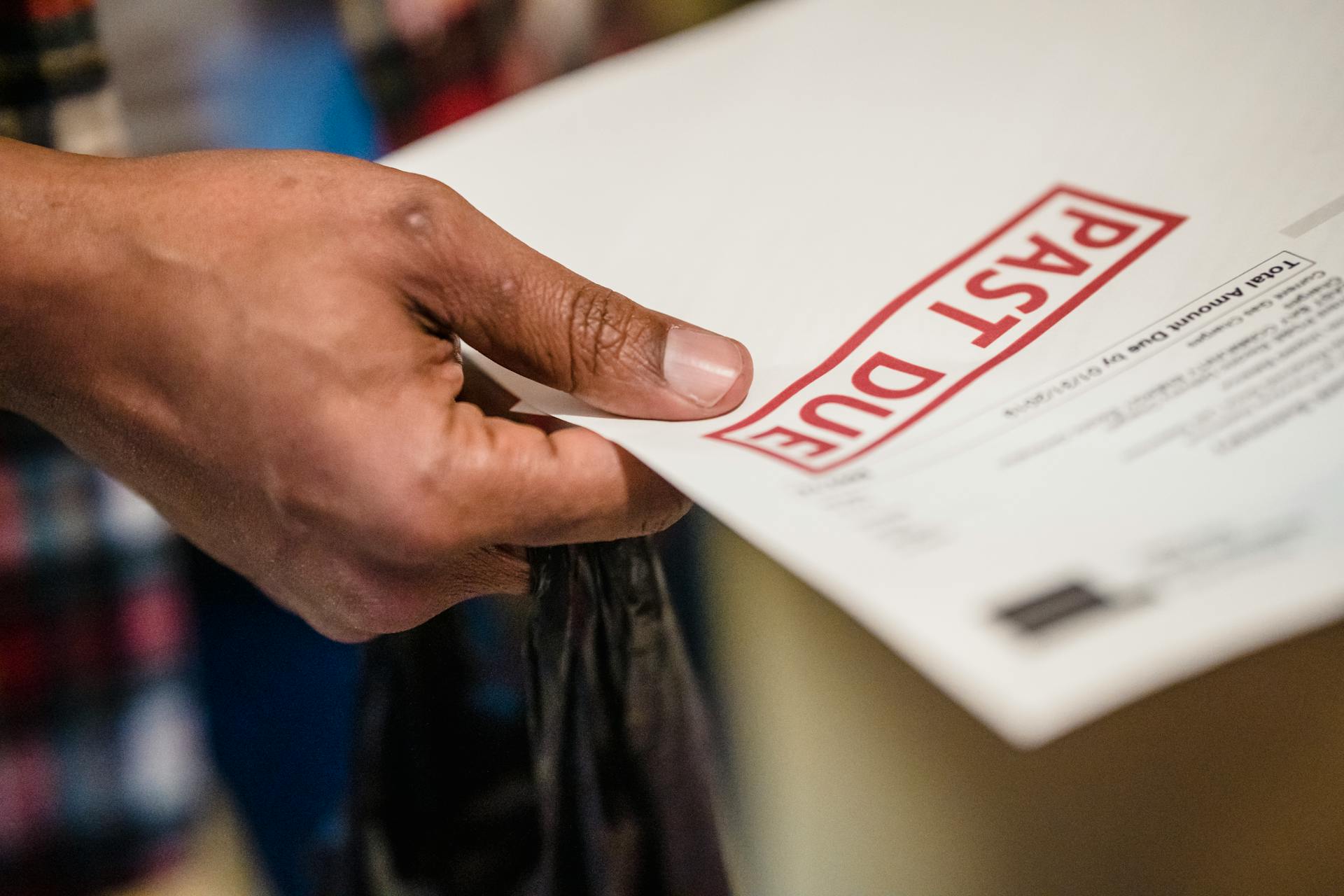
A credit crunch is a situation where banks and other lenders become hesitant to lend money to businesses and individuals, often due to a lack of trust in the economy.
This can happen when there's a decrease in the availability of credit, making it harder for people and companies to access the funds they need to operate.
The economy can suffer significantly during a credit crunch, as businesses and individuals struggle to access the credit they need to invest, grow, and make ends meet.
In extreme cases, a credit crunch can even lead to widespread job losses and business closures, as companies are unable to access the credit they need to stay afloat.
Check this out: Delta Skymiles Platinum American Express Card Lounge Access
Causes and Contributing Factors
A credit crunch often results from careless and inappropriate lending that leads to losses for lending institutions and investors when loans turn sour.
Banks may suddenly stop or slow lending activity due to inadequate information about borrowers' financial condition, leading to overestimated creditworthiness.
A sustained period of overestimating borrowers' creditworthiness can lead to a boom in lending, followed by a sudden contraction of credit when the true extent of bad debts becomes known.
An anticipated decline in collateral value can also cause banks to reduce lending activity.
The central bank can impose new regulatory constraints or raise reserve requirements, limiting banks' ability to lend.
Direct credit controls by the central government can restrict lending activity, and an increased perception of risk regarding other banks' solvency can also lead to reduced lending.
Banks may curtail lending activity and seek out borrowers with pristine credit, a behavior known as a flight to quality, after a crisis.
Intriguing read: Unsecured Corporate Bonds Are Known as
History of the Crisis
The history of the credit crunch is a complex and multifaceted topic, but let's break it down into some key events.
In recent decades, credit crunches have not been rare or black swan events. During the past fifty years, there have been 28 severe house-price boom-bust cycles and 28 credit crunches in 21 advanced OECD economies.
The first sign of the bursting of the United States housing bubble was in 2006, when housing prices peaked and mortgage loan delinquency rose. One-third of all mortgages in 2006 were subprime or no-documentation loans, which comprised 17% of home purchases that year.
The yield curve inverted in August 2006, signaling a recession was likely within a year or two. This was a warning sign that was ignored by many economists.
In 2007, the first banking casualty of the crisis was IKB Deutsche Industriebank, which was bailed out by the German public financial institution KfW in July. This was followed by the liquidation of two hedge funds by Bear Stearns in July.
The Dow Jones Industrial Average (DJIA) closed above 14,000 for the first time in July 2007, but it had fallen 1,164.63 or 8.3% by August 16, 2007. This was a significant decline in a short period of time.
The Federal Open Market Committee began reducing the federal funds rate from its peak of 5.25% in September 2007, in response to worries about liquidity and confidence. This was a move to stimulate the economy.
The DJIA hit its peak closing price of 14,164.53 in October 2007, but it had fallen to 12,945.78 by August 16, 2007. This was a decline of 1,218.75 points in a short period of time.
Additional reading: Credit Cards Only Sign Nyt

Here is a list of some key events in the history of the credit crunch:
- May 2005: Michael Burry closed a credit default swap against subprime mortgage bonds with Deutsche Bank.
- 2006: Housing prices peaked and mortgage loan delinquency rose.
- August 2006: The yield curve inverted, signaling a recession was likely within a year or two.
- July 2007: IKB Deutsche Industriebank was bailed out by the German public financial institution KfW.
- September 2007: The Federal Open Market Committee began reducing the federal funds rate.
- October 2007: The DJIA hit its peak closing price of 14,164.53.
Federal Response and Policy
The Federal Reserve's prolonged policy of artificially low interest rates in the early 2000s created a credit bubble that allowed for speculative investments and unsustainable levels of debt, particularly in housing.
Ron Paul and Tom Woods, two prominent critics, argue that the Fed's actions distorted normal price signals, leading to widespread malinvestment and an inevitable correction. The government's intervention in the housing market through Fannie Mae and Freddie Mac also played a significant role in the crisis.
Fannie Mae and Freddie Mac expanded homeownership beyond sustainable levels, creating a moral hazard that encouraged financial institutions to take on riskier behavior, assured they would receive government support in times of crisis.
See what others are reading: Federal Takeover of Fannie Mae and Freddie Mac
Financial System Issues
Financial innovation and complexity played a significant role in the credit crunch. The term financial innovation refers to the development of financial products designed to achieve particular client objectives, such as offsetting a particular risk exposure or to assist with obtaining financing.
The usage of these products expanded dramatically in the years leading up to the crisis. CDO issuance grew from an estimated $20 billion in Q1 2004 to its peak of over $180 billion by Q1 2007.
Banks had already been clamping down on lending even before the recent mayhem. They reported tightening their standards for credit cards, home equity lines of credit, auto loans, and other consumer loans.
The shadow banking system played a significant role in the crisis. It was a system of financial institutions and instruments that were not subject to the same regulatory controls as traditional banks.
Related reading: In a Fractional Reserve Banking System Banks Create Money Because
Weak Underwriting Practices
Banks had already been clamping down on lending standards before the crisis, tightening their standards for credit cards, home equity lines of credit, and auto loans.
In the fourth quarter, banks reported increasing the minimum credit scores required to secure such loans. They also tightened standards for commercial and industrial lending to businesses.
A significant share of banks also tightened standards for consumer loans, such as credit cards and home equity lines of credit.
Credit unions, on the other hand, were less likely to fail during the crisis, with a 7% market share of write-downs and losses between 2007 and 2011.
The cooperative banking sector had a 20% market share of the European banking sector, but accounted for only 7% of all the write-downs and losses during that period.
Banks were not the only ones to blame for weak underwriting practices - mortgage lenders also relaxed their standards, allowing subprime lending to increase significantly.
Subprime lending rose from 10% of all mortgage originations in 2003 to nearly 20% in 2004 and remained there through the 2005-2006 peak of the United States housing bubble.
The growth of subprime lending was driven by competition between mortgage lenders for revenue and market share, as well as the desire to originate riskier mortgages to less creditworthy borrowers.
In fact, the riskiest loans were originated in 2004-2007, the years of the most intense competition between securitizers and the lowest market share for government-sponsored enterprises (GSEs).
Expand your knowledge: Credit Counseling Certificate Chapter 7 Free
The GSEs eventually relaxed their standards to try to catch up with the private banks, contributing to the proliferation of substandard loans.
These substandard loans were often characterized by low or no down payments, which increased the risk of default and contributed to the housing bubble.
The boom in subprime lending was fueled by the development of new financial products, such as mortgage-backed securities (MBS) and collateralized debt obligations (CDO).
The usage of these products expanded dramatically in the years leading up to the crisis, with CDO issuance growing from $20 billion in Q1 2004 to over $180 billion by Q1 2007.
However, the credit quality of CDOs declined during this period, as the level of subprime and other non-prime mortgage debt increased from 5% to 36% of CDO assets.
The collapse of the shadow banking system, which included entities such as asset-backed commercial paper conduits and structured investment vehicles, was a key contributor to the crisis.
These entities were vulnerable to disruptions in credit markets, which forced them to engage in rapid deleveraging and sell their long-term assets at depressed prices.
The combined effect of these factors was a financial system vulnerable to self-reinforcing asset price and credit cycles.
Consider reading: What Is the Debt to Assets Ratio
Savings Glut
The Savings Glut is a significant contributor to the global asset bubble. It's a complex issue, but let's break it down.
The global savings glut is caused by the demand for safe assets following the Asian Financial Crisis. This created an unmet demand for "risk-free" assets, which led to institutional investors like sovereign wealth funds and pension funds purchasing synthetic safe assets like Triple-A Mortgage Backed Securities.
The demand for these safe assets fueled the free flow of capital into housing in the United States. This had a devastating effect, as banks and other financial institutions were incentivized to issue more mortgages than before.
Reports on the causes of the global savings glut are categorized under Business and Economics, Money, and Banks.
Intriguing read: Can You Pay Credit Card from Savings Account
Housing Market and Economy
The housing market was severely affected by the credit crunch, with a significant decline in housing prices. In some areas, prices fell by as much as 30%.
Many homeowners found themselves "underwater" on their mortgages, owing more on their homes than they were worth. This led to a rise in defaults and foreclosures.
The credit crunch also had a ripple effect on the broader economy, with many businesses struggling to access credit. This led to a decline in consumer spending and a rise in unemployment.
In 2007, the US housing market saw a 12% decline in prices, with the median existing single-family home price falling to $207,000. This was a significant drop from the peak price of $265,000 in 2006.
Intriguing read: $10000 Upside down Car Loan
Consequences and Effects
A credit crunch can have severe consequences on the economy and individuals. Financial institutions may fail, economic growth may slow, unemployment may rise, and social unrest may increase.
The usual consequence of a credit crunch is a prolonged recession or slower recovery, resulting from the shrinking credit supply. This can lead to businesses unable to borrow funds at all, facing trouble growing or expanding, and some may struggle to remain in business.

Increased borrowing costs hinder an individual's ability to spend money in the economy, eating into business capital that could otherwise be used to grow operations and hire workers. Productivity declines and unemployment rises, two leading indicators of a worsening recession.
Businesses and consumers who are highly leveraged (i.e., carrying a high debt burden) are more severely affected when a bubble bursts, causing recession or depression. The ratio of household debt to after-tax income rose from 60% in 1984 to 130% by 2007, contributing to the Subprime mortgage crisis of 2007–2008.
During a credit crunch, loans, credit cards, and mortgages might be tough to get, with lenders dramatically tightening their standards. This usually translates into higher credit score requirements for borrowers, higher interest rates on loans, or both.
The effects of a credit crunch depend on your specific situation. Some folks may benefit from better interest rates on their savings, while people who need credit will likely be in a tougher spot.
For another approach, see: Higher Credit Limit Cards
Understanding the Crisis
A credit crunch is an economic condition where investment capital is hard to secure, making it difficult for individuals and corporations to obtain loans.
Banks and other financial institutions become wary of lending due to the fear of borrowers defaulting on payments, causing interest rates to rise as a way to compensate for the added risk.
This can have a ripple effect throughout the economy, leading to a decline in home-ownership rates and businesses being forced to cut back due to a lack of capital.
A credit crunch often follows a period of lenient lending, where loans are advanced to borrowers with questionable ability to repay, resulting in a rise in default rates and bad debt.
In extreme cases, the rate of bad debt becomes so high that banks become insolvent and may shut their doors or require a government bailout to continue operating.
A credit crunch can be triggered by a sudden shortage of funds, making it nearly impossible for companies to borrow due to lenders' fear of bankruptcies or defaults.
This can occur independently of a sudden change in interest rates, and often happens during recessions when the economy is already experiencing a downturn.
Check this out: Which Type of Debt Is Most Often Secured
Timeline and Events
The credit crunch, a pivotal moment in economic history, was marked by a series of events that had far-reaching consequences. The financial crisis began in 2007 with the collapse of the US housing market.
The subsequent credit crunch was triggered by a decrease in the availability of credit, making it difficult for businesses and individuals to access loans. Banks, who had invested heavily in mortgage-backed securities, found themselves with large losses.
In response to the crisis, governments around the world implemented various measures to stabilize the financial system. The US government, for example, passed the Troubled Asset Relief Program (TARP) in 2008.
The subsequent economic recovery was slow and uneven, with many countries experiencing a prolonged period of high unemployment and stagnant economic growth.
A unique perspective: Economic Impact of the Russian Invasion of Ukraine
Background and Context
In the summer of 2007, the credit crunch began to take shape. Stock prices in China and the U.S. fell by the most since 2003 due to reports of a decline in home prices and durable goods orders.
Alan Greenspan predicted a recession, and Freddie Mac stopped investing in certain subprime loans due to increased delinquency rates. This marked a significant turning point in the crisis.
The Dow Jones Industrial Average (DJIA) reached a milestone on July 19, 2007, closing above 14,000 for the first time. However, this was short-lived, as the DJIA would soon plummet.
Here are some key events that highlighted the severity of the crisis:
- February 27, 2007: Stock prices in China and the U.S. fell by the most since 2003.
- June 20, 2007: Bear Stearns bailed out two of its hedge funds with $20 billion of exposure to collateralized debt obligations.
- July 30, 2007: IKB Deutsche Industriebank announced its bailout by German public financial institution KfW.
- August 9, 2007: BNP Paribas blocked withdrawals from three of its hedge funds due to "a complete evaporation of liquidity".
The DJIA closed at 12,945.78 on August 16, 2007, after falling 1,164.63 or 8.3% from its peak.
Recommended read: The Debt Snowball Method Involves . . .
Pre 2007
In the years leading up to 2007, there were several warning signs that something was amiss in the housing market. Michael Burry, a fund manager, closed a credit default swap against subprime mortgage bonds in 2005, predicting they would become volatile within two years.
One-third of all mortgages in 2006 were subprime or no-documentation loans, which made up 17% of home purchases that year. This was due to increasingly lax underwriting standards.
Readers also liked: College Debt 5 Years after Graduation

JPMorgan was one of the first major banks to sound the alarm, warning clients of a housing downturn, especially in sub-prime housing, in May 2006.
The yield curve inverted in August 2006, signaling that a recession was likely within a year or two. This was a clear warning sign that the economy was heading into trouble.
UBS also weighed in, warning of an impending crisis in the US housing market in November 2006.
Here are some key dates and events that highlight the warning signs leading up to 2007:
- May 19, 2005: Michael Burry closed a credit default swap against subprime mortgage bonds with Deutsche Bank valued at $60 million.
- May 2006: JPMorgan warned clients of a housing downturn, especially in sub-prime housing.
- August 2006: The yield curve inverted, signaling a recession was likely within a year or two.
- November 2006: UBS warned of "an impending crisis in the U.S. housing market".
Background
In the summer of 2007, the global economy was on shaky ground. February 27th marked a significant downturn in stock prices in both China and the U.S., with prices falling by the most since 2003 due to concerns about a decline in home prices and durable goods orders.
Alan Greenspan, a prominent economist, even predicted a recession. This was a major red flag, and it's no wonder that investors were getting nervous. I remember hearing about the instability in the markets at the time and wondering what was going to happen next.
The subprime mortgage crisis was gaining momentum, with New Century, a real estate investment trust, filing for Chapter 11 bankruptcy protection on April 2nd. This was a major blow to the industry and a sign that things were about to get much worse.
Bear Stearns was also feeling the heat, bailing out two of its hedge funds with $20 billion in exposure to subprime mortgages on June 20th. This was a huge investment, and it's a testament to the scale of the crisis.
Here's a timeline of some of the key events that took place in the summer of 2007:
- February 27, 2007: Stock prices in China and the U.S. fell by the most since 2003.
- April 2, 2007: New Century filed for Chapter 11 bankruptcy protection.
- June 20, 2007: Bear Stearns bailed out two of its hedge funds with $20 billion of exposure to subprime mortgages.
- July 19, 2007: The Dow Jones Industrial Average (DJIA) closed above 14,000 for the first time.
- July 30, 2007: IKB Deutsche Industriebank announced its bailout by German public financial institution KfW.
- July 31, 2007: Bear Stearns liquidated the two hedge funds.
- August 6, 2007: American Home Mortgage filed for bankruptcy.
- August 9, 2007: BNP Paribas blocked withdrawals from three of its hedge funds.
- August 16, 2007: The DJIA closed at 12,945.78 after falling 1,164.63 or 8.3%.
Preparation and Prevention
To prepare for a possible credit crunch, it's essential to ensure your creditworthiness is as attractive as possible. This can be achieved by paying credit card bills and other debt payments in full and on time each month.
Reducing your credit utilization rate can also make a significant difference. Consider requesting a credit report and disputing any errors to avoid any negative marks on your report.
Businesses with loans nearing the end of their term should explore refinancing or rolling over the loan as soon as possible. This will help them avoid any potential cash flow issues.
Having a personal balance sheet in order is crucial in case of a credit crunch. This means having an emergency reserve to cover household essentials, such as three to six months' worth of expenses.
Older working adults and those in specialized career paths may need more substantial reserves, closer to a year's worth of expenses, as it may take longer to replace a lost job.
Suggestion: Does Having More Credit Cards Hurt Your Score
Specific Events and Companies
The credit crunch of 2007-2008 was a global financial crisis that was triggered by a housing market bubble in the United States.
The crisis began in the United States with the collapse of the subprime mortgage market, which was fueled by lax lending standards and the packaging of these mortgages into securities that were sold to investors around the world.
Several major financial institutions, including Lehman Brothers and Bear Stearns, were severely impacted by the crisis, with Lehman Brothers ultimately filing for bankruptcy in September 2008.
The US government responded to the crisis by bailing out several major financial institutions, including Bank of America and Citigroup, with billions of dollars in taxpayer money.
The crisis had a significant impact on the global economy, leading to widespread job losses and a sharp decline in economic output.
A different take: Visa Announces Major Changes to Credit Debit Cards in U.s
Featured Images: pexels.com