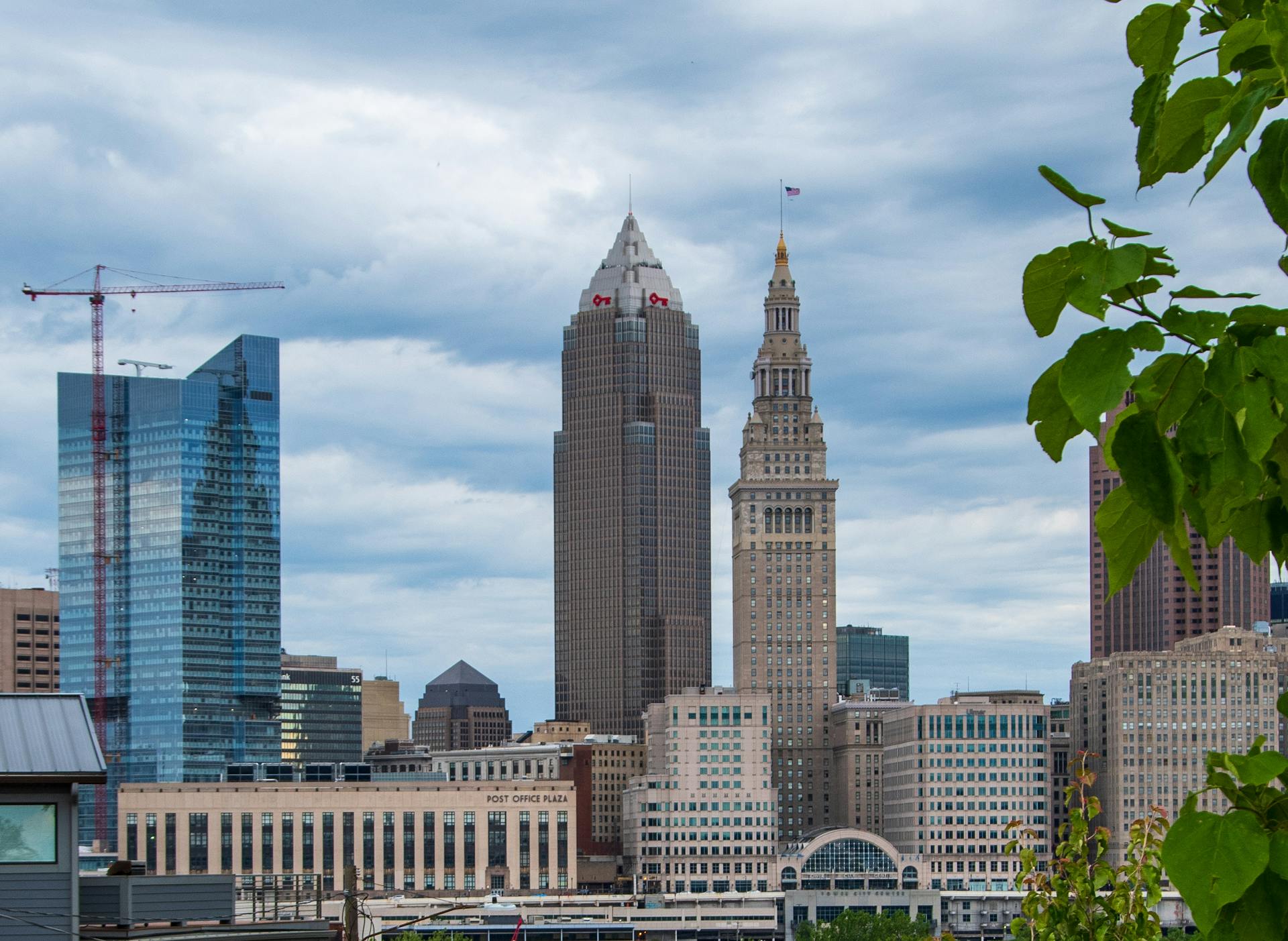
Cleveland-Cliffs has been on a mission to drive strategic growth and sustainability in the steel industry. The company has been expanding its operations through strategic acquisitions, including the acquisition of ArcelorMittal USA in 2021.
This move has significantly increased Cleveland-Cliffs' iron ore pellet production capacity, making it one of the largest pellet producers in North America. Cleveland-Cliffs has also been investing in digitalization and automation to improve operational efficiency and reduce costs.
The company's focus on sustainability is evident in its commitment to reducing greenhouse gas emissions and implementing environmentally responsible practices across its operations. Cleveland-Cliffs has set a goal to achieve net-zero emissions by 2050, a significant step towards a more sustainable future.
Worth a look: Cleveland Cliffs Nucor Us Steel Bid
Company Operations
Cleveland-Cliffs operates four main divisions: Steelmaking, Tubular, Tooling and Stamping, and European Operations.
The company has a significant presence in the steel industry, with eight blast furnaces and five electric arc furnaces (EAFs) located in various states across the US and Ontario.
It also operates finishing facilities in multiple states, including Kentucky, Indiana, Illinois, Ohio, Michigan, Pennsylvania, West Virginia, North Carolina, and Ontario.
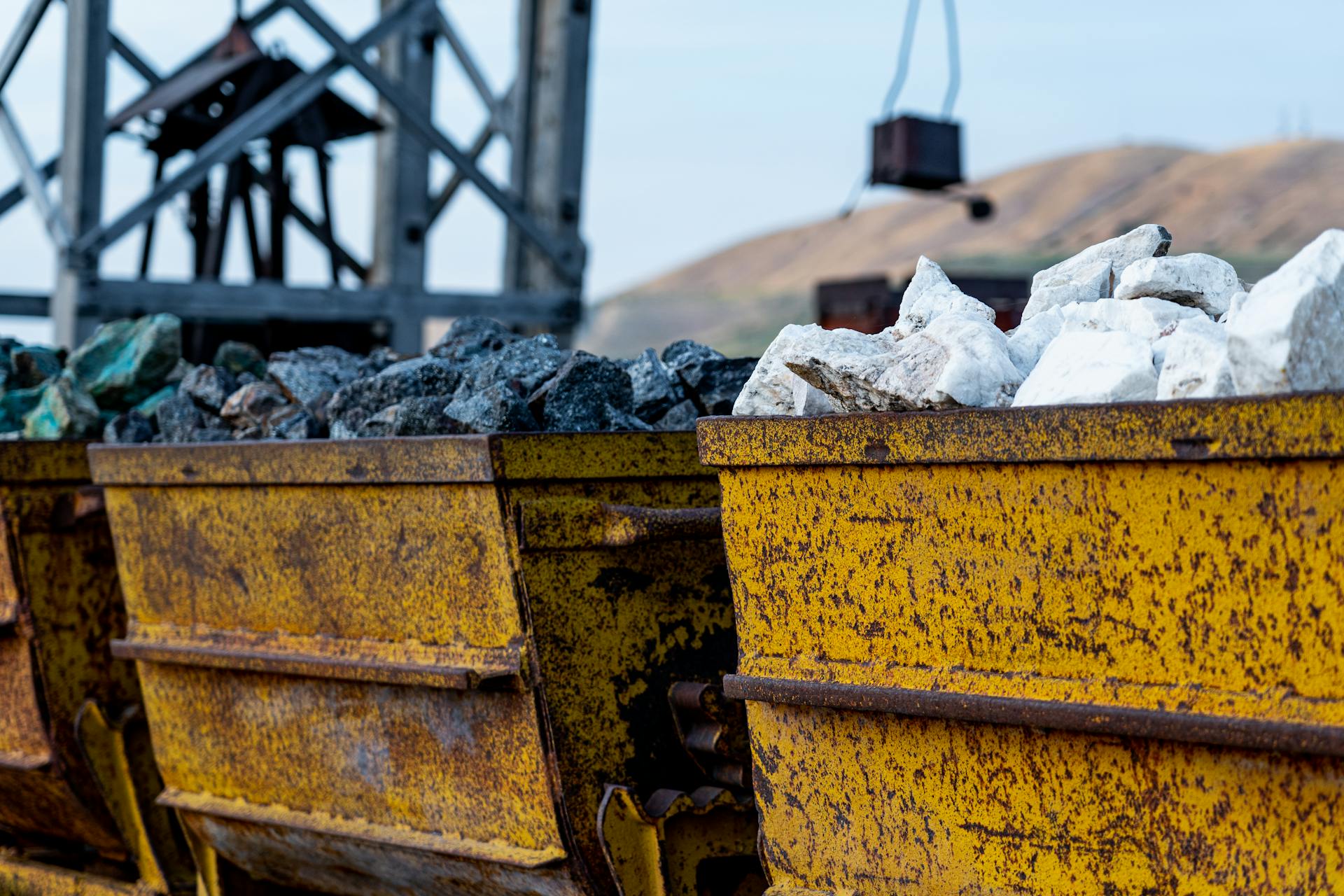
Cleveland-Cliffs manages and operates four iron ore mines in Minnesota and two mines in Michigan, one of which has been indefinitely idled.
The company produces various grades of iron ore pellets, including standard and fluxed, for use in blast furnaces, as well as direct reduced (DR) grade pellets for use in direct reduced iron (DRI) applications.
The majority of the pellets are transported by rail to loading ports for shipments via vessel to steelmakers in North America.
Cleveland-Cliffs operates a hot-briquetted iron (HBI) facility in Toledo, Ohio, which produces a form of DRI that can be used as an alternative to scrap iron.
The company also operates three coke-making facilities in Burns Harbor, Indiana, Monessen, Pennsylvania, and Warren, Ohio, with an annual capacity of 2.6 million tons.
In addition, Cleveland-Cliffs operates a coal mine in Princeton, West Virginia.
For more insights, see: Progressive Corporation Ohio
Financial Performance
Cleveland-Cliffs has undertaken aggressive cost-cutting measures to strengthen its balance sheet, idling six underperforming facilities that generated $300 million in annual savings.
The company's financial flexibility has improved significantly, with liquidity now standing at $2.7 billion and secured note capacity of $3.3 billion.
A $50 per ton reduction in steel unit costs for 2025 has also contributed to the company's improved financial performance.
This financial flexibility is crucial in the steel sector, where capital intensity and cyclical demand are persistent challenges.
Investment and Outlook
Cleveland-Cliffs' current valuation looks pretty attractive to investors, trading at a 7x 2026 EBITDA multiple, which is a discount to its historical average of 10x.
The company's liquidity and cost discipline are improving, which is a positive sign. However, a shift in U.S. trade policy could erode pricing power, making investors cautious.
The company has $2.7 billion in liquidity, which is a manageable amount, but its debt load remains a concern in a high-interest-rate environment.
Investment Implications and Strategic Outlook
Cleveland-Cliffs' current valuation appears compelling, trading at a 7x 2026 EBITDA multiple, which is a discount to its historical average of 10x.
This valuation is a result of the company's improving liquidity and cost discipline. However, caution is warranted as a shift in U.S. trade policy or a slowdown in automotive demand could erode pricing power.
A manageable debt load of $2.7 billion in liquidity is a concern in a high-interest-rate environment. Investors should monitor the sustainability of current tariffs and the pace of EV adoption.
Cleveland-Cliffs' dominance in the U.S. automotive steel market, with 36% of revenue, has helped the company insulate itself from short-term price swings through contractual agreements with automakers.
The contracts' fixed pricing structure mitigates the risk of margin compression typically accompanying cyclical downturns. This is a stark contrast to the company's previous reliance on one-year agreements.
While tariffs have provided a near-term tailwind, Cleveland-Cliffs' long-term success hinges on its ability to navigate structural risks, such as its reliance on blast furnace technology.
The company's vertical integration, spanning iron ore to finished steel, reduces exposure to raw material price swings, a key differentiator in a sector where input costs can erode margins.
Cleveland-Cliffs' focus on high-margin automotive and construction steel segments, less susceptible to price undercutting, mitigates the risk of global overcapacity.
You might like: Where to Stay near Cliffs of Moher?
Acquiring ArcelorMittal USA
Cleveland-Cliffs is acquiring ArcelorMittal USA for about $1.4 billion, a deal that will make the company North America's largest producer of both flat-rolled steel and iron ore pellets.
The acquisition includes five steelmaking plants, eight finishing plants, and two iron ore mines.
Cleveland-Cliffs has been a raw materials supplier for the ArcelorMittal plant in Cleveland for decades.
The company's CEO, Lourenco Goncalves, believes the purchase will benefit both companies and create a stronger entity.
Goncalves mentioned that the opportunity to combine the two companies has been there, but the current situation made it possible.
ArcelorMittal, the world's largest steel producer, has struggled during the pandemic, laying off 454 workers at its Cleveland plant in July.
The union representing workers at the Cleveland plant, United Steelworkers Local 979, is waiting to hear how the sale might affect local workers.
For more insights, see: Oregon Iron Company
Sustainability and Growth
Cleveland-Cliffs is making strides in sustainability, aiming to be climate positive by 2030. This ambitious goal is a significant step towards reducing the company's environmental footprint.
The company has already made progress in reducing its greenhouse gas emissions, specifically in Scope 1 and Scope 2, which are directly and indirectly related to their operations. They're on track to meet these targets.
Here's a breakdown of their sustainability targets:
- Cleveland-Cliffs Inc: Cleaner Steel
- Climate positive by 2030
- Scope 1: Achieved
- Scope 2: Achieved
- Scope 3: Not achieved
While they've made significant progress, there's still work to be done, especially in Scope 3, which includes emissions from their supply chain and customers.
Corporate News
Cleveland-Cliffs has been involved in a research project with funding from the U.S. Department of Energy, focusing on an initial phase of research.
The company is based in Cleveland and trades on the New York Stock Exchange under the ticker symbol CLF.
Cleveland-Cliffs has announced a price increase for its steel products, with a minimum hike of $100 per net ton.
This price increase applies to all carbon hot rolled, cold rolled, and coated steel products.
The company's research project is part of the Great Lakes Clean Hydrogen Partnership, a collaborative effort to advance clean hydrogen technology.
If this caught your attention, see: DuPont Central Research
Featured Images: pexels.com