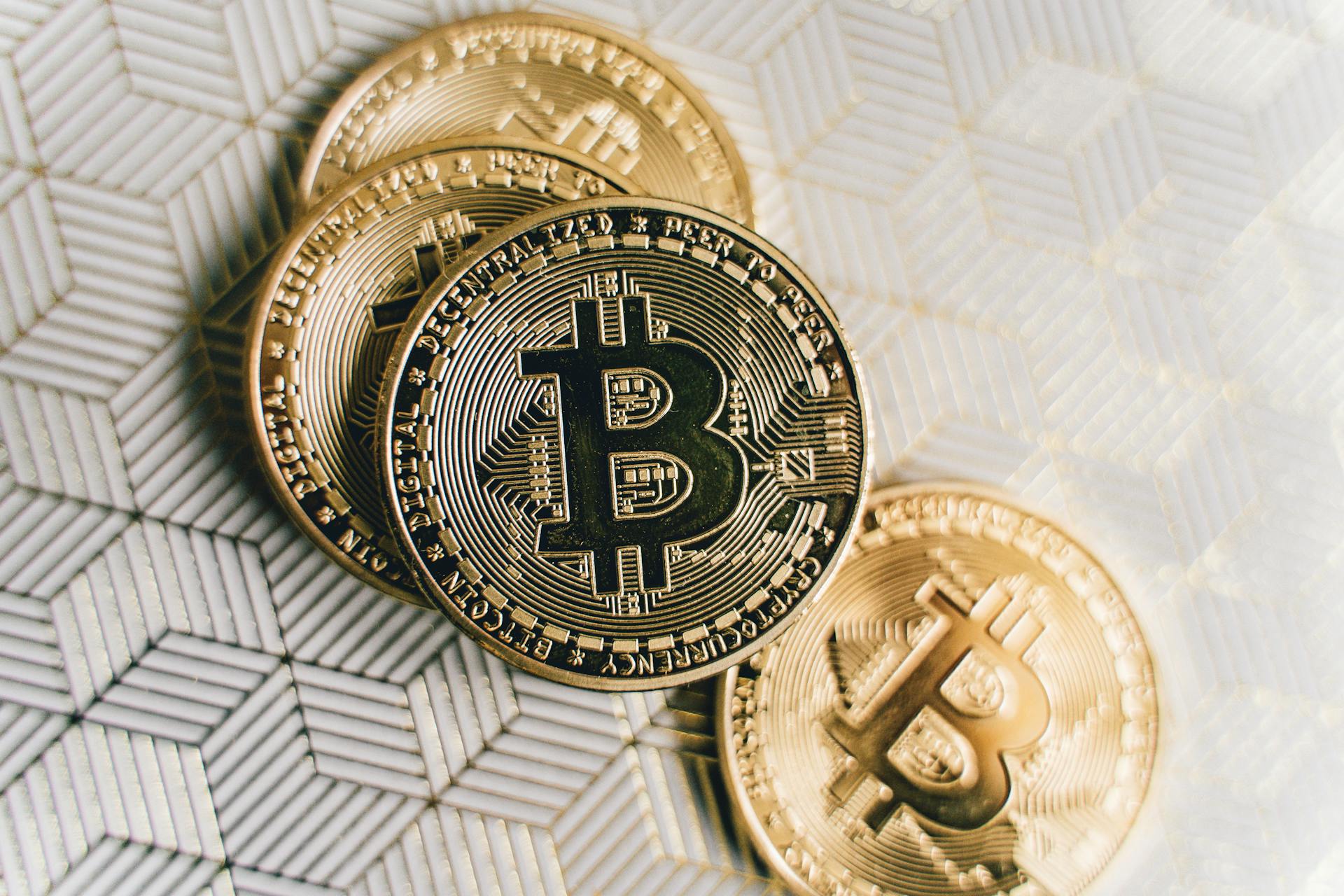
There's a finite number of Bitcoins in existence, capped at 21 million. This scarcity is a key factor in Bitcoin's value and appeal.
The total supply of Bitcoins is predetermined and cannot be increased. This limited supply is built into the Bitcoin protocol and is a fundamental aspect of the cryptocurrency's design.
As a result of this limited supply, the value of each Bitcoin can increase over time, making it a potentially attractive investment for some people.
Bitcoin Supply
Bitcoin's supply is capped at 21 million, a number hardcoded into the protocol by its creator, Satoshi Nakamoto.
This limited supply is a fundamental factor in Bitcoin's value, creating scarcity similar to precious metals like gold. It ensures that the value of Bitcoin is maintained, unlike fiat currency which can be printed without limits.
The current circulating supply of Bitcoin is 19,722,500 BTC, which is approximately 93.9% of the total supply. This means that 6.083% of the Bitcoin supply is still left to mine.
Bitcoin's mining reward decreases every four years through a process called halving, reducing the number of new Bitcoins created. As new Bitcoins become scarcer, their value increasingly depends on demand.
The number of Bitcoins in circulation will continue to increase after each block is mined, approximately every 10 minutes, with 3.125 BTC entering circulation. This will continue until Bitcoin reaches its maximum supply of 21 million tokens.
Here are some key figures to understand the current state of Bitcoin's supply:
The final Bitcoin is expected to be mined around 2140, marking the end of new Bitcoin creation.
Halving Mechanism
The halving mechanism is an essential feature of Bitcoin that regulates the issuance of new Bitcoins. It's a built-in feature that ensures a predictable and decreasing supply of new Bitcoins over time.
Every 210,000 blocks, the reward for miners is halved, which reduces the supply of new Bitcoins entering circulation by 50%. This process is known as the Bitcoin halving event.
A different take: Bitcoin Halving Cuts in Half the Reward for Mining Bitcoin.
The first Bitcoin halving event occurred in November 2012, after 210,000 blocks were mined, reducing the mining reward from 50 BTC to 25 BTC. This has been repeated every four years since then.
Here's a breakdown of the past Bitcoin halving events:
The next Bitcoin halving event is scheduled to occur in approximately 2028, after 1,050,000 blocks are mined, reducing the mining reward to 1.5625 BTC. This process will continue until the total supply of 21 million Bitcoins is reached, expected around 2140.
Mining and Decentralization
The Bitcoin network is decentralized, meaning a central bank or government doesn't control it. This is a unique feature that sets Bitcoin apart from traditional currencies.
Bitcoin transactions don't require third-party authorization, unlike traditional currencies that must go through banks and other intermediaries when transferred. This makes the Bitcoin network more inclusive, allowing anyone to help mine transactions.
To mine transactions, miners connect hardware to a device, which attempts to solve a complex equation. This equation is so complex that only a specialist device can solve it, taking about 10 minutes on average.
The equation is solved every 10 minutes, which is how new BTC tokens enter circulation. Miners receive a reward after each new block, which continues until the Bitcoin supply reaches 21 million tokens.
Here's a breakdown of the Bitcoin supply distribution:
- 50 BTC was the initial circulating supply when the first Bitcoin block was mined on January 3rd, 2009.
- The current circulating supply of Bitcoin is 19,722,500 BTC.
- This figure also refers to the number of Bitcoins that have been mined.
As a result, 100% of Bitcoin tokens in circulation were initially distributed to miners.
Mining and Supply
Approximately 19,722,500 Bitcoins have been mined as of February 2025, representing the total amount of Bitcoin introduced into circulation since the network's launch in 2009.
The circulating supply of Bitcoin is 19,722,500 BTC, which also refers to the number of Bitcoins that have been mined.
New Bitcoins are created at a rate of about 900 per day, resulting from the mining of 144 blocks per day, each containing 6.25 Bitcoins.
However, due to increased mining power, blocks are often mined in 9.5-minute intervals instead of the standard 10 minutes, slightly accelerating the supply growth.
Here's an interesting read: Does Pattern Day Trading Apply to Crypto
The next Bitcoin halving is predicted to occur around March 30, 2028, which will reduce the reward miners receive for adding new blocks to the blockchain.
The last Bitcoin is expected to be mined around the year 2140, coinciding with the final Bitcoin halving, marking the end of new Bitcoin creation as the protocol reaches its 21 million coin limit.
Here's a breakdown of the number of Bitcoins mined before the next halving:
- 167,283 blocks remain before the next halving
- The most recent bitcoin halving occurred on April 20, 2024, cutting the block reward from 6.25 BTC to 3.125 BTC
Once all 21 million Bitcoins are mined, miners will no longer receive block rewards for creating new blocks, but will continue to validate and secure Bitcoin transactions, earning compensation solely from transaction fees paid by users.
Halving Dates and Impact
The halving mechanism is a crucial aspect of Bitcoin's design, and it's essential to understand its impact on circulating Bitcoins.
Every 210,000 blocks, or approximately every four years, the Bitcoin halving event occurs, reducing the supply of new tokens entering circulation by 50%.
Related reading: Halving Event Bitcoin
The first halving event took place in November 2012, when the mining reward was reduced from 50 BTC to 25 BTC.
The most recent halving event occurred in April 2024, on block 840,000, reducing the mining reward to 3.125 BTC.
Here's a list of the halving events, including the date, number of blocks, new BTC per block, and total new BTC tokens:
The next halving event is scheduled for approximately 2028, on block 1,050,000, and will reduce the mining reward to 1.5625 BTC.
This predictable and fixed inflation rate is a key aspect of Bitcoin's design, providing clarity and certainty to its ecosystem.
Stolen and Unrecoverable Bitcoins
Stolen and unrecoverable Bitcoins pose a significant challenge to the crypto world. Approximately 970,000 Bitcoins have been stolen in major incidents, including the 2014 Mt. Gox hack that lost 850,000 BTC.
The risk of Bitcoins being lost or stolen will never go away, making Bitcoin a deflationary asset when it reaches the maximum supply. This is because no new tokens will enter the market, while the supply will keep declining with every stolen or lost token.
The largest Bitcoin wallet identified as belonging to a hacker contains over 80,000 BTC, worth around $5.4 billion at current rates. These tokens have remained idle since 2011, leading some to argue that they shouldn't be included in the circulating supply.
Stolen Bitcoins are often laundered before being cashed out, but advancements in blockchain forensics have made this increasingly difficult. Authorities and researchers can now trace transactions, making it harder for thieves to cash out without detection.
A significant portion of the total supply may never be recovered or used again, contributing to the overall scarcity of Bitcoin. This reduction in supply can potentially impact supply-and-demand dynamics.
Here's a breakdown of the estimated number of stolen Bitcoins:
Bitcoin Economy
The Bitcoin Economy is a fascinating topic. It's estimated that there are over 18 million bitcoins in circulation, with a total market capitalization of over $1 trillion.
The majority of these circulating bitcoins are held by individual investors, with some estimates suggesting that up to 80% of all bitcoins are held in personal wallets.
How Many Millionaires Were Created
In 2024, a study by Henley & Partners revealed that the number of cryptocurrency millionaires nearly doubled in the past year.
The report found that 172,300 individuals held more than $1 million in crypto assets.
Over 85,000 of these individuals were Bitcoin millionaires, benefiting from the rising value of Bitcoin.
Determining the exact number of Bitcoin millionaires is challenging due to the anonymous nature of the system.
A single individual can control multiple bitcoin wallets, making it difficult to assess unique ownership.
Most Interested Countries
India tops the list with over 75 million Bitcoin holders, representing 16.80% of its population.
The United States follows closely, with around 28 million holders and a well-established Bitcoin ecosystem.
Brazil, Indonesia, and Turkey also show high adoption rates, driven by economic factors and financial inclusion needs.
Bitcoin serves as a tool against inflation and currency instability in regions like Africa and Latin America.
These countries are among the most interested in Bitcoin, highlighting its growing role in diverse economies.
For your interest: Million Bitcoins
Bitcoin Availability and Trading
There are over 19.6 million Bitcoins in circulation, but not all of them are available for direct trading.
The number of available Bitcoins fluctuates at any given time because some investors hold onto their Bitcoin and only sell it when they want to trade.
Around 2 million Bitcoins are likely lost forever, which is about 10% of the total supply, according to Glassnode's 2020 estimate.
These lost Bitcoins still exist, but the owners may have no access to them due to factors like lost private keys or the death of owners without a crypto inheritance.
Bitcoin Limitations and End
Bitcoin's unique design ensures its value is maintained through a limited supply of 21 million coins. This scarcity is a deliberate feature, set by Satoshi Nakamoto, to prevent depreciation like fiat currency.
Satoshi Nakamoto's decision to limit the supply of Bitcoin has a significant impact on its value and stability. This is in contrast to other assets like gold or commodities, which can experience large fluctuations due to changes in supply.
Recommended read: Bitcoins Satoshi
The last Bitcoin is expected to be mined around 2140, coinciding with the final Bitcoin halving. This event will mark the end of new Bitcoin creation as the protocol reaches its 21 million coin limit.
Predicting the exact date of the last Bitcoin being mined is challenging due to various factors, including technological advancements and changes in mining power. However, it's clear that the process will take over 120 years.
Once all 21 million Bitcoins are mined, miners will no longer receive block rewards for creating new blocks. Instead, they will continue to validate and secure Bitcoin transactions, but their compensation will come solely from transaction fees paid by users.
You might enjoy: Where Are Bitcoins Mined
Featured Images: pexels.com