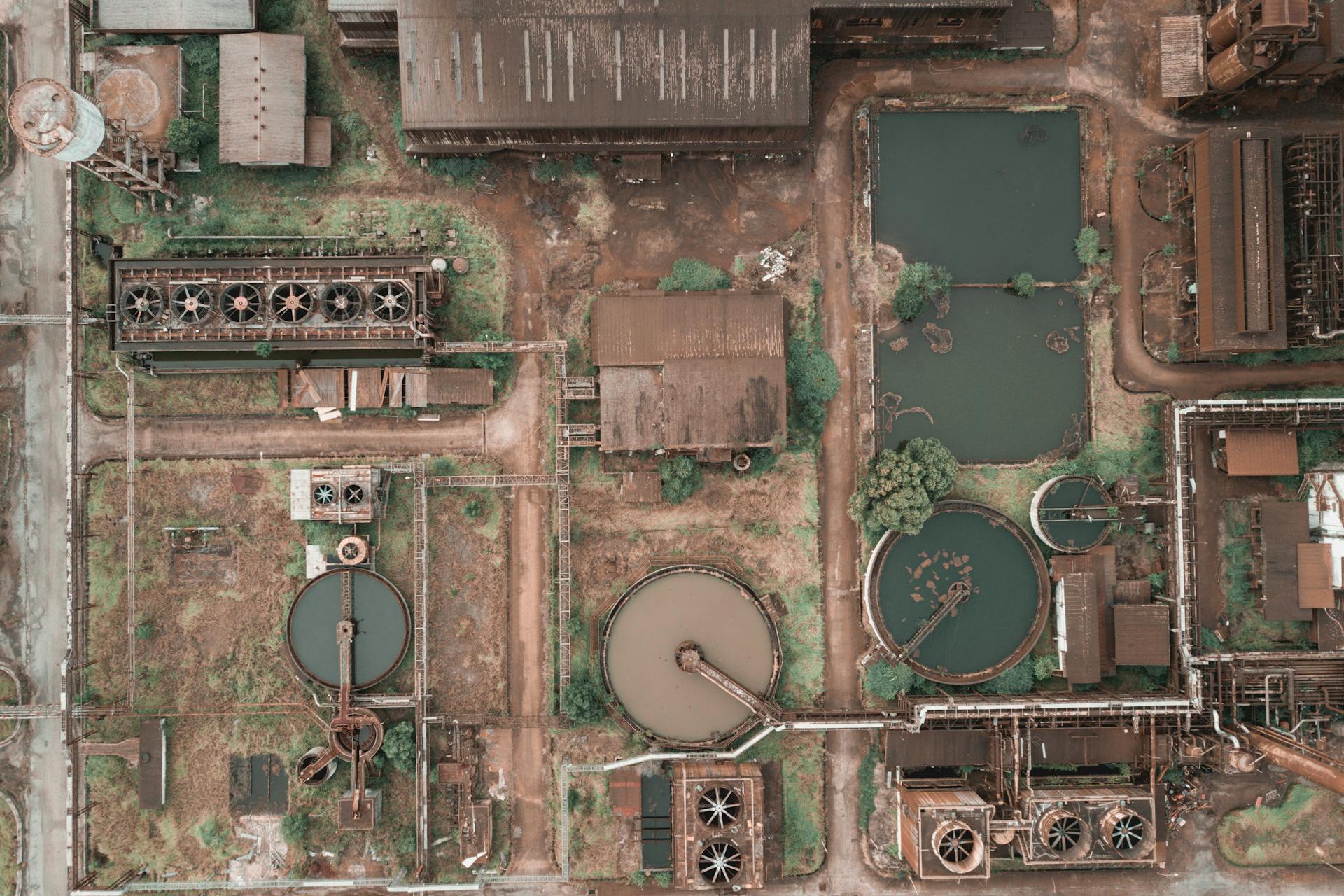
The Ciba Geigy Toms River Site has been a source of concern for many years. It was a chemical plant that operated from 1952 to 1990, releasing pollutants into the environment.
The site is located in Toms River, New Jersey, and has been linked to various health problems. In fact, a study found that residents who lived near the site were more likely to develop childhood leukemia.
Ciba Geigy, the company that owned the site, was responsible for the contamination. The company used chemicals such as dioxin and furans, which are known to be hazardous to human health.
The site was contaminated with high levels of dioxin, a toxic chemical that can cause a range of health problems.
Recommended read: Toms Fit Compared
Ciba-Geigy Corp
The Ciba-Geigy Corp site in Toms River, New Jersey, was owned and operated by the Ciba Specialty Chemicals Corporation, which was formerly known as Ciba-Geigy. The site encompasses approximately 1,400 acres, with 320 acres developed and the remainder consisting of cleared areas, pine barrens, and wetlands.
Expand your knowledge: Ciba Vision Company
From 1952 to 1990, Ciba-Geigy manufactured dyes, pigments, resins, and epoxy additives on the site. The company ceased pigments and dyestuffs manufacturing operations in 1988 and resins and epoxy manufacturing operations in December 1990. All commercial operations at the site ceased in December 1996.
Sludge and process wastes were disposed of in several locations on the site, including a stacked drum disposal area originally believed to contain approximately 35,000 drums and a 12-acre filtercake disposal area containing wastewater treatment plant sludge and process wastes. Wastewater treatment operations at the site contaminated several areas, including backfilled lagoons near the Toms River and two equalization basins.
Contamination from these areas and several others on site has leached into the groundwater, which flows east towards the Toms River and adjacent wetlands. Groundwater in the local area is tapped by municipal, industrial, and private wells.
Consider reading: Bay Area News Group
Settlement and Opposition
The settlement proposal for the Ciba Geigy Superfund site in Toms River has been met with opposition from residents and environmental groups. This is not surprising, given the site's history of polluting groundwater for decades.
The proposed settlement would give BASF, the current owner of the site, a nature preserve in exchange for cleaning up the site. However, many are questioning whether this is enough, considering the site's contamination is still not fully cleaned up.
A $13 million settlement was reached in 2002 for families affected by cancer caused by the site's pollution. However, new cases of childhood cancer are still being diagnosed each year.
The NJ Department of Environmental Protection (DEP) plans to offer BASF a settlement that includes the creation of a park and nature center at the site. But critics argue that this is not enough, considering the site's contamination is still not fully cleaned up.
The notorious toxic waste site was home to the manufacture of epoxy resins, pigments, industrial dyes, and plastics from 1952 until operations were shut down in 1996. Tens of thousands of toxic waste drums were stored at the site and wastewater was pumped into Toms River, a drinking water source for nearby residents.
The last public comment on the proposed settlement was accepted April 5, but many are calling for a delay in the settlement to investigate recent evidence of per-fluoro octanoic acid (PFOA) on the site.
Curious to learn more? Check out: S a Spurs News
Health and Environmental Concerns
The Ciba-Geigy site in Toms River has a long history of health and environmental concerns. Cancer cluster incidents have been documented, affecting the local community.
The site was once owned by Ciba-Geigy, but is now owned by BASF, a German chemical corporation that acquired it in 2009. Cleanups at Superfund sites like this one are ongoing processes that can last for generations.
The people of Ocean County have suffered from disease, death, and fear due to the site's pollution. The state of New Jersey has deemed the site ready for assessment of Natural Resource Damages, a process that allows the owner to compensate the local community and state for the damage done.
BASF has been granted a settlement that many experts and the public consider a sweetheart deal, allowing the company to escape further responsibility for the site. The settlement has been criticized for not providing legitimate compensation to the people of Toms River and Ocean County.
Consider reading: State of Michigan Municipal Bonds
The contaminants present at the site include various chemicals, but the exact types and amounts are not specified in the article section. Determining the human health or ecological effects of these contaminants is crucial to understanding the risks they pose.
A key step in assessing the site's risks is identifying people and ecological resources that could be exposed to contamination. This involves determining the amount and type of contaminants present, as well as their potential effects on human health and the environment.
The settlement has been criticized for only awarding the town of Toms River the woods over the polluted groundwater, rather than the 255 less polluted acres. This decision has sparked concerns about the fairness of the settlement and the lack of accountability from BASF.
See what others are reading: B P C L Share
Remediation and Current Status
Remediation efforts at the Ciba Geigy Toms River site began in earnest in 1989, when the EPA issued a Record of Decision (ROD) for Operable Unit 1 (OU1). The ROD described a selected groundwater remedy that included decommissioning irrigation wells and imposing restrictions on the installation of domestic wells.
The remedy also involved the on-site recharge of treated groundwater, which was achieved through the installation of extraction and recharge systems. These systems became fully operational in March 1996 and were optimized by 2014.
The groundwater treatment process, which began in 1996, uses a combination of Powdered Activated Carbon Treatment (PACT), clarification and separation, and Granular Activated Carbon (GAC) adsorption. This process has been effective in shrinking the plume of contaminated groundwater and reducing contaminant concentrations at its edges.
Here's a summary of the groundwater treatment process:
The current status of the site is positive, with groundwater samples indicating a shrinking plume and decreasing contaminant concentrations. However, the site is not yet ready for anticipated use, as one or more of the necessary criteria have not been met.
Remediation Techniques
Remediation Techniques involve selecting the right approach to clean up contaminated sites. The first Record of Decision (ROD) for OU1, signed on April 24, 1989, described the selected groundwater remedy.
The remedy included decommissioning irrigation wells near the site and imposing well restrictions to prevent installation of domestic wells in the plume. This was done in accordance with the Ocean County Board of Health regulations.
The EPA issued an Explanation of Significant Differences (ESD) on September 30, 1993, which eliminated the discharge to the Toms River and called for on-Site recharge of treated groundwater. The ESD also established standards for the treated water.
The groundwater treatment process involves Powdered Activated Carbon Treatment (PACT), clarification and separation of the sludge/carbon, and Granular Activated Carbon (GAC) adsorption. These systems became fully operational in March 1996 and were optimized by 2014.
The EPA uses two primary documents to identify changes to remedies: Record of Decision (ROD) Amendments and Explanation of Significant Differences (ESDs).
Current Status
The remediation efforts at this site have been ongoing for a while now, and it's great to see some progress being made. According to the groundwater samples, the plume of contaminated groundwater has shrunk, and contaminant concentrations at the edges of the plume have decreased.
The site investigation, which began in 1989 and finished in 1994, helped identify the extent and nature of contamination in the source areas. This information was crucial in developing a plan to excavate and treat about 150,000 cubic yards of contaminated soil.
Excavation and on-site bioremediation of contaminated soil is being considered as part of the optimization of the groundwater remedy. This approach aims to reduce the amount of contaminants in the soil and groundwater.
The physical construction of the cleanup is complete for the entire site, which is a significant milestone in the remediation process. However, the site is not yet ready for anticipated use, as one or more of the necessary criteria have not been met.
Here's a summary of the current status of the site:
Featured Images: pexels.com