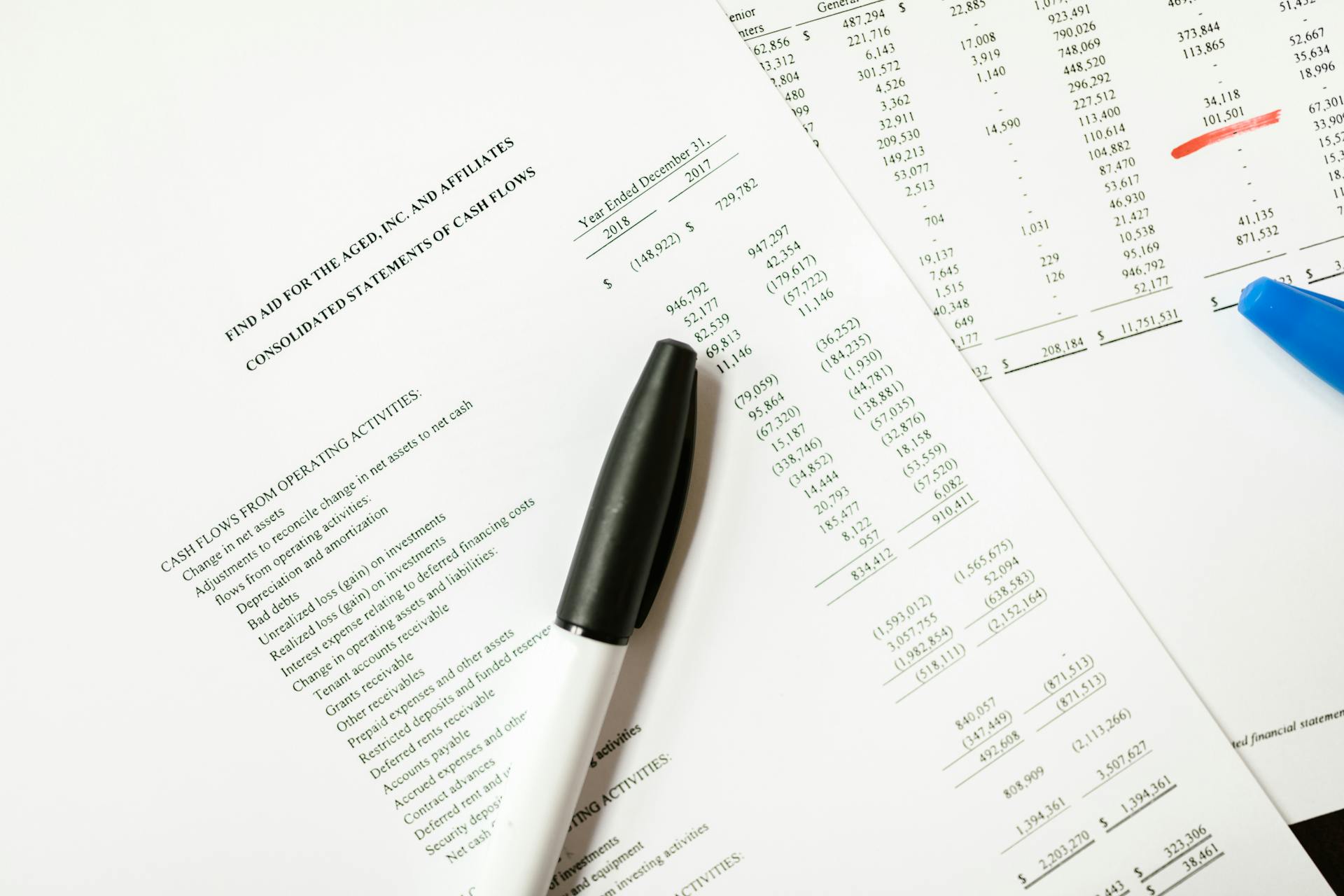
Managing cash and cash equivalents is crucial for any business or individual looking to maintain financial stability. Cash is the lifeblood of any operation, and having a solid understanding of how to manage it is essential.
Cash and cash equivalents are liquid assets that can be quickly converted into cash to meet financial obligations. Examples of cash equivalents include money market funds, commercial paper, and treasury bills.
Having a sufficient cash reserve is vital for paying bills, covering unexpected expenses, and taking advantage of business opportunities. A well-managed cash reserve can help you avoid financial stress and ensure the long-term sustainability of your business.
A different take: Mirae Asset Financial Group
What Is CCE?
Cash and cash equivalents (CCE) are a company's most liquid assets, which can be tapped into when needed to cover expected or unexpected expenses. These assets are typically found on a company's balance sheet.
The cash equivalents line item on the balance sheet includes cash on hand, as well as other highly liquid assets that can be readily converted into cash. Under U.S. GAAP and IFRS, these assets are considered liquid if they can be converted into cash within 90 days or less.
A unique perspective: Cash Balance Plan
To be classified as a cash equivalent, an asset must meet two primary criteria: it must be readily convertible into cash with a relatively known value, and it must have a short-term maturity date with minimal exposure to external factors.
Some examples of cash equivalents include short-term investments that mature in three months or less. These investments are considered low-risk and can be easily liquidated if needed.
Here are the two primary criteria for classification as a cash equivalent:
- Readily Convertible into Cash On-Hand with Relatively Known Value (i.e. Low-Risk)
- Short-Term Maturity Date with Minimal Exposure to External Factors (e.g. Interest Rates Cuts/Hikes)
Formally, U.S. GAAP defines cash equivalents as short-term, highly liquid investments that are readily convertible to known amounts of cash and that are so near their maturity that they present insignificant risk of changes in value because of changes in interest rates.
Key Concepts
Cash and cash equivalents are the most liquid assets a company has, making it easy to pay bills and manage finances. They're like a safety net that helps businesses stay afloat during tough times.
Cash includes physical money and bank account balances, which are easily accessible. You can think of it like having cash in your wallet or money in your checking account.
Cash equivalents, on the other hand, are short-term investments that can quickly be converted into cash. Examples of cash equivalents include government bonds, money market funds, and commercial paper.
Accurately tracking cash and cash equivalents is crucial for a company's financial health. It's like keeping track of your personal finances – you need to know where your money is going in and out.
Here are some common types of cash equivalents:
- Government bonds
- Money market funds
- Commercial paper
Assets like inventory and accounts receivable are not considered cash equivalents, because they're not as easily converted into cash.
On a similar theme: Apple Cash Not Showing up
Business Use
Cash and cash equivalents play a vital role in a business's financial health. A company can be extremely profitable, yet not have enough cash on hand to pay the bills.
Cash and cash equivalents should comfortably cover a company's immediate financial requirements, including wages, debt repayments, various invoices, and emergencies. Without cash on hand to pay for these expenses, the company would be forced to potentially sell long-term assets at a loss or otherwise struggle.
Check this out: Financial Asset
In fact, cash is king, as many investors often say. A company needs to maintain a sufficient level of cash and cash equivalents to pay its bills and meet its financial obligations.
According to Apple's balance sheet, the company held $30.3 billion in cash and cash equivalents on December 28, 2024, which is 1.2% more than three months earlier. This amount includes $27.1 billion from cash and the rest from money market funds, government bonds, CDs, commercial paper, and corporate bonds.
A healthy balance of cash and cash equivalents helps businesses meet short-term liabilities without facing liquidity issues. This is essential for liquidity management and covers a company's immediate financial requirements.
Here are some examples of cash and cash equivalents:
- Cash
- Commercial Paper
- Short-Term Government Bonds
- Marketable Securities
- Money Market Accounts
- Certificate of Deposit (CD)
These assets have high liquidity, meaning the owner could sell and convert them into cash quickly. They are included in the calculation of numerous measures of liquidity, such as the Cash Ratio, Current Ratio, and Quick Ratio.
A different take: What Is a Good Total Asset Turnover Ratio
Components and Calculation
Cash and cash equivalents are made up of various components, each with its own characteristics. Currency and coins are the most basic forms of cash.
Cash in checking accounts allows for easy writing of checks and electronic debit access. Petty cash, on the other hand, is a small amount of cash used for insignificant expenses, with varying minimum amounts depending on the organization.
Treasury bills are a type of security issued by the U.S. Department of Treasury, where their purchase lends money to the U.S. government. Commercial paper is another type of borrowing used by big companies, with a minimum amount of £100,000.
Marketable securities make businesses look more liquid, and they can be traded on public exchanges. Money market funds are similar to checking accounts but pay higher interest rates on deposited funds.
To calculate cash and cash equivalents, you can use the following formula: Cash and Cash Equivalents = Cash on Hand + Cash in Bank + Short-Term Investments (mature in 3 months or less).
Here's a breakdown of the components of cash and cash equivalents:
- Cash on hand: includes cash registers, petty cash, or other notes and coins
- Cash in bank: includes demand deposits
- Short-term investments: include treasury bills, commercial paper, short-term CDs, and money market funds that mature in 3 months or less
Types of CCE
Cash and cash equivalents (CCE) can be a bit tricky to understand, but essentially, they're assets that can be easily converted to cash.
Cash on hand, like an office's petty cash supply or a cash float in a register, is considered cash. This is the most liquid form of CCE, as it's readily available for immediate use.
Cash in the bank, including savings, checking, and money market accounts, is also considered cash. This is because you can access these funds quickly, usually within a day or two.
Short-term investments, such as treasury bills (t-bills), commercial paper, and Certificates of Deposits, can be easily converted to cash within a short time period, typically less than three months.
Money market funds are another type of CCE, as they invest in highly liquid short-term securities that provide returns in the form of dividends and can be easily converted to cash.
Some companies may also consider banker's acceptance, a short-term credit instrument guaranteed by a bank, as a CCE due to its immediate liquidity.
Discover more: Alternative Investments to Stock Market
Marketable securities, such as stocks and bonds, can be sold and converted to cash quickly, making them a type of CCE.
Overdraft protection, though technically a liability, can be classified as a CCE due to its immediate liquidity, providing a safety net for companies in case of unexpected expenses.
Here are the different types of CCE, categorized for easy reference:
- Cash:
- Cash on hand
- Cash in the bank (savings, checking, and money market accounts)
- Cash Equivalents:
- Short-term investments (treasury bills, commercial paper, and Certificates of Deposits)
- Money market funds
- Banker's acceptance
- Marketable securities (stocks and bonds)
- Overdraft protection
Exclusions and Restrictions
Restricted cash is a type of cash that's restricted for withdrawal and usage, often due to contracts or entity statements of intention.
For example, if a company receives an advance payment from a customer for a machine that needs to be produced and shipped within 2 months, the deposit must be put into a separate bank account and cannot be used for operations until the equipment is shipped.
Restricted cash can be classified as a current asset if it's expected to be used within one year after the balance sheet date, but it's considered a non-current asset if it's restricted for a longer period.
Broaden your view: Apple Cash Account Restricted

Some assets are excluded from cash and cash equivalents, including long-term investments, bank overdrafts, accounts receivable, inventory, prepaid expenses, post-dated checks, and certificates of deposit with long maturity.
Restricted cash and compensating balances are reported separately from regular cash if the amount is material, and are disclosed and reported as either a current asset or a long-term asset.
Here are some examples of assets that are not considered cash or cash equivalents:
- Long-term investments
- Restricted cash
- Bank overdrafts
- Accounts receivable
- Inventory
- Prepaid expenses
- Post-dated checks
- Certificates of deposit (CDs) with long maturity
- Investments in equity securities
- Convertible debt
Financial Impact
Cash and cash equivalents have a significant impact on a company's financial stability.
Having sufficient cash reserves can help a business avoid debt and maintain a healthy cash flow.
According to our previous discussion, a company's cash and cash equivalents can make up to 20% of its total assets.
Take a look at this: Asset Management Company Financial Statements
Liquidity Measurement Ratios
Liquidity Measurement Ratios are a crucial aspect of evaluating a company's financial health. A higher Current Ratio is generally considered better for an organisation, as it indicates that current assets are available to cover current liabilities.
For your interest: Current Asset

The Current Ratio is calculated by dividing Current Assets by Current Liabilities. For example, if a company has $100,000 in current assets and $50,000 in current liabilities, its Current Ratio would be 2.
The Quick Ratio is a more conservative measure of liquidity, which excludes inventories and other assets that are difficult to convert into cash. This ratio is calculated by dividing the most liquid current assets by Current Liabilities.
Here are the three liquidity measurement ratios:
- Current Ratio = Current Assets / Current Liabilities
- Quick Ratio = (Current Assets - Inventories) / Current Liabilities
- Cash Ratio = Cash and Cash Equivalent / Current Liabilities
The Cash Ratio is the most restrictive of the three, as it only considers cash and cash equivalents as available to pay off current debt.
Financial Modeling
In financial modeling, it's essential to consider the liquidity of long-term investments. Long-term investments can be grouped together with cash and cash equivalents if they are marketable securities that can be sold in the open market without a significant loss in value.
For example, Apple's financial model includes both short-term and long-term marketable securities in the cash and cash equivalents line item. This is because the drivers of the cash and investments roll-forward schedules are identical, meaning they have the same net impact on the ending cash balance.
The key to accurate financial modeling is understanding the drivers of cash and investments. By considering the liquidity of long-term investments, you can make more informed decisions about how to group and analyze financial data.
For your interest: Asset/liability Modeling
Disclosures and Controls
Disclosures of cash and cash equivalents are a crucial part of financial statements, providing stakeholders with a clear understanding of a company's liquidity and financial position. This includes cash and cash equivalents, which are typically reported on the balance sheet.
Cash and cash equivalents are usually classified as current assets, but can be classified as long-term assets if designated for specific purposes, such as a plant expansion project. Petty cash funds, for example, are classified as cash because they are used to meet current operating expenses.
In financial statements, cash and cash equivalents are typically reported together, but restricted cash items should be included on the balance sheet and separated in the notes to the financial statements. This is illustrated in the example of Orange Inc.'s balance sheet, which reports cash and cash equivalents as $18,050 and $12,652 respectively at December 31, 2020 and 2019.
Effective internal control of cash is also essential for reliable recognition, measurement, and reporting of cash transactions. This includes implementing internal controls over the physical custody of cash, separation of duties regarding cash, and maintaining adequate cash records.
Expand your knowledge: Cash Assistance Card Balance
Disclosures

Disclosures are an essential part of financial reporting, and when it comes to cash and cash equivalents, there are specific requirements to keep in mind.
Cash and cash equivalents are disclosed on the balance sheet, and this includes unrestricted cash, bank accounts, and negotiable instruments. Petty cash funds are also included in the cash balance, even if they're set aside for a specific purpose.
The balance sheet for Orange Inc. shows cash and cash equivalents as $18,050 at December 31, 2020, and $12,652 at December 31, 2019. This is a significant increase, indicating the company's financial health.
Restricted cash items are included on the balance sheet, but detailed explanations are provided in the notes to the financial statements. This is crucial for transparency and accountability.
Here's a breakdown of what's included in cash and cash equivalents:
- Cash
- Bank accounts funds and deposits
- Negotiable instruments such as money orders, certified cheques, cashiers’ cheques, personal cheques, bank drafts, and money market funds with chequing privileges
- Petty cash funds
On the other hand, the following items are excluded from cash and cash equivalents:
- Post-dated cheques from customers and IOUs (informal letters of a promise to pay a debt)
- Travel advances granted to employees
- Postage stamps on hand
Internal Control
Internal control is a crucial aspect of effective financial management. It's designed to protect assets, ensure reliable recognition, measurement, and reporting, promote efficient operations, and encourage compliance with company policies and practices.
The purpose of internal control is multifaceted: it protects assets, ensures reliable recognition, measurement, and reporting, promotes efficient operations, and encourages compliance with company policies and practices.
Effective internal control involves implementing measures to control the physical custody of cash, including adequate levels of authority required for all cash-based transactions and activities. This is essential for protecting assets.
Separation of duties regarding cash is also a key aspect of internal control. This means that no single person should have complete control over cash handling.
Maintaining adequate cash records, including petty cash and regular bank reconciliations, is another critical component of internal control. This helps ensure that cash transactions are accurately recorded and reported.
A robust financial reporting system is also vital for reliable and timely information about a company's cash position. This can be achieved by consolidating bank accounts, converting idle cash into less accessible commercial paper, and implementing a financial reporting system that provides reliable and timely information about the cash position.
Here are the key components of internal control:
- Protecting assets
- Ensuring reliable recognition, measurement, and reporting
- Promoting efficient operations
- Encouraging compliance with company policies and practices
Comparison and Improvement
Cash and cash equivalents are crucial for businesses to manage their finances effectively. Knowing the difference between the two is essential to make informed decisions.
Cash is considered highly liquid and can be used instantly, making it accessible for any kind of payment or transaction. It's the most easily usable asset a company possesses.
Cash equivalents, on the other hand, are short-term, highly liquid investments that can be quickly converted into cash. They must meet two key criteria: being highly liquid and having a short maturity period of three months or less.
Assets like treasury bills, commercial paper, and some Certificates of Deposits (CDs) are considered cash equivalents. These investments can be converted into cash with minimal loss in value.
To improve cash flow management, businesses should focus on getting on top of their cash and cash equivalents. This means knowing what kinds of liquid assets they have on hand to service debts and pay their short-term liabilities.
Broaden your view: How Much Cash on Hand Does Apple Have
Here are some key differences between cash and cash equivalents:
By understanding the characteristics of cash and cash equivalents, businesses can make more informed decisions about their finances and improve their cash flow management.
Calculating and Managing
Calculating and managing cash and cash equivalents is a straightforward process. You can calculate the change in cash and cash equivalents by subtracting the beginning of year value from the end of year value.
To do this, you'll need to know the end of year cash and cash equivalents and the beginning of year cash and cash equivalents. The formula for this is: Change in CCE = End of Year Cash and Cash Equivalents - Beginning of Year Cash and Cash Equivalents.
Calculating the value of cash and cash equivalents at the end of a period is also important. This can be done by adding the net cash flow to the value of cash and cash equivalents at the beginning of the period.
If this caught your attention, see: Calculating Incremental Cash Flows
To calculate the total cash and cash equivalents, you'll need to add up three types of assets: cash on hand, cash in bank, and short-term investments. Cash on hand includes cash registers, petty cash, and other notes and coins. Cash in bank includes demand deposits. Short-term investments include treasury bills, commercial paper, short-term CDs, and money market funds.
Here's a simple formula to calculate the total cash and cash equivalents:
Cash and Cash Equivalents = Cash on Hand + Cash in Bank + Short-Term Investments (mature in 3 months or less)
To get the total, simply add up the values of these three types of assets.
Improving cash flow management is critical for businesses, and knowing what kinds of liquid assets you have on hand is key. This includes knowing what your cash and cash equivalents are.
On a similar theme: Types of Cash Flows in Cash Flow Statement
Featured Images: pexels.com