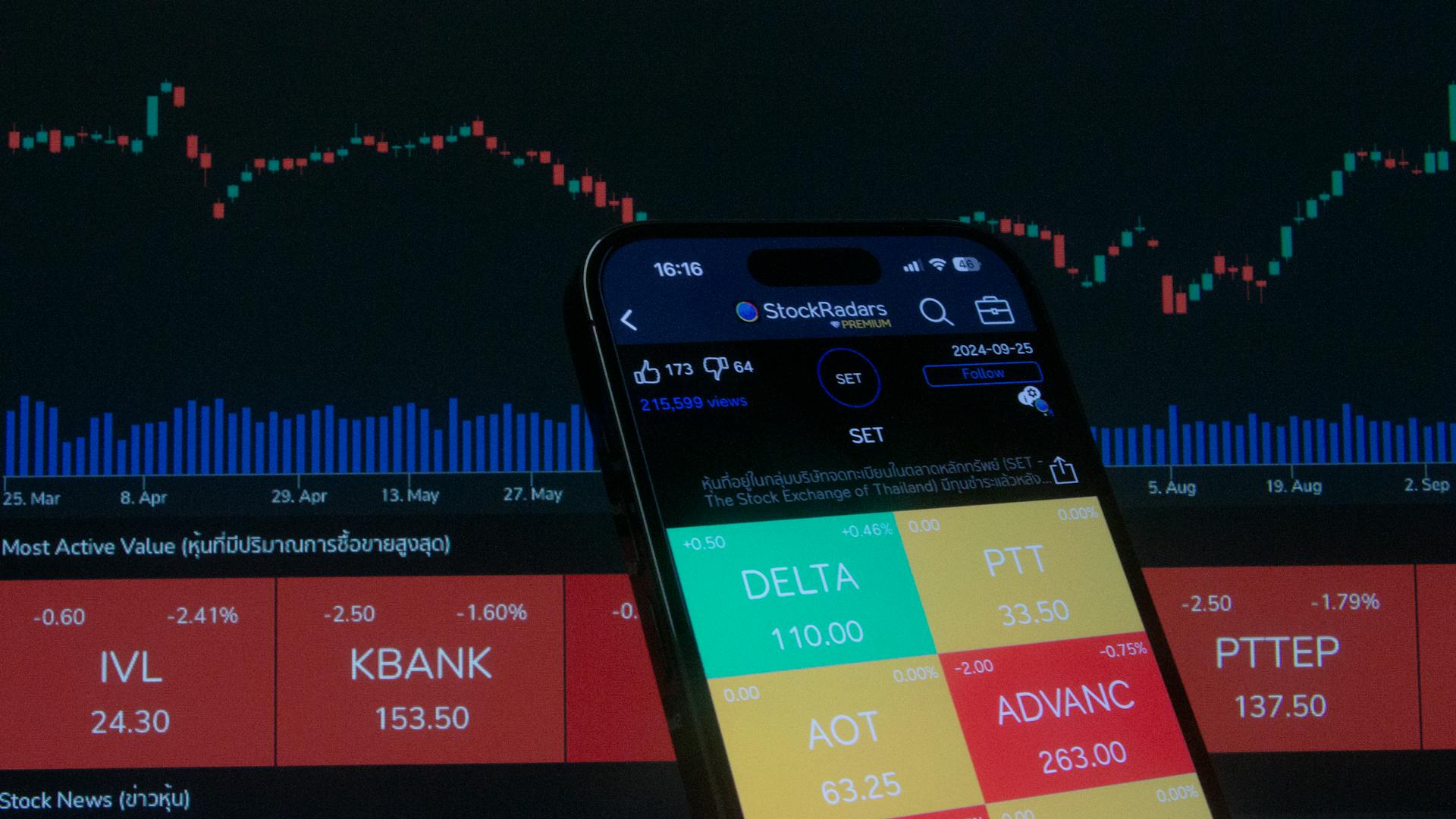
The CAC 40 Index is one of the most widely followed stock market indices in the world, specifically tracking the performance of the 40 largest and most liquid companies listed on the Euronext Paris stock exchange.
It's calculated using a market capitalization-weighted methodology, meaning the more valuable a company is, the greater its influence on the index.
The CAC 40 Index is reviewed quarterly by the index provider, Euronext, to ensure it remains representative of the French market, and companies are added or removed accordingly.
The CAC 40 Index has been in existence since 1987 and has become a benchmark for French and European investors alike.
Here's an interesting read: Euronext Dublin
What Is the CAC 40?
The CAC 40 is a benchmark index for funds investing in the French stock market. It gives a general idea of the direction of the Euronext Paris, the largest stock exchange in France.
The CAC 40 represents a capitalization-weighted measure of the 40 most significant values among the 100 highest market caps on the exchange. It's similar to the Dow Jones Industrial Average in that it's the most commonly used index to represent the overall level and direction of the market in France.
The index includes companies like L'Oreal, Renault, and Michelin, which are among the 40 largest equities listed on the Euronext Paris in terms of liquidity. These companies are considered significant players in the French market.
An independent steering committee reviews the CAC 40 index composition quarterly.
Here's an interesting read: List of Companies Listed on Euronext Dublin
Trade the Index
You can trade the CAC 40 index using exchange-traded funds (ETFs) or CFDs.
One of the most popular ETFs that follow the CAC 40 is the Lyxor ETF CAC 40. Other options include the EasyETF CAC 40, Amundi ETF CAC 40, DBXT CAC 40, and ComStage ETF CAC 40.
Trading the CAC 40 index is popular among traders because it's one of the most liquid stock market indices in the world. This means that the market fluctuates very quickly, presenting you with the opportunity to buy and sell the index in the short term.
Some of the reasons why traders get exposure to the CAC 40 include the Paris Stock Exchange's fixed opening and closing time, which enables you to identify trends and patterns. You can also use fundamental analysis to understand price movements before making a prediction.
You can distribute risk by trading the CAC 40 index instead of a single company stock. This is because the CAC 40 index is a basket of top 40 France-based companies, including L'Oreal, Renault, and Michelin.
You might like: Desventajas De La Caja Popular Mexicana
Here are some of the benefits of trading the CAC 40 index:
- The Paris Stock Exchange has a fixed opening and closing time, enabling you to identify trends and patterns.
- You can use fundamental analysis to understand price movements before making a prediction.
- You can distribute risk by trading the CAC 40 index instead of a single company stock.
To trade the CAC 40 index, you can choose how you want to trade it, open a CFD live account or practice on a demo, take steps to manage your risk, and place your deal and monitor your position.
CAC 40 Data and History
The CAC 40 has seen some impressive growth over the years, with a 10-year increase of +73.70%. This is a significant rise, and it's no wonder that investors are taking notice.
Looking at the historical data, we can see that the CAC 40 has consistently increased over the past 10 years, with some notable fluctuations along the way. The 1-year increase is +7.33%, while the 3-year increase is +34.68%.
Here's a breakdown of the CAC 40's performance over the past decade:
In the last 5 days, the CAC 40 has seen a variation of +3.19%, with the highest closing price being €8,239.67 and the lowest being €8,151.35.
A fresh viewpoint: What Credit Cards Use Fico Bankcard Score 8
Historical Data
Historical data is a crucial aspect of understanding the CAC 40, and it's fascinating to see how the market has performed over time. The data shows that the CAC 40 has experienced significant growth, with a 34.68% increase over the past 3 years.
Looking at the 1-year performance, we can see that the CAC 40 has gained 7.33% in value. This is a relatively modest increase, but it's still a positive trend. In contrast, the 10-year performance is much more impressive, with a 73.70% increase in value.
Here's a table summarizing the CAC 40's performance over different time periods:
The CAC 40 has also shown some volatility in the short term, with a 3.19% increase over the past 5 days. This is a relatively small increase, but it's still a positive trend.
Indices Internationaux
Indices Internationaux are a crucial part of the global financial landscape, and several prominent indices are worth mentioning.
For more insights, see: Dow Jones Sustainability World Index Djsi
The Euro Stoxx 50, for example, is a widely followed index that tracks the performance of the 50 largest and most liquid stocks in the Eurozone.
Here are some of the most notable international indices:
- Euro Stoxx 50
- S&P 500
- FTSE 100
- Ibex 35
- SBF 120
- AEX
These indices provide a snapshot of the overall health of their respective markets and are closely watched by investors and analysts.
CAC 40 Companies and Index
The CAC 40 Companies and Index are made up of some of the biggest names in France, including LVMH, L'Oreal, Hermès, TotalEnergies and Sanofi. These five companies are just a few of the 40 that make up the index.
The CAC 40 index is reviewed every quarter by an independent committee, which means the ranking can change based on the current value of the companies' turnover from the previous 12 months and their overall market capitalisation.
Most of the companies listed on the CAC 40 are France-based corporations, but the index has a significant number of multinational stocks, with around 45% of the listed stocks owned by foreign investors.
The Paris Stock Exchange has a fixed opening and closing time, which allows traders to identify trends and patterns and get exposure to the market.
Some of the reasons why traders get exposure to the CAC 40 include:
- The Paris Stock Exchange has a fixed opening and closing time.
- The CAC 40 is the easiest way to take a position on the French market.
- You can distribute risk by trading the CAC 40 instead of a single company stock.
The CAC 40 index is tracked by 3 ETFs, which allow investors to benefit from price gains and dividends of the CAC 40 constituents.
Trading and Investing in CAC 40
Trading and investing in CAC 40 can be done through various exchange-traded funds (ETFs), such as Lyxor ETF CAC 40, EasyETF CAC 40, Amundi ETF CAC 40, DBXT CAC 40, and ComStage ETF CAC 40.
These ETFs offer a convenient way to gain exposure to the CAC 40 index, which is one of the most liquid stock market indices in the world. The CAC 40 index is popular among traders due to its high liquidity and quick market fluctuations.
You can also trade the CAC 40 index using contracts for difference (CFDs), which allow you to speculate on the price rising or falling without taking ownership of the underlying asset. This can be done through a CFD trading account.
To trade the CAC 40 index, you'll need to choose how you want to trade it, open a CFD live account or practice on a demo, take steps to manage your risk, and place your deal and monitor your position.
Some of the reasons why traders get exposure to the CAC 40 index include the Paris Stock Exchange's fixed opening and closing time, which enables you to identify trends and patterns, and the CAC 40 index being the easiest way to take a position on the French market.
Here are some of the top 40 France-based companies that make up the CAC 40 index: L'Oreal, Renault, Michelin.
You can trade individual stocks that make up the CAC 40 index, which can provide more targeted exposure to specific companies. This can be done through a CFD trading account or by trading CAC 40-linked fund shares.
Worth a look: Financial Position of the United States
CAC 40 ETFs
The CAC 40 ETFs are a popular way to invest in the French stock market. They allow you to gain exposure to the 40 largest and most liquid stocks listed on the Euronext Paris exchange.
You can trade CAC 40 ETFs using a CFD trading account, which gives you access to a wide range of markets and assets through a single point of entry. Alternatively, you can trade CAC 40 ETF-linked fund shares using a derivative product.
The total expense ratio (TER) of CAC 40 ETFs is between 0.20% p.a. and 0.25% p.a., which is significantly lower than most actively managed funds.
The best CAC 40 ETF by 1-year fund return as of 31.12.24 is the Amundi CAC 40 UCITS ETF Acc, with a return of 0.68%. However, the Xtrackers CAC 40 UCITS ETF 1D is the cheapest, with a TER of 0.20% p.a.
Here are the top 3 CAC 40 ETFs ranked by fund size:
To make an informed decision, it's essential to consider factors beyond just return, such as fund size, cost, age, use of profits, fund domicile, and replication method.
CAC 40 Charts and Facts
The CAC 40 Index is the most important stock benchmark for French equities. It contains the 40 largest stocks listed on the Euronext Paris stock exchange that are particularly important for the French economy.
The market capitalisation of the free float determines the weighting, similar to most other stock indices. This means that the size of each company's free float influences its share of the overall index.
ETF investors can benefit from price gains and dividends of the CAC 40 constituents.
Related reading: Currency French Guiana
Chart 1 Year
The CAC 40 Chart 1 Year shows a significant fluctuation in stock prices over the past year.
The CAC 40 index has experienced a range of 6,500 to 7,200 points during this period.
The chart reveals a notable dip in October 2022, where prices dropped by over 1,000 points.
However, the CAC 40 has consistently recovered and even surpassed its previous highs.
In fact, by the end of the year, the index had reached a new high of 7,200 points.
This remarkable recovery can be attributed to the resilience of the French economy and the efforts of investors.
The Index Factsheet
The CAC 40 Index is the most important stock benchmark for French equities. It's a key indicator of the French economy's performance.
The CAC 40 Index contains the 40 largest stocks listed on the Euronext Paris stock exchange. These stocks are crucial for the French economy.
The market capitalisation of the free float determines the weighting of the index. This is similar to most other stock indices.
ETF investors can benefit from price gains and dividends of the CAC 40 constituents. This is a great opportunity for those investing in the CAC 40.
You might like: French Polynesian Franc
CAC 40 Selection and Holdings
The CAC 40 index composition is reviewed quarterly by an independent Index Steering Committee, with any changes taking effect at least two weeks after the review meeting.
The top 100 companies on Euronext Paris are ranked according to free float market capitalisation and share turnover over the prior 12 months, from which 40 are chosen to enter the CAC 40.
The CAC 40 is a benchmark for portfolio management and a suitable underlying asset for derivatives products, with only the most actively traded class of shares being accepted into the index.
Foreign investors own about 45% of the listed shares in the CAC 40, with German, Japanese, American, and British investors being amongst the most significant holders.
The large percentage of foreign ownership is due to the fact that CAC 40 companies are more international, with over two-thirds of their business and workforce outside of France.
Selection
The CAC 40 index composition is reviewed quarterly by an independent Index Steering Committee. This committee makes changes to the index, which are effective a minimum of two weeks after the review meeting.
The review process involves ranking companies listed on Euronext Paris according to their free float market capitalisation and share turnover over the prior 12 months. The top 100 companies in this ranking are then considered for inclusion in the CAC 40.
Companies with more than one class of shares traded on the exchange are only accepted into the index if the most actively traded of these shares is the ordinary share. This ensures that the index includes the most liquid and actively traded shares.
The CAC 40 is designed to be a relevant benchmark for portfolio management and a suitable underlying asset for derivatives products.
Holders
The CAC 40 is a unique market, and its ownership structure reflects its global nature. About 45% of its listed shares are owned by foreign investors.
One of the most significant foreign investor groups is German investors, who hold a substantial portion of CAC 40 shares.
Many CAC 40 companies are multinational, with over two-thirds of their business conducted outside France.
This international focus is also reflected in their workforce, with over two-thirds of employees based outside France.
Investors from the United States, Japan, and the United Kingdom are also major holders of CAC 40 shares.
The fact that CAC 40 companies are so international makes them attractive to foreign investors.
Discover more: Paid outside Closing
CAC 40 Markets and Returns
The CAC 40 has experienced significant fluctuations in its annual returns since 1969. The index has seen a 16.52% increase in 2023, marking a notable recovery from the 9.50% decline in 2022.
The CAC 40 has consistently shown resilience in the face of market downturns. For example, in 2008, the index plummeted by 42.68% due to the global financial crisis, but it managed to recover by 22.32% in 2009.
Here's a brief overview of the CAC 40's annual returns since 1969:
The CAC 40 has also achieved record values in recent years. The closing high was reached on May 15, 2024, at 8,239.99, while the intraday high was achieved on May 10, 2024, at 8,259.19.
Markets
The CAC 40 has experienced significant fluctuations over the years, with some notable highs and lows. The index has been in operation since 1969, and its value has changed dramatically since then.
The CAC 40 has closed at its highest value of 8,239.99 on May 15, 2024, and reached an intraday high of 8,259.19 on May 10, 2024. This demonstrates the volatility of the market.
The CAC 40 has seen a steady increase in value over the past few years, with a notable jump in 2023, where it rose by 1,069.42 points, or 16.52%. This growth is a testament to the resilience of the market.
Here's a breakdown of the CAC 40's annual returns from 1969 to 2024:
Annual Returns
The CAC 40 has a long history, dating back to 1969. The index started at 334.12 points in 1969 and has been steadily increasing ever since.
The CAC 40 experienced a significant decline in 1970, with a drop of 23.64 points, or 7.08%. This was followed by a slight recovery in 1972, with a gain of 49.05 points, or 17.14%.
Here's a breakdown of the CAC 40's annual returns:
Frequently Asked Questions
Is CAC 40 open?
The CAC 40 market index is open Monday to Friday from 9am to 5:30pm CET. Constituents of the CAC 40 index trade during these regular hours.
How is CAC 40 calculated?
The CAC 40 is calculated by multiplying the number of shares of each constituent by its last closing price and then dividing by a dynamic index divisor. This divisor is adjusted based on the index's initial capitalization and base level.
Featured Images: pexels.com