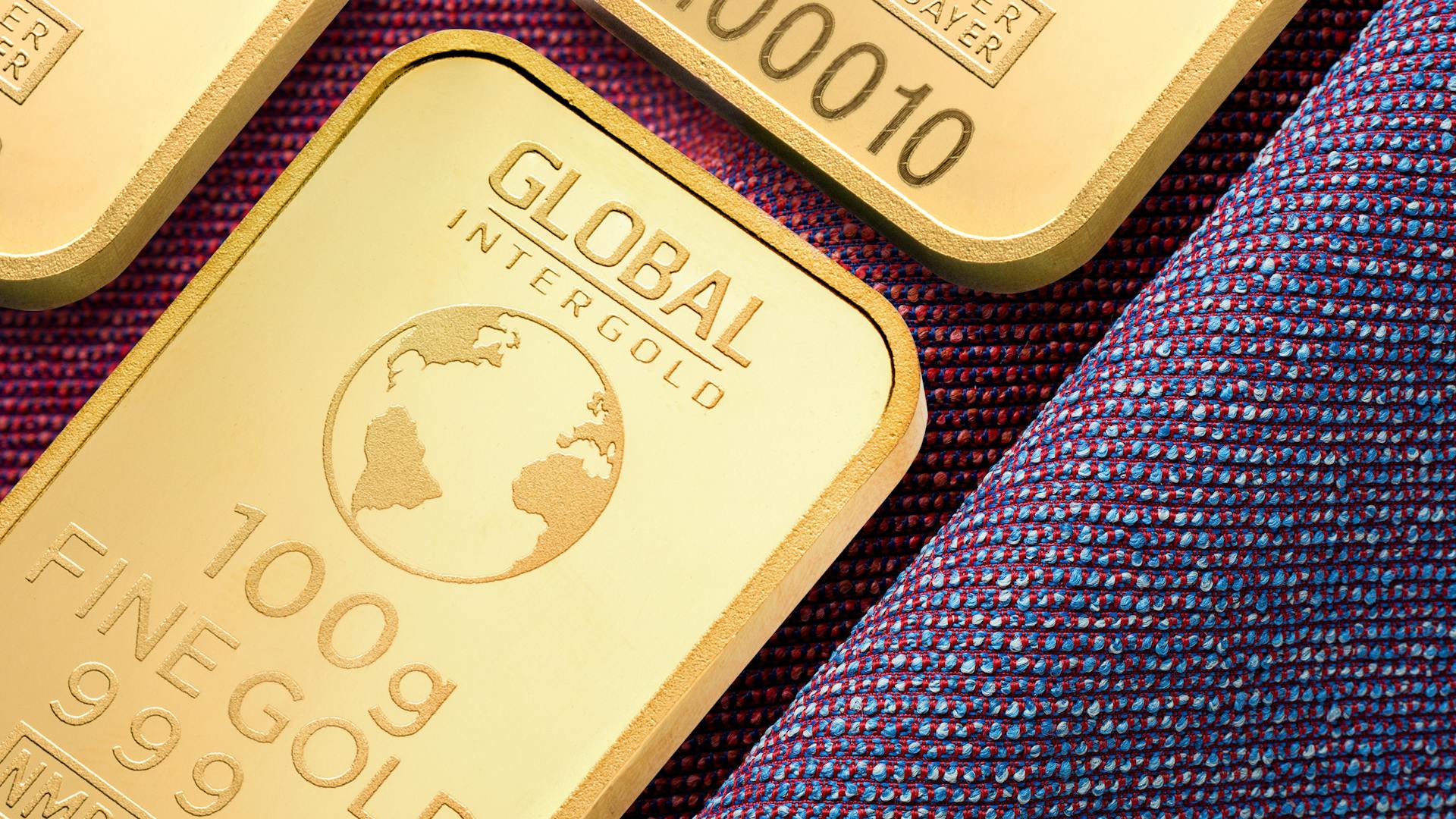
Buying gold as an investment for long-term wealth is a solid choice. It's a tangible asset that can provide a hedge against inflation and market volatility.
Gold has historically performed well during times of economic uncertainty, with a 70% increase in value between 2008 and 2011. This makes it an attractive option for investors looking to diversify their portfolios.
One key benefit of buying gold is its ability to retain its value over time. In fact, gold has maintained its purchasing power for centuries, with its value remaining relatively stable despite fluctuations in currency values.
Investing in gold can be done through various methods, including buying physical gold coins or bars, or investing in gold exchange-traded funds (ETFs).
Why Invest in Gold
Gold has a proven track record for returns, liquidity, and low correlations, making it a highly effective diversifier.
Gold has outperformed stocks and bonds over certain stretches, though it doesn’t always beat them, and its track record shows much lower returns over time.
Curious to learn more? Check out: How to Track Gold Prices
To diversify your portfolio, consider allocating 5% to 10% of your assets to gold, or up to 15% in times of crisis.
Gold is largely immune to inflation, and its value tends to appreciate during economic slowdowns, such as the Great Depression and the COVID-19 pandemic.
Investing in gold can be a smart way to protect your wealth from inflation, economic disaster, and market volatility.
Here are some key benefits of investing in gold:
- Returns: Gold has outperformed stocks and bonds over certain stretches.
- Liquidity: Gold-based assets, such as ETFs, can be easily converted to cash.
- Low correlations: Gold often performs differently from stocks and bonds.
- Diversification: Gold can help reduce portfolio volatility.
- Defensive store of value: Gold can protect your wealth during economic downturns.
Investing in gold can be done in two main ways: physical gold (bullion) or gold securities (stocks, funds, and futures).
Types of Gold Investments
There are several types of gold investments to consider, each with its own set of benefits and drawbacks. One option is physical gold, such as coins or bars, which can be bought directly from a dealer and stored at home or with a custodian.
Physical gold can be a tangible and secure way to invest in gold, but it requires storage and can be subject to markups and commissions. You can buy coins or bars from a dealer, and some governments even issue gold coins for investors.
Suggestion: How Do I Become a Gold Dealer
If you don't want to deal with physical gold, you can consider gold ETFs, which track the price of gold and offer a more convenient and practical way to invest. Gold ETFs can be traded like stocks and offer the benefits of owning physical gold without the hassle of storage.
Some of the largest gold ETFs include SPDR Gold Shares (GLD), iShares Gold Trust (IAU), and abrdn Physical Gold Shares ETF (SGOL), with expense ratios of 0.4 percent, 0.25 percent, and 0.17 percent, respectively, as of September 2024.
You can also consider gold mining stocks or gold mutual funds, which offer a more diversified and lower-risk way to invest in gold. Gold-backed ETFs tend to invest directly in physical gold, while mutual funds favor gold mining stocks.
Here are some popular gold ETFs and mutual funds:
These funds offer a liquid and low-cost entry into the gold market, making them a great option for more conservative investors.
Coins and Bars
Gold coins and bars are the most common ways to invest in gold, and they're a great option for those who want to own physical gold. You can buy coins or bars from a trusted dealer and store them safely.
The prices of gold coins and bars are based on their gold content, also known as their "melt value", plus a 1-5% premium. This means that the price you pay for a gold coin or bar is a bit higher than the value of the gold it contains.
Some popular types of gold coins include the American Gold Eagle, Australian Gold Nugget, Canadian Maple Leaf, and South African Krugerrand. These coins are widely recognized and traded, making them a good choice for investors.
You can also buy gold bars, which come in a range of sizes, from 1g to 1kg or more. While large bars are often associated with high costs, smaller bars like the 1g or 5g bar can be a more affordable option for beginners.
For more insights, see: Union Bank of Switzerland Gold Bar
Markups and commissions on physical gold sales can be high, and you may also have to pay sales tax on the purchase. Additionally, storing physical gold can be a challenge, as you'll need to keep it safe from theft, fire, or natural disasters.
Here are some popular gold bullion coins:
- American Gold Eagle
- Australian Gold Nugget
- Canadian Maple Leaf
- South African Krugerrand
It's essential to ensure that any coins or bars you purchase meet your preferred purity standards. You can store your gold at home, but this comes with risks, or you can store it with a custodian, which may incur a storage fee.
Investing in Securities
Investing in securities can be a great way to add gold to your portfolio. You can buy shares in gold-oriented mutual funds or exchange-traded funds (ETFs). These funds have varying investment approaches, but they all offer a liquid, low-cost entry into the gold market.
Some funds invest in both physical gold and gold mining stocks, while others focus on one or the other. For example, gold-backed ETFs tend to invest directly in physical gold, while mutual funds favor gold mining stocks. It's essential to consider your investment goals and risk tolerance before choosing a fund.
Consider reading: Nickel Etfs
Gold securities offer several advantages, including liquidity, compounded returns, and low initial investment. You can buy and sell gold securities easily, without the need for storage costs. Additionally, gold securities can provide returns through dividends and appreciation in share price.
Here are some popular gold ETFs:
- SPDR Gold Shares (GLD)
- iShares Gold Trust (IAU)
- abrdn Physical Gold Shares ETF (SGOL)
- VanEck Gold Miners ETF (GDX)
- iShares MSCI Global Gold Miners ETF (RING)
These ETFs track the price of gold, offering a convenient and practical way to invest in the precious metal. They also provide a way to diversify your portfolio, as gold often performs differently from stocks and bonds.
Advantages of Physical Gold
Physical gold offers several advantages that make it a popular choice among investors. Gold is a tangible asset that maintains an intrinsic value reflecting the cost of living.
One of the benefits of physical gold is that it acts as an inflation hedge. As Juan Carlos Artigas, global head of research at the World Gold Council, notes, gold has a proven track record for returns, liquidity, and low correlations, making it a highly effective diversifier.
Gold also serves as a counterweight to stocks, usually moving in the opposite direction of the stock market. In fact, when the subprime mortgage meltdown began in 2008, gold shot up to $1,000 per ounce and continued to rise for three years.
Physical gold is also seen as a safe haven in uncertain times or socio-political turmoil. After the 2016 Brexit vote, its price rose over 10% in one month. Owning gold appeals to individuals concerned about the collapse of global markets or other threats to a government's ability to back its currency.
Gold is virtually indestructible. As Charles Stevens, COO of Bullion Box Subscriptions, notes, "Physical gold cannot be hacked or erased." A natural disaster cannot destroy gold and will not get worn down in time.
Here are some key benefits of physical gold:
- Inflation hedge: Gold maintains an intrinsic value reflecting the cost of living.
- Counterweight to stocks: Gold moves in the opposite direction of the stock market.
- Safe haven: Gold is seen as a safe haven in uncertain times or socio-political turmoil.
- Virtually indestructible: Physical gold cannot be hacked or erased.
Investment Strategies
Investing in gold can be a smart way to diversify your portfolio, especially during times of economic uncertainty. This is because gold tends to appreciate in value when the rest of the stock market falls.
Gold's low correlation to traditional assets makes it a potential hedge against systemic risk. Proponents say it can act as a safeguard against major losses in other financial assets.
Financial advisors recommend keeping anywhere from 5% to 10% of your portfolio in gold, and up to 15% in times of crisis. This can help protect your investments and provide a safety net during economic downturns.
If this caught your attention, see: Regal Assets Gold Ira
Futures
Futures can be a good way to speculate on the price of gold rising or falling. You can even take physical delivery of gold if you want, but that's not what motivates most speculators.
The biggest advantage of using futures to invest in gold is the immense amount of leverage you can use. You can own a lot of gold futures for a relatively small sum of money.
Leverage cuts both ways, though - if gold moves against you, you'll be forced to put up substantial sums of money to maintain the contract or your broker will close the position and you'll take a loss.
A unique perspective: How to Buy Gold Futures
The futures market is generally for sophisticated investors, and you'll need a broker that allows futures trading. Not all major brokers provide this service.
Investors who use leverage can make a lot of money quickly if gold prices move in their favor, but they can also lose it just as quickly if the trend reverses.
Leverage is also an integral part of trading gold derivatives and unhedged gold mining company shares. This can increase investment gains, but it also increases the corresponding risk of capital loss.
Broaden your view: Short Term Gold Trading
Investing Strategies
Investing in gold can add alternative assets to your portfolio, but you need to consider your portfolio strategy and what makes sense for your investing objectives.
Gold miner ETFs can give you exposure to the biggest gold miners in the market, offering the advantages of owning individual miners with the safety of diversification. The expense ratios on funds like VanEck Gold Miners ETF and iShares MSCI Global Gold Miners ETF are relatively low, ranging from 0.39 to 0.52 percent.
On a similar theme: Direxion Daily Gold Miners Index Bull 2x Shares
Not all funds are created equal, though, and some have established miners while others have junior miners, which are more risky. You should do your own research and consider the risks before investing in a fund.
There are many ways to add gold to your portfolio, including buying physical gold coins or bars, which can be a lower barrier to entry due to their smaller size and lower cost. However, you'll need to store them safely to avoid theft or damage.
Investing in gold can help diversify your portfolio and protect you against economic disaster, as it tends to appreciate in value during economic slowdowns. It's a good idea to keep around 5-10% of your portfolio in gold, especially in times of crisis.
Using leverage can increase your investment gains, but it also increases the risk of capital loss if the trend reverses. It's essential to be cautious when using leverage and to understand the risks involved.
To invest in gold, you'll need to know more than just the price, including the spot price and any fees associated with buying or storing physical gold.
You might enjoy: Gold Miner Etf
Pros and Cons of Gold Investments
Buying gold as an investment can be a smart move, but it's essential to consider the pros and cons. One of the main advantages of gold is its ability to act as a hedge against inflation and economic disaster.
Gold has a proven track record for returns, liquidity, and low correlations, making it a highly effective diversifier. It's also a defensive store of value, as investors often retreat to gold when they perceive threats to the economy.
Here are some key benefits of gold investments:
- Hedge against inflation
- Counterweight to stocks
- Less volatile than many stocks or bonds
- Physical durability
However, gold investments also come with some drawbacks. Physical gold can be expensive to hold, and storing it at home carries enormous risks of theft or loss. Additionally, physical gold does not produce income or profit, and its value can fluctuate significantly.
In contrast, gold securities can be more liquid and earn dividends, but they also come with volatility and systematic risks. Ultimately, the decision to invest in gold should be based on a thorough understanding of its benefits and drawbacks, as well as your individual financial goals and risk tolerance.
Pros of Gold Investments
Gold investments have several pros that make them an attractive option for diversifying your portfolio. Some advisors recommend keeping 5% to 10% of your portfolio in gold, and up to 15% in times of crisis.
Gold is largely immune to inflation, instead hewing closely to the cost of living. This means that even if the economy is experiencing high inflation, gold's value will remain relatively stable.
Gold can also serve as a hedge against economic disaster. During economic slowdowns, such as the Great Depression and the COVID-19 pandemic, gold has historically appreciated in value.
One of the main advantages of gold is its ability to act as a counterweight to stocks. When stocks are performing poorly, gold tends to do well, and vice versa.
Here are some of the key pros of gold investments:
- Hedge against inflation
- Counterweight to stocks
- Less volatile than many stocks or bonds
- Physical durability
Physical gold, in particular, offers several advantages. It can be used as an inflation hedge, as its value reflects the cost of living. It's also a safe haven in uncertain times, and its physical durability makes it virtually indestructible.
Overall, gold investments offer a range of benefits that can help diversify your portfolio and protect your wealth.
Cons of Gold Investments
Gold investments, like any other investment, come with their fair share of drawbacks. One of the main cons is that physical gold can be expensive to hold, with storage costs ranging from 0.5% to 2% of its value.
Storing gold at home is a risk, as it can be stolen or lost, and even using a professional storage facility incurs ongoing charges.
Physical gold is also illiquid, meaning it can't be sold quickly or easily. In fact, selling physical gold can take days or even weeks to settle.
Physical gold doesn't generate any income or profit, so if you invest $1,000 in gold, you'll only get back $1,000 – no interest or dividends.
Here are some of the key cons of gold investments:
- Risky asset to hold
- Illiquid
- Does not produce income or profit
Gold securities also have their drawbacks, including volatility, which can be influenced by factors such as a miner's operating costs and management. In fact, if bullion sinks 10%, gold stocks often plummet 15%.
Systematic risks, such as political and economic conditions in a mining company's native country, can also impact the performance of gold securities. This can be a concern for socially responsible and institutional investors.
You don't own gold when you invest in gold securities – you only have the right to redeem them for the actual metal in rare cases.
How to Buy Gold
If you're considering buying gold as an investment, you have several options for purchasing physical gold. Physical gold comes in many forms and sizes, each with its own characteristics and costs.
You can buy gold coins, which are a popular choice among investors due to their portability and collectibility. Gold coins can be stored at home, in a safe deposit box, or at a secure facility.
There are various types of gold coins available, including the American Gold Eagle and the Canadian Gold Maple Leaf. Each coin has its own unique features and mintage limits, which can impact its value.
Ultimately, the best way to buy gold will depend on your individual financial goals and preferences.
Buy Timing
Buying gold can be a smart move, especially during times of economic uncertainty. The price of gold tends to move in opposition to the stock market, making it a good hedge against a recession or financial crisis.
It's essential to know when to buy gold to maximize its value. Buying gold when a recession or financial crisis is looming may not be the best strategy, as demand tends to shoot up in such moments, depleting gold reserves faster than they can be refilled.
Consider buying gold when things have calmed down, at least temporarily – the eye of the storm, so to speak. This may be a better time to jump in, as the long-term outlook for gold remains good.
Check this out: When Should I Buy Gold
Find a Dealer
If you're looking to buy gold, you'll need to find a dealer. Your regular brokerage or financial services firm probably doesn't deal in gold.
Bullion is typically only sold at banks and gold dealers. Banks often offer lower markups than dealers, so it's a good idea to try purchasing from a bank first.
A unique perspective: Why Are Central Banks Buying Gold
You may not always find the exact coins or size bars you're looking for at a bank, so if you do turn to a dealer, be sure to do your research. Look closely at online ratings in trade journals and sites to find a reputable dealer.
Checking the dealer for complaints is also a good idea. Don't be afraid to shop around and compare different dealers to find the best one for your needs.
Storage Plan
You'll want to have a storage plan for your gold to ensure it's protected. Stashing large amounts of gold in your home leaves you vulnerable to theft.
Consider insuring your gold, as this can provide an added layer of protection. The IRS mandates that gold can be stored with a metals-specialist custodian through a gold IRA.
You can also locate an off-site storage location where your gold will be safe. This is a good option if you're concerned about storing gold at home.
If you choose to store your gold in an IRA account, you'll need to work with a metals-specialist custodian.
Curious to learn more? Check out: Ira Gold Storage
Gold vs Other Investments
Gold has an emotional attachment that can make it different from other investments, with some advisors recommending it as a way to add diversification to a traditional portfolio of stocks and bonds.
Gold's low correlation to traditional assets can potentially act as a hedge against systemic risk, especially during periods of stress in stock and bond markets. This is because gold often performs differently from stocks and bonds, meaning when they go up, gold may go down or vice versa.
Some benefits of gold include its proven track record for returns, liquidity, and low correlations. Gold has outperformed stocks and bonds over certain stretches, though it doesn’t always beat them, and its track record shows much lower returns over time.
Here are some key benefits of gold:
- Returns: Gold has outperformed stocks and bonds over certain stretches
- Liquidity: Gold-based assets like ETFs can be readily converted to cash
- Low correlations: Gold often performs differently from stocks and bonds
It's worth noting that gold's high volatility can make it a less stable investment compared to stocks and bonds. In the long-term, a dollar invested in gold in 1801 would be worth just 78 cents by 1998, compared to a dollar invested in bonds that would be worth nearly a thousand dollars and a dollar invested in stocks that would be worth more than half a million dollars.
A different take: Gold Stock Etf
Versus Stocks
Gold and stocks are often pitted against each other as different investment vehicles. Gold is regarded as a store of value, whereas stocks are seen as a return on value.
The value of gold bullion has been compared to the Dow Jones Industrial Average since 1800, and stocks have consistently gained value in comparison to gold. This is partly due to the stability of the American political system.
The ratio of the Dow Industrials to gold has fluctuated over time, with long periods of stock outperformance followed by long periods of gold outperformance. The ratio peaked at 41.3 in January 2000 and has fallen sharply since.
In the long-term, gold's high volatility means it doesn't hold its value compared to stocks and bonds. To put this into perspective, a dollar invested in stocks in 1801 would be worth over half a million dollars in real terms by 1998, while a dollar invested in gold would be worth just 78 cents.
The performance of gold and stocks is influenced by various factors, including political stability and turmoil. The attached graph shows the value of the Dow Jones Industrial Average divided by the price of an ounce of gold, highlighting the cyclical nature of their relationship.
A unique perspective: Is Gold a Good Long Term Investment
Stocks
Stocks can be a more practical choice than bullion, especially for novice investors, as they offer a more convenient way to invest in gold.
Gold's performance is often compared to stocks, with some viewing gold as a store of value and stocks as a return on value.
Since 1800, stocks have consistently gained value in comparison to gold, partly due to the stability of the American political system.
The ratio of the Dow Jones Industrial Average to the price of an ounce of gold has fluctuated over the years, peaking at 41.3 in January 2000 and falling sharply since.
Investing in gold stocks can be a way to play the gold market, with about 300 companies listed on major stock exchanges.
The growth and return in gold stocks depend on the expected future earnings of the company, not just on the value of gold.
Over the long-term, gold's high volatility when compared to stocks and bonds means that gold does not hold its value compared to stocks and bonds.
A dollar invested in bonds in 1801 would be worth nearly a thousand dollars by 1998, while a dollar invested in gold in 1801 would be worth just 78 cents by 1998.
You might enjoy: Gold Us Dollar Coins
Understanding Gold Prices
Gold has been a popular investment choice for centuries, and its price can fluctuate significantly over time. In 1970, the gold price was $37 per ounce, whereas by 2010, it had risen to $1,410 per ounce, a staggering increase of 3,792%.
The London gold fixing, a twice-daily telephone meeting of representatives from five bullion-trading firms, has been the most common benchmark for the price of gold since 1919. This system helps to establish a standard price for gold that is widely recognized around the world.
The price of gold is influenced by a range of factors, including supply and demand, speculative demand, and changes in sentiment. According to the World Gold Council, annual mine production of gold is around 2,500 tonnes, with about 2,000 tonnes going into jewelry, industrial and dental production, and around 500 tonnes going to retail investors and exchange-traded gold funds.
The huge quantity of gold stored above ground, estimated to be around 158,000 tonnes, means that changes in annual production have a relatively small impact on the price of gold. Instead, the price is mainly affected by changes in market sentiment, which can result in significant price swings.
Here's a rough breakdown of the gold price versus various assets and key statistics at five-year intervals:
Frequently Asked Questions
What is the most profitable way to buy gold?
For aggressive investors, buying gold futures can be a highly efficient way to invest, but it's essential to understand the risks involved, including sharp price fluctuations.
Featured Images: pexels.com