
The Business Model Canvas is a game-changer for entrepreneurs and small business owners. It's a comprehensive business planning tool that helps you visualize and organize your business model in a single canvas.
This tool was created by Alexander Osterwalder and Yves Pigneur, two experts in business model innovation. Their work has been widely adopted by businesses and organizations around the world.
The Business Model Canvas consists of nine building blocks that outline the key elements of your business. These building blocks are: Key Partners, Key Activities, Key Resources, Value Proposition, Customer Relationships, Channels, Customer Segments, Revenue Streams, and Cost Structure.
Consider reading: Building Credit as a Foreign Entrepreneur
What is the Business Model Canvas?
The Business Model Canvas is a powerful tool for entrepreneurs and intrapreneurs. It gives you the structure of a business plan without the overhead of a traditional plan.
The Canvas has nine elements that work together to provide a clear view of a business' key drivers. These elements are:
Customer Segments: Who are the customers? What do they think? See? Feel? Do?Value Propositions: What's compelling about the proposition? Why do customers buy, use?Channels: How are these propositions promoted, sold and delivered? Why? Is it working?Customer Relationships: How do you interact with the customer through their 'journey'?Revenue Streams: How does the business earn revenue from the value propositions?Key Activities: What uniquely strategic things does the business do to deliver its proposition?Key Resources: What unique strategic assets must the business have to compete?Key Partnerships: What can the company not do so it can focus on its Key Activities?Cost Structure: What are the business' major cost drivers? How are they linked to revenue?
The Business Model Canvas delivers three key benefits: focus, flexibility, and transparency. By using the Canvas, you can strip away the unnecessary clutter of a traditional business plan and get straight to the heart of what drives your business.
Here's an interesting read: Value at Risk Modeling
Components and Structure
The business model canvas is a powerful tool for entrepreneurs and business owners to visualize and design their business models. A key aspect of the canvas is its structure, which is based on Osterwalder's 2004 thesis and his 2010 book Business Model Generation.
Osterwalder's canvas consists of nine boxes, which are the building blocks of a business model. These boxes are organized in a specific way to help entrepreneurs and business owners think critically about their business.
Here are the nine boxes of the business model canvas:
- Customer segments
- Value propositions
- Channels
- Customer relationships
- Revenue streams
- Key resources
- Key activities
- Key partnerships
- Cost structure
Components
The Business Model Canvas has nine boxes that form the building blocks of a business. These boxes are the foundation of a business model, and they help entrepreneurs and businesses describe their business model.
There are several types of business conceptualizations, but Osterwalder's 2004 thesis and 2010 book propose a single reference model based on the similarities of a wide range of business model conceptualizations.

The nine boxes of the Business Model Canvas are:
- Customer segments
- Value propositions
- Channels
- Customer relationships
- Revenue streams
- Key resources
- Key activities
- Key partnerships
- Cost structure
Key Partners are a list of external companies, suppliers, or parties that a business may need to achieve its key activities and deliver value to the customer. These partners are crucial in helping a business fulfill its value proposition.
A Value Proposition is the core of the Business Model Canvas, representing a unique product or service that solves a customer problem or creates value. It should stand out from competitors through innovation or unique features.
Key Partnerships are a way to denote which specific partners are handling various key activities for a business. By mapping Key Partners to Key Activities, businesses can identify which partners are essential to their operations.
To get a deeper understanding of Key Partnerships, you can map them to Key Activities. This will help you identify which partners are handling specific activities for your business.
You might like: What Does Value Mean in Business
Activities
An organization's activities are crucial to its success. They should focus on fulfilling its value proposition, reaching customer segments, and maintaining customer relationships, as well as generating revenue.
You might enjoy: How a Business Can Improve Its Cash Flow

There are three categories of key activities. Here's a breakdown of each:
- Production: This involves designing, manufacturing, and delivering a product in significant quantities and/or of superior quality.
- Problem-solving: It's about finding new solutions to individual problems faced by customers.
- Platform/network: This category includes creating and maintaining platforms, such as Microsoft providing a reliable operating system to support third-party software products.
Cost Structure
Cost Structure is a crucial component of your business model, outlining all the costs involved in delivering value, generating revenue, and managing customer relationships. It's essential to understand how your Key Activities drive your costs and whether they align with your Key Value Propositions.
A Cost Structure typically includes expenses related to delivering value, generating revenue, and managing customer relationships. These costs can be fixed or variable, and it's essential to understand how they change as your business scales.
To create a Cost Structure, you'll want to consider how your Key Activities drive your costs and whether they're well-aligned with your Key Value Propositions. This will help you identify major cost components that don't map to a Key Activity.
Here are the key elements to consider when creating a Cost Structure:
- Fixed costs: These costs remain the same even if your business scales or changes.
- Variable costs: These costs change as your business scales or changes.
- Linear costs: These costs increase proportionally with your business's growth.
By understanding your Cost Structure, you'll be able to make informed decisions about your business and identify areas for cost reduction or optimization. It's also essential to regularly review and update your Cost Structure as your business evolves.
Revenue Streams
Revenue Streams are the lifeblood of any business, and it's essential to understand how they work. Revenue Streams are the sources from which a company generates money by selling their product or service to customers.
A revenue stream can be transaction-based, meaning customers make a one-time payment, or recurring, with ongoing payments for continuing services or post-sale services. There are several ways to generate revenue, including asset sales, usage fees, subscription fees, and more.
Asset sales involve selling the rights of ownership for a product to a buyer. Usage fees charge customers for the use of a product or service, while subscription fees charge customers for regular and consistent use. Lending, leasing, or renting involve customers paying for exclusive rights to use an asset for a fixed period.
Revenue Streams can also be generated through brokerage fees, licensing, and advertising. Brokerage fees are revenue generated by acting as an intermediary between two or more parties. Licensing involves customers paying for permission to use a company's intellectual property. Advertising involves charging customers to advertise a product, service, or brand using company platforms.
Check this out: How to Become a Forex Broker
Here are some common revenue models:
- Transaction-based revenue: Made from customers who make a one-time payment
- Recurring revenue: Made from ongoing payments for continuing services or post-sale services
- Pay per product (pay per view)
- Fee for service
- Fixed rate
- Subscription
- Dividends
- Referral fees
- Freemium
- Equity gain
Understanding your revenue Streams is crucial to creating a successful business model. By mapping your Segments to Propositions to Revenue Streams, you can identify areas for improvement and optimize your revenue Streams for maximum growth.
Channels
Channels are the avenues through which your customer comes into contact with your business and becomes part of your sales cycle. They play a crucial role in raising awareness of your product or service among customers and delivering your value propositions to them.
There are two types of channels: owned channels, such as company websites and social media sites, and partner channels, like partner-owned websites and wholesale distribution.
Channels can be used to allow customers to buy products or services and offer post-purchase support. They also give you a way to communicate your proposition to your segments and sell products.
Here are some examples of channels:
- Social media
- Public speaking
- Electronic mail (email marketing)
- Networking
- SEM (Search Engine Marketing)
- SEO (Search Engine Optimisation)
- Engineering as marketing
- Viral marketing
- Targeting blogs
- Sales and promotions for commissions
- Affiliates
- Existing platforms
- PR
- Unconventional PR
- Social advertising
- Trade shows
- Content marketing
- Community building
- Offline advertising (billboards, TV, radio)
Understanding how to reach your customers is crucial to your business. You should think through the customer journey in specific terms, considering the channels you use to get a customer's attention, onboard them, and support them over the long term.
Segments

Segments are the groups of people or companies that your business is trying to target and sell its product or service to. These segments can be divided into different categories, including mass market, niche market, segmented, diversified, and multi-sided markets.
A mass market focuses on the general population or a large group of people with similar needs, such as a product like a phone. On the other hand, a niche market targets a specific group of people with unique needs and traits.
You should be able to answer questions about your customer segment dimensions, such as whether you have a single or multi-sided market. If you have a multi-sided market, you'll have at least as many segments as you have sides, like a media property with readers and advertisers.
To understand your customer segments, you can create customer personas for each group. This involves visualizing the personas, including what kind of shoes they wear, and understanding what they think, see, feel, and do in your product area.
Here's an interesting read: Product Liability Attorney
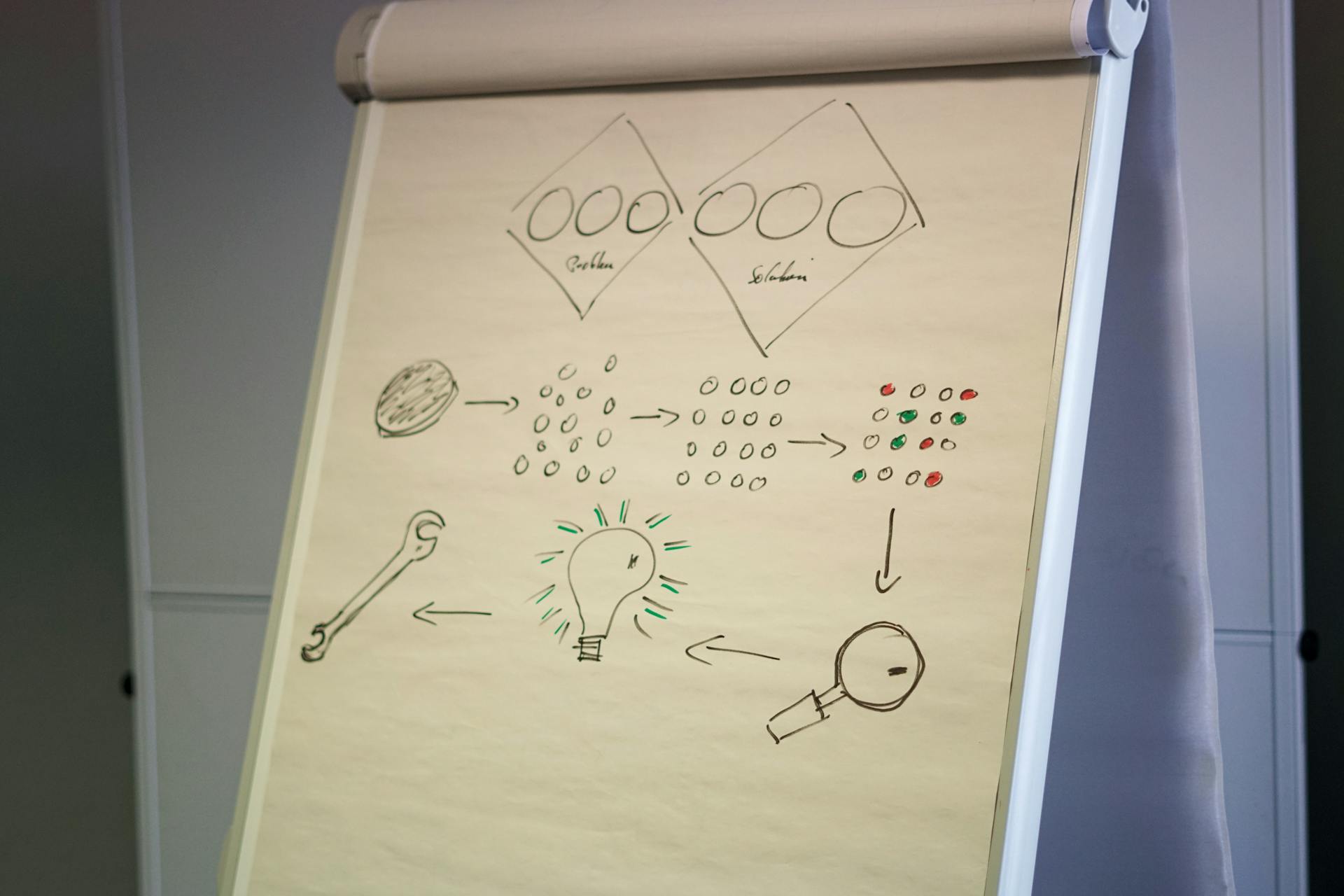
When determining your customer segments, consider who you're solving the problem for, who will value your value proposition, and whether they're another business or individual. You should also consider the characteristics of those businesses or individuals, such as their age, gender, interests, and spending habits.
Here are the different types of customer segments:
- Mass market: targets the general population or a large group of people with similar needs.
- Niche market: targets a specific group of people with unique needs and traits.
- Segmented: based on slightly different needs, with different groups within the main customer segment.
- Diversified: includes customers with very different needs.
- Multi-sided markets: includes interdependent customer segments.
Understanding your customer segments is crucial to creating a successful business model. By identifying your target market and creating customer personas, you can develop a value proposition that meets their needs and sets your business apart from the competition.
Relationships
Relationships are a crucial aspect of any business, and understanding how they work is essential to creating a successful business model. There are three categories of key activities that should focus on fulfilling the value proposition, reaching customer segments, and maintaining customer relationships.
These key activities can be categorized into Production, Problem-solving, and Platform/network activities. Production activities involve designing, manufacturing, and delivering a product in significant quantities and/or of superior quality. Problem-solving activities involve finding new solutions to individual problems faced by customers. Platform/network activities involve creating and maintaining platforms, such as Microsoft's operating system that supports third-party software products.
Expand your knowledge: Business Angel Network of Southeast Asia
Customer relationships are defined as how a business interacts with its customers. This can be through personal assistance, dedicated personal assistance, self-service, automated services, communities, or co-creation. Personal assistance involves interacting with customers in person or through email, phone, or other means. Dedicated personal assistance involves assigning a dedicated customer representative to an individual customer.
Here are some common types of customer relationships:
- Personal assistance: You interact with the customer in person or by email, through phone call or other means.
- Dedicated personal assistance: Assign a dedicated customer representative to an individual customer.
- Self-service: Maintain no relationship with the customer, but provides what the customer needs to help themselves.
- Automated services: This includes automated processes or machinery that helps customers perform services themselves.
- Communities: Online communities where customers can help each other solve their own problems with regard to the product or service.
- Co-creation: Company allows the customer to get involved in the designing or development of the product.
A User Journey Map can help clarify the points of engagement between you and your customer and the modes used to relate to your customers. This can also help identify opportunities for automation. Good questions to ask when identifying the channels to reach your customers are: Can the Value Proposition be delivered to the Customer this way? Can you make the numbers work? Is there a premium support product you need to create/test?
Creating and Using the Canvas
Creating and using the Business Model Canvas is a straightforward process that can be tailored to your needs. You can use a ready-made template to access and update your work anytime, from anywhere.
To get started, define the purpose and scope of what you want to map out and visualize in the canvas. This will help you narrow down the business or idea you want to analyze with your team and its context.
Divide the workspace into nine equal sections to represent the nine building blocks of the business model canvas. These blocks are customer segment, value proposition, channels, customer relationships, revenue streams, key resources, key activities, and cost structure.
Label each section accordingly and work with your team to fill in each section with relevant information. You can use data, keywords, diagrams, and more to represent ideas and concepts.
Once your team has filled in the canvas, analyze the relationships to identify strengths, weaknesses, opportunities, and challenges. This will help you discuss improvements and make adjustments as necessary.
You can use the canvas to facilitate alignment and focus by filling out the elements of the business you're working on and asking yourself if it makes sense. You can also use the canvas to facilitate a workshop with your team to work through the business model.
The Business Model Canvas can be used in various formats, including printing it out, projecting it on a whiteboard, or using a digital template. You can also use a Google App's template or download a printable PDF.
Here are some options for documenting your canvas in an editable format:
Benefits and Applications
The Business Model Canvas is a versatile tool that can be printed out and used with post-it notes or board markers to foster understanding and discussion among groups of people. It's a hands-on tool that's distributed under a Creative Commons license, making it freely available for use.
The Business Model Canvas is also available in a web-based software format, making it easy to access and use. It's been used and adapted to suit specific business scenarios and applications, such as Ash Maurya's Lean Canvas for startup companies.
One of the key benefits of the Business Model Canvas is its simplicity and focus, making it easy for a wide audience to understand and engage with. It's also highly amenable to change on the margins, which is essential for innovation and adaptation in a rapidly changing business environment.
See what others are reading: Can I Lease My Car to My S Corp
Why Do It?
The Business Model Canvas is a powerful tool that can help you innovate and adapt quickly. It's simple yet focused, making it easy for your audience to understand.

The Corporate Innovation Canvas is a great starting point for large corporations with multiple lines of business, but the Business Model Canvas is an excellent choice for bringing clarity to specific business questions, such as how to create focus and implement innovation-friendly strategies.
Using the Business Model Canvas can help you testable business model designs, product charters, and individual learning pathways to cultivate the talent you need to execute. It's a key element in the innovation stack, where you can cascade objectives with testable results and KPIs.
The Business Model Canvas allows you to quickly draw a picture of your idea, understand your business, and make connections between your idea and how to turn it into a business. It helps you identify customer decisions that influence the use of your systems and gives everyone a clear idea of what your business will likely be.
By using the Business Model Canvas, you can facilitate the 'creative destruction' that a good innovation program needs. This means you can be open to new ideas and willing to challenge existing assumptions.
The Business Model Canvas is foundational to any business or product, and it's essential to understand the value proposition, which is the exchange of value between your business and your customer. Good questions to ask when defining your business or product include:
- What problem do you solve for your customers?
- How do you relieve pain or solve a problem for your customers?
- What value do you exchange for money from your customers?
Applications Analysis

The business model canvas is a versatile tool that can be used in various ways to analyze and improve your business. It's a hands-on tool that fosters understanding, discussion, creativity, and analysis, and it's available in both print and web-based formats.
To get the most out of the canvas, you can ask yourself core questions like "Does it make sense?", "Could it be better?", and "Does the rest of my team understand and agree?" These questions can help you identify areas for improvement and ensure everyone is on the same page.
The canvas is also a great tool for evaluating competitiveness. By using Michael Porter's Five Forces framework, you can analyze the competitive environment and identify potential areas of advantage.
Every business is a work in progress, and the canvas can help you identify areas that need improvement. Some common issues that arise when using the canvas include trouble crystallizing customer segments and value propositions, and needing a more end-to-end view of the business.
To overcome these issues, you can use resources like the material on personas to help with customer segments and value propositions, and the hypothesis-driven development materials for a more comprehensive view of the business.
The canvas is also a useful tool for making innovation an everyday thing. By setting up the list of canvas items in the slide master, you can achieve rudimentary layering and show things on top of the canvas without having to recopy all the elements.
Here are some key applications of the business model canvas:
- To quickly draw a picture of what the idea entails.
- To get an understanding of your business and make connections between your idea and how to make it into a business.
- To look at what kinds of customer decisions influence the use of your systems.
- To get a clear idea of what the business will likely be.
The value proposition is foundational to any business or product, and it's essential to define it clearly. Good questions to ask when defining your business or product include what kinds of value are exchanged between your business and your customer or clients, and how you can solve problems or relieve pain for your customers.
Suggestion: Shareholder Value Definition
Enable Quiz
Enable Quiz is a great example of a company that's nailed down its product/market fit. They have a clear view of what works and what doesn't, thanks to their Business Model Canvas.

Their current working view of product/market fit is showcased on a page that demonstrates their ability to enable quizzes. This suggests that they've found a sweet spot in the market where their product meets the needs of their customers.
Enable Quiz's Business Model Canvas provides valuable insights into their product/market fit. They've identified key elements that drive their business forward, such as their revenue streams and customer segments.
Their current view of product/market fit is a result of their ability to analyze and refine their business model. This is a testament to their dedication to understanding their customers and the market they operate in.
A different take: Market Cap of Microstrategy
Understanding the Canvas
The Business Model Canvas is a powerful tool for clarifying and aligning your business. It's a simple yet effective way to map out the most important aspects of your business model.
To get started, try filling out the Canvas yourself and asking if it makes sense. This will help you identify the most important linkages and components of your model.
You can use the Canvas to facilitate alignment on a team, especially when working on a new venture or project. In fact, HVAC in a Hurry, a company with a working version of product/market fit, used the Canvas to manage upwards and improve discussions about focus and success.
Additional reading: Began Canvas
HVAC in a Hurry and Canvas
HVAC in a Hurry has a working version of product/market fit, but they're in a competitive industry where tech is used to improve customer experience and reduce costs.
Their small "digital transformation" team uses the Canvas to facilitate better discussions about where to focus and how it aligns with the business as a whole.
The team wants to manage upwards and define success in a way that makes sense for them.
Suggestion: Patrick Mahomes Invests in Soccer Team
High Level
Understanding the Canvas requires a clear and concise approach. Start by mapping out the business on a high level, focusing only on the most important, vital aspects of the business model.
At this stage, don't worry about the details, just get a broad overview of the key elements. This is where the magic happens, and you start to see the big picture.
Begin by identifying the key partners, suppliers, and customers that drive the business. This will help you understand the flow of resources and revenue.
The goal is to create a simple, yet effective map that captures the essence of the business. This will serve as the foundation for further development.
Explore further: Key Business Banking Online
Current State
In a large organization, you might find varying value propositions and business models.
It's a good idea to ask the different departments to map out their own business models, which can then be compared afterwards.
Working with a large organization can be complex, so it's essential to understand the current state of your business.
This involves identifying the different departments and their respective value propositions and business models.
By doing so, you can gain a clearer picture of your business and make informed decisions.
This process will help you to identify areas of overlap and duplication, as well as opportunities for growth and improvement.
It's a crucial step in understanding the Canvas and developing a successful business model.
Additional reading: The Trump Organization
Resources
When building a business, you need to think about the resources required to make it happen. This includes everything from physical spaces to people and equipment.
Your business might need office space, which can be rented or owned, depending on your budget and preferences.
Explore further: Do You Need Collateral for a Business Loan
To operate effectively, you'll also need computers, hosting services, and a reliable internet connection. These are the basics that will allow you to communicate, process information, and connect with customers.
Other essential resources include people, or staff, who will help drive your business forward. You might also need a car, bike, or other transportation methods to get around.
Some businesses require specialized equipment, such as an oven, to produce their products or services. Others might need electricity or car parts to function.
Here's a list of some common resources that businesses might need:
- Office space
- Computers
- Hosting
- People (staff)
- Internet connection
- Car
- Bike
- Oven
- Electricity
- Car Parts
Frequently Asked Questions
What are the 9 business model canvases?
The Osterwalder business model canvas consists of 9 essential elements: customer segments, value propositions, channels, customer relationships, revenue streams, key resources, key activities, key partnerships, and cost structure. Understanding these elements is crucial for developing a solid business model.
What is the purpose of a BMC?
The Business Model Canvas (BMC) helps businesses identify and mitigate risks, and optimize costs by providing a comprehensive view of their model. It enables informed decision-making to minimize waste and reduce vulnerabilities.
Featured Images: pexels.com