
Bloomberg L.P. is a global financial data and media company that provides real-time and historical financial data, news, and analytics to professionals and institutions worldwide.
Founded in 1981 by Michael Bloomberg, the company started as a financial data terminal business and has since expanded to offer a wide range of products and services.
Bloomberg's data terminals are used by over 325,000 professionals across the globe, providing them with access to real-time market data, news, and analytics.
The company's impact on the financial industry is significant, with its data and analytics being used by investors, traders, and financial institutions to make informed decisions.
Broaden your view: Sudanese Professionals Association
History
In 1981, Salomon Brothers was acquired, and Michael Bloomberg was given a $10million partnership settlement.
Michael Bloomberg used his settlement to start Innovative Market Systems (IMS), which later became Bloomberg L.P.
Bloomberg developed and built his own computerized system to provide real-time market data, financial calculations, and other financial analytics to Wall Street firms.
The Market Master terminal, later called the Bloomberg Terminal, was released to market in December 1982.
Merrill Lynch became the first customer, purchasing 20 terminals and a 30% equity stake in the company for $30million in exchange for a five-year restriction on marketing the terminal to Merrill Lynch's competitors.
In 1986, the company renamed itself Bloomberg L.P. (limited partnership).
Bloomberg launched Bloomberg Business News, later Bloomberg News, in 1990, with Matthew Winkler as editor-in-chief.
Bloomberg.com was first established on September 29, 1993, as a financial portal with information on markets, currency conversion, news, and events, and Bloomberg Terminal subscriptions.
In late 1996, Bloomberg bought back one-third of Merrill Lynch's 30 percent stake in the company for $200million, valuing the company at $2billion.
In 2008, Merrill Lynch agreed to sell its remaining 20 percent stake in the company back to Bloomberg Inc., majority-owned by Michael Bloomberg, for a reported $4.43billion, valuing Bloomberg L.P. at approximately $22.5billion.
For your interest: Apple Pay Later Terminated
Acquisitions and Mergers
Bloomberg L.P. has made several notable acquisitions since its founding.
The company acquired the radio station WNEW in 1992 for $13.5 million, which was later converted into an all-news format and renamed Bloomberg Radio.
Bloomberg L.P. also purchased BusinessWeek magazine, a research company called New Energy Finance, and the Bureau of National Affairs.
In addition to these acquisitions, Bloomberg L.P. acquired the financial software company Bloomberg PolarLake and the research company New Energy Finance.
On July 9, 2014, the company acquired RTS Realtime Systems, a global provider of low-latency connectivity and trading support services.
Bloomberg L.P. continued to expand its services by acquiring RegTek.Solutions in 2019 to enhance its regulatory reporting and data management services.
The company's most recent acquisition was Broadway Technology, a provider of high-performance trading systems and fixed income trading solutions, announced on March 13, 2023.
For more insights, see: Bcbs Medicare Advantage Provider
Media and Content
Bloomberg L.P. has a diverse range of media outlets that cater to various audiences. It began by launching Bloomberg Business News in 1991, a Washington, D.C.-based news service that covered financial aspects of politics, business, general news, and sports.
In addition to its news service, Bloomberg also ventured into radio, acquiring WNEW in New York City for $13.5 million and renaming it WBBR, or Bloomberg Business Radio. The company also started publishing the Bloomberg Magazine and its Sunday insert magazine, Bloomberg Personal, which initially had a circulation of around 6 million.
Bloomberg expanded its media presence further by launching a 24-hour financial news service, Bloomberg Information Television, in 1994. This service was distributed by DirecTV and allowed subscribers to access it from their terminals.
Broaden your view: Daytrading Radio
Radio (Formerly WNEW)**
Bloomberg Radio (formerly WNEW) was purchased by Bloomberg L.P. in 1992 for $13.5 million. This marked the company's entry into the radio industry.
The station was converted into an all-news format, known as Bloomberg Radio, and the call letters were changed to WBBR. This move was part of Bloomberg's strategy to expand its media presence.
Bloomberg Radio was a significant addition to the company's media offerings, providing real-time news and information to listeners. By leveraging its existing news service, Bloomberg was able to deliver high-quality content to a new audience.
The acquisition of WNEW and its subsequent rebranding as Bloomberg Radio demonstrated Bloomberg's commitment to innovation and expansion into new markets.
Recommended read: Jordan Radio and Television Corporation
Businessweek
Businessweek was acquired by Bloomberg L.P. in 2009, a move that aimed to attract general business to its media audience.
The magazine was renamed Bloomberg Businessweek after the acquisition, and it was struggling with declining advertising revenue and limited circulation numbers at the time.
In 2018, Joel Weber was named editor of the magazine, taking the reins after a period of significant change for the publication.
Polar Lake
Bloomberg L.P. acquired PolarLake, a Dublin-based software provider, in May 2012.
This acquisition marked a significant move by Bloomberg to expand its capabilities in enterprise data management. The company launched a new service to help companies acquire, manage, and distribute data across their organizations.
PolarLake's software was likely integrated into Bloomberg's existing infrastructure to provide a comprehensive data management solution.
Sports Analysis
In September 2014, Bloomberg sold its Bloomberg Sports analysis division to the data analysis firm STATS LLC, now known as Stats Perform, for a fee rumored to be between $15 million and $20 million.
The sale marked a significant shift in the market for sports analysis.
Bloomberg's decision to sell the division suggests that the company was looking to focus on other areas of its business.
The acquisition of Bloomberg Sports by Stats Perform has likely had a lasting impact on the sports analysis industry.
Stats Perform is a well-established player in the data analysis space, with a deep understanding of the needs of sports teams and organizations.
The sale of Bloomberg Sports for a fee between $15 million and $20 million indicates the value that companies place on sports analysis.
News
Bloomberg News was co-founded by Michael Bloomberg and Matthew Winkler in 1990.
The news organization started with a mission to deliver financial news reporting to Bloomberg terminal subscribers.
In 2000, Bloomberg News included more than 2,300 editors and reporters in 100 countries.
Content produced by Bloomberg News is disseminated through various channels, including the Bloomberg terminal, Bloomberg Television, Bloomberg Radio, and Bloomberg.com.
John Micklethwait has served as editor-in-chief of Bloomberg News since 2015.
Markets

Bloomberg Markets is a monthly magazine that provides in-depth coverage of global financial markets for finance professionals. It was launched in 1992.
The magazine was redesigned in 2010 to update its readership beyond Bloomberg terminal users. This change aimed to make the magazine more accessible to a wider audience.
Michael Dukmejian has been serving as the magazine's publisher since 2009. He has been instrumental in shaping the magazine's content and direction.
Bloomberg Markets is a valuable resource for finance professionals looking to stay up-to-date on global financial markets. It provides in-depth analysis and coverage of market trends.
See what others are reading: Depth of Market Forex
Pursuits and Culture
Bloomberg L.P. had a luxury magazine called Bloomberg Pursuits that was distributed to newsstands and Bloomberg terminal users, but it ceased publication in 2016.
A digital edition and show on Bloomberg Television continue under the same name, so you can still access Bloomberg Pursuits content in other formats.
The Bloomberg L.P. offices are a unique place to work, with a non-hierarchical structure that even executives don't have private offices.
All employees sit at identical white desks with custom-built Bloomberg computer terminals, creating a collaborative and equal work environment.
Rows of flat-panel monitors overhead display news, market data, the weather, and Bloomberg customer service statistics, keeping everyone informed and connected.
Pursuits

Bloomberg Pursuits was a bimonthly luxury magazine that ceased publication in 2016, but its legacy lives on through a digital edition and a show on Bloomberg Television.
It was initially distributed to Bloomberg terminal users and newsstands, making it a unique publication that catered to a specific audience.
The fact that it was a luxury magazine suggests that it focused on high-end topics and interests, likely appealing to a niche group of readers.
I'm not aware of any personal experience with the magazine, but its existence is a testament to the diverse range of publications available in the market.
Bloomberg Pursuits continues to have a presence in the digital world, with a show on Bloomberg Television that explores similar themes and topics.
You might enjoy: 60 Days in Tv Show Payment Terms
Corporate Culture
Bloomberg L.P.'s corporate culture is surprisingly egalitarian, with even executives giving up private offices.
The company's non-hierarchical structure means that all employees sit at identical white desks, each topped with a custom-built Bloomberg computer terminal.
This uniformity extends to the office space, which features rows of flat-panel monitors overhead that display a range of information, including news, market data, the weather, and Bloomberg customer service statistics.
The lack of private offices creates a sense of community and collaboration among employees, who are encouraged to work together and share ideas freely.
Becoming an Open System
Bloomberg stood apart from its competitors by being the only market data provider that required customers to lease one of its terminals to gain access to its information.
In the mid-1990s, rivals like Bridge Information, Dow Jones, and Reuters allowed subscribers to use their own PCs to link into a digital data feed, giving users more flexibility and customization options.
Bloomberg required customers to use its proprietary machines, which were considered among the most comprehensive in the industry, with high-speed telephone lines that allowed users to access real-time market price information about securities.
You might like: Boeing Warns Some 737 Max Customers of Delays Bloomberg News

The firm began allowing subscribers to access its data from any PC in 1995, but restricted the actual download of raw data, limiting users to dumping numbers into spreadsheet software.
The price of the data was the same as the terminal itself—roughly $1,140 per month—for the Open Bloomberg package, which required data to be transferred via a Bloomberg server to desktops using either Unix or Windows NT.
In 1996, the firm's Bloomberg Data License opened things up a bit further, giving subscribers access to a raw data feed and allowing them to select the data they wanted, which varied in price depending on the amount and type chosen.
Bloomberg's analytic features, which many analysts believe are its most valuable commodity, could not be downloaded until later, when the firm introduced technology called ActiveX that allowed subscribers to customize the information displayed on their Bloomberg boxes.
Consider reading: What Is an Advantage of Allowing Employees to Telecommute
Internet's Impact
The internet has revolutionized the way we access information, with the number of internet users worldwide increasing from 738 million in 2000 to 4.9 billion in 2022.
The internet's impact on education is profound, with online courses and resources making it possible for people to learn new skills and acquire knowledge from anywhere in the world. This has democratized access to education, especially for those in remote or underprivileged areas.
The internet has enabled global communication, allowing people to connect with others across the globe through social media, email, and video conferencing. This has facilitated international collaboration, business, and cultural exchange.
The internet has also enabled the creation and dissemination of digital art, music, and literature, with platforms like YouTube, SoundCloud, and Medium providing a global stage for creatives to showcase their work.
TicToc
TicToc is a social media brand created by Bloomberg, initially launched on Twitter.
The brand has expanded to other platforms, including Facebook, Instagram, YouTube, and Amazon's Alexa.
You can find TicToc playing at several screens across multiple airports in the United States and Canada.
The team behind TicToc consists of 70 members, comprising editors, producers, and social media specialists.
These experts are located across three bureaus in New York, London, and Hong Kong.
Controversies and Lawsuits
Bloomberg L.P. has been involved in several controversies and lawsuits over the years. One notable case is the Turner Construction and Bloomberg LP construction scandal, which involved a "pay-to-play" scheme between Turner Construction executives and Bloomberg executives, resulting in bribery and tax evasion charges.
Michael Campana, Bloomberg's construction manager, was sentenced to two years in prison for tax evasion on $420,000 in connection with accepting bribery. Anthony Guzzone, the Director of Global Construction at Bloomberg from 2010 to 2017, pleaded guilty to evading taxes on over $1.45 million he received in bribes from construction subcontractors.
The company has also faced allegations of sexual harassment and discrimination. In 1996, former sales representative Mary Ann Olszewski sued Bloomberg L.P. for allegedly being drugged and raped by her supervisor. The case was dismissed, but Olszewski claimed the company internally investigated her and attempted to portray her as "flirtatious" or a "sex hound."
Bloomberg L.P. has also faced discrimination lawsuits. In 2000, a class-action lawsuit was filed against the company on behalf of over 80 female employees who claimed they were discriminated against for taking maternity leave. The case was dismissed in 2011, but another lawsuit was filed in 2013 on behalf of 29 pregnant employees, which was also dismissed.
Here are some notable lawsuits against Bloomberg L.P.:
- Olszewski v. Bloomberg L.P. (1996)
- EEOC v. Bloomberg L.P. (2007)
- EEOC v. Bloomberg L.P. (2013)
- Nafeesa Syeed v. Bloomberg L.P. (2020)
Controversies

Bloomberg L.P. has been involved in several controversies and lawsuits over the years.
A "pay-to-play" scheme went on between Turner Construction executives, Bloomberg executives, and vendors at the Bloomberg offices, including its headquarters at 731 Lexington Ave., between 2010 and 2017. This scheme involved bribery and tax evasion, with Michael Campana, Bloomberg's construction manager, sentenced to two years in prison for tax evasion on $420,000.
In 1996, former Bloomberg L.P. sales representative Mary Ann Olszewski sued the company, alleging she was drugged and raped by her supervisor and that the company internally investigated her, attempting to portray her as "flirtatious" or a "sex hound."
Bloomberg testified that he was made aware of the rape allegation and offered to move Olszewski into another sales unit, but did not find her allegation genuine because there was not an unimpeachable third-party witness present during the alleged event.
The Equal Employment Opportunity Commission (EEOC) filed a class-action lawsuit against Bloomberg L.P. in September 2007 on behalf of over 80 female employees who argued that the company discriminated against women who took maternity leave. Judge Loretta A. Preska dismissed the charges in August 2011.
In 2020, Bloomberg L.P. was again charged with discrimination against black and non-white workers in a case brought by Nafeesa Syeed, a former national security reporter and Middle East reporter who served at the company for around four years.
Intriguing read: How to File a Complaint against a Loan Officer
Bloomberg v Bloomberg Ltd

Bloomberg v Bloomberg Ltd was a notable case that highlights the importance of unique business names. Bloomberg L.P. applied for a change of name of Bloomberg Ltd in 2008.
The Company Names Tribunal ordered Bloomberg Ltd to change its name on May 11, 2009, to avoid interfering with the goodwill of Bloomberg Finance Three L.P. This shows how companies must be mindful of potential name conflicts.
Bloomberg Ltd was also required to pay costs as a result of the name change order. This adds another layer of responsibility for companies to manage their names effectively.
Additional reading: Cryptocoin Names
Regulatory and Legal Issues
Bloomberg L.P. has been involved in a notable lawsuit against the Board of Governors of the Federal Reserve System.
Bloomberg L.P. won at the trial court level in the lawsuit.
The Second Circuit Court ruled in favor of Bloomberg L.P. in March 2010.
A group of large U.S. commercial banks appealed the case to the Supreme Court in October.
The Supreme Court let stand the Second Circuit Court ruling mandating the release of Fed bailout details in March 2011.
The records documented Federal Reserve loans issued to financial firms and revealed the identities of the firms, the amounts borrowed, and the collateral posted in return.
If this caught your attention, see: Djia Circuit Breakers
Overview and Background
Bloomberg L.P. was founded by Michael Bloomberg in 1981 with the help of a few key partners. He had a vision to create a computerized system that would provide financial calculation, real-time market data, and analytics to Wall Street firms.
Michael Bloomberg's background is in finance, having attained partner status at Salomon Brothers investment Bank before starting his own company. He received a $10 million buyout when Salomon was acquired by another organization, which he used to develop his own system.
The Market Master terminal, later known as the Bloomberg Terminal, was released in December 1982. This was the core product that would drive the company's success and establish its position in the business landscape.
Bloomberg L.P. now provides a range of services, including analytics, equity trading platforms, data services, news, and financial software tools and applications. These services are offered through the Bloomberg Terminal, which is used by financial companies and organizations around the world.
Take a look at this: Verisk Analytics
Leadership

The leadership team at Bloomberg L.P. is comprised of experienced and influential individuals. Michael Bloomberg is a key member of the Management Committee.
Let's take a closer look at the current leadership structure. The Management Committee includes Michael Bloomberg, Peter Grauer, and Thomas Secunda.
Here's a brief rundown of the committee members:
- Michael Bloomberg
- Peter Grauer
- Thomas Secunda
Overview
Bloomberg L.P. was founded by Michael Bloomberg in 1981 with the help of Thomas Secunda, Duncan MacMillan, and Charles Zegar. Michael Bloomberg had already achieved partner status at Salomon Brothers investment Bank before starting his own company.
Michael Bloomberg was left without a job when Salomon was acquired by another organisation, and he received a $10 million buyout. This payment allowed him to develop and build his own computerised system.
The Market Master terminal, later known as the Bloomberg Terminal, was released in December 1982. This was the core of Bloomberg L.P.'s success and a key factor in its position in the business landscape today.
Bloomberg L.P. provides a range of services, including analytics and equity trading platforms, data services, news, and financial software tools and applications to financial companies and organisations through the Bloomberg Terminal.
Some of the company's other notable services include a wire service (Bloomberg News), a global television network (Bloomberg Television), and radio stations (Bloomberg Radio).
Related reading: Radio Africa Group
Funding and Growth
Bloomberg L.P. generates revenue from subscriptions and fees associated with Bloomberg Terminal.
The company's diversified revenue streams also include Bloomberg News and Bloomberg Business, which focus on venture capital, brokerage, and more.
Bloomberg Terminal is a key source of revenue for the company, with subscriptions and fees playing a significant role in the company's financials.
Bloomberg News and Bloomberg Business are additional revenue streams that contribute to the company's overall growth.
Impact and Future
Bloomberg L.P. is expanding its reach by focusing on end-to-end securities processing capabilities. This shift in focus targets a broader base of trading clients than ever before.
In 2000, Bloomberg decided to increase its end-to-end securities processing capabilities from order placement to transaction completion. This move positions Bloomberg as the company that can guide clients onto the smooth path of straight-through processing.
By processing orders from all types of systems, Bloomberg can open its platform to a wider range of clients. This openness should improve Bloomberg's bottom line, as clients will likely need more of Bloomberg's machines if they use its terminals for securities processing.
The success of this shift should also lead to increased sales of Bloomberg's machines.
If this caught your attention, see: Odoo Clients
Services and Products
Bloomberg L.P. offers a range of services and products that cater to the financial industry. Its flagship product is the Bloomberg Terminal, a proprietary computer system that allows subscribers to access real-time financial data.
The Bloomberg Terminal is available at a starting price of $24,000 per user per year, making it a significant investment for financial institutions. This cost provides access to a vast array of financial data, news, and analytics.
Bloomberg Tradebook is another key service offered by Bloomberg L.P., providing electronic agency brokerage for equity, futures, options, and foreign exchange trades. Founded in 1996, it offers a range of services including trading algorithms, analytics, and marketing insights.
Worth a look: Average True Range
New Energy Finance
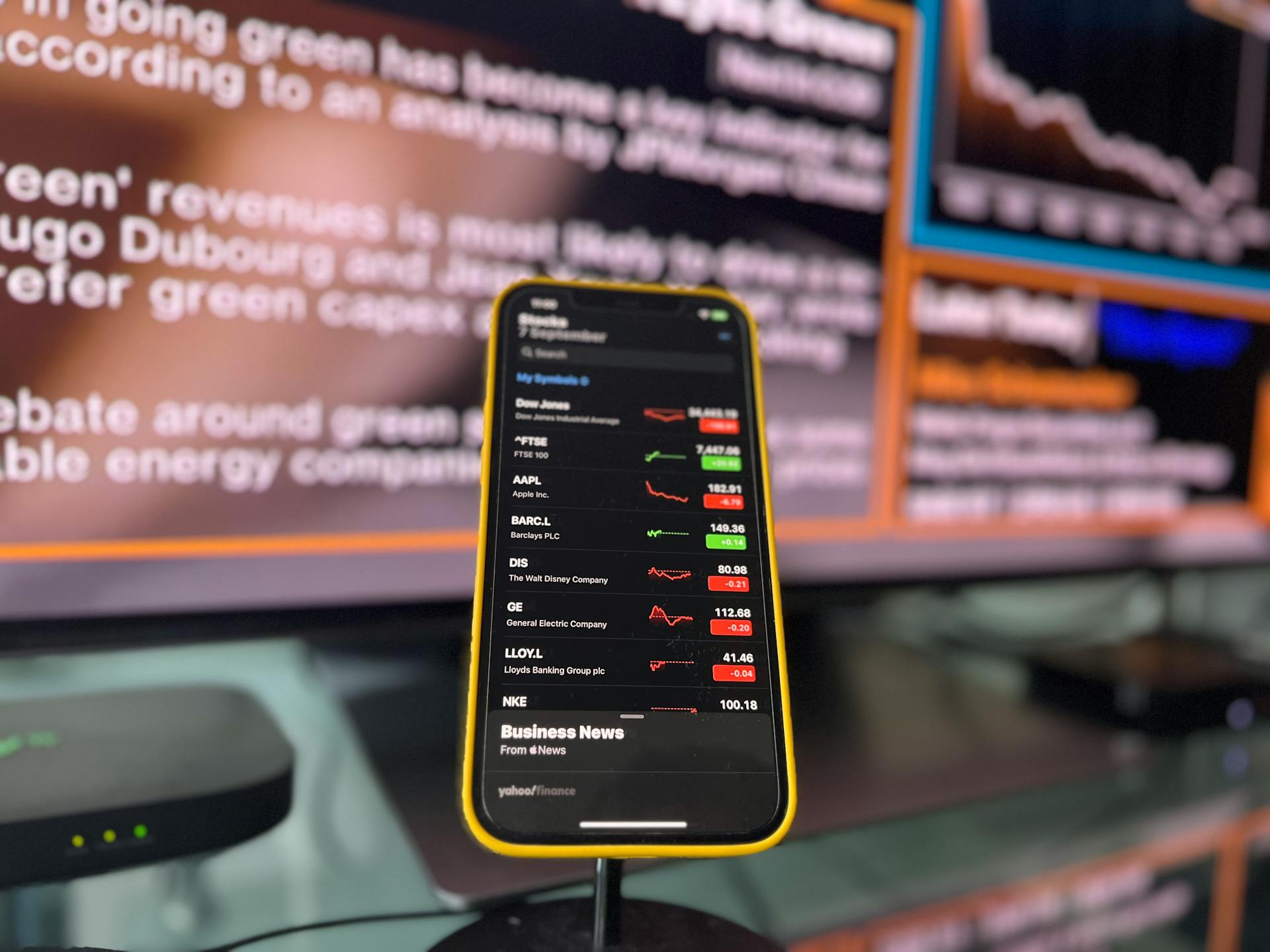
New Energy Finance is a data company that provides news, data, and analysis on carbon and clean energy markets. Bloomberg L.P. purchased the company in 2009.
Bloomberg New Energy Finance, or BNEF for short, was created by Michael Liebreich in 2004. It was renamed after the acquisition.
BNEF provides research, long-term forecasts, analytical tools, and global in-depth analysis covering a wide range of energy and related industries. This includes renewable energy, advanced transport, digital industry, innovative materials, sustainability, and commodities.
Analysts covering 6 continents publish more than 700 research reports a year.
Professional Services
Bloomberg Professional Services are a major source of revenue for the company, accounting for more than 85 percent of annual revenue in 2011.
The Bloomberg Terminal, also known as the Bloomberg Professional Service, is a proprietary computer system that allows subscribers to access real-time financial data and analyze it.
This system starts at $24,000 per user per year and offers a range of features, including the ability to search financial news, obtain price quotes, and send electronic messages through the Bloomberg Messaging Service.
The Terminal covers both public and private markets globally, making it a valuable tool for financial professionals.
Subscribers can use the Terminal to monitor and analyze real-time financial data, which is essential for making informed investment decisions and staying ahead of the market.
Related reading: Professional Pensions
Tradebook
Tradebook offers electronic agency brokerage services for equity, futures, options, and foreign exchange trades.
You can access trading algorithms, analytics, and marketing insights through its "buyside" services.
Bloomberg Tradebook was founded in 1996 as an affiliate of Bloomberg L.P.
Its "sellside" services connect you to electronic trading networks and provide global trading capabilities.
Bloomberg Tradebook was founded in 1996, making it a well-established player in the industry.
Beta
Bloomberg Beta is a venture capital firm capitalized by Bloomberg L.P. It was founded in 2013.
The fund is capitalized with $75 million, which is a significant investment in the tech industry.
Open
In 1995, Bloomberg began allowing subscribers to access its data from any PC, but restricted the actual download of raw data so that users could do little more than dump numbers into spreadsheet software.
The price of the data was the same as the terminal itself—roughly $1,140 per month. This package, known as the Open Bloomberg, required that data be transferred via a Bloomberg server to desktops using either Unix or Windows NT.
It also required subscribers to use a Bloomberg keyboard, which had built-in audio capabilities and color-coded keys.
Bloomberg's analytic features, which many analysts believe are its most valuable commodity, could not be downloaded until later.
The firm's Bloomberg Data License, introduced in 1996, opened things up a bit further by giving subscribers access to a raw data feed and allowing them to select the data they wanted.
However, the price varied depending on the amount and type of data chosen.
In 2011, sales from the Bloomberg Professional Service, also known as the Bloomberg terminal, accounted for more than 85 percent of Bloomberg L.P.'s annual revenue.
The service allows subscribers to access the Bloomberg Professional service to monitor and analyze real-time financial data, search financial news, obtain price quotes and send electronic messages through the Bloomberg Messaging Service.
Bloomberg has openly licensed its symbology system (Bloomberg Open Symbology, BSYM), and financial data API (Bloomberg Programming API, BLPAPI).
Broaden your view: Professional Indemnity Insurance for Finance Brokers
Locations and Exchange
Bloomberg L.P.'s headquarters is located in Midtown Manhattan, New York City, at 731 Lexington Avenue, also known as Bloomberg Tower.
The company occupies a significant amount of office space, with 900,000 square feet at the base of the tower as of 2011.
Bloomberg L.P. also has offices in New York at 120 Park Avenue, covering 400,000 square feet of space.
The company maintains offices in 167 locations around the world, including its European headquarters in Bloomberg London.
Entity Exchange
Entity Exchange is a web-based platform for firms to fulfill Know Your Customer (KYC) compliance requirements.
It's a centralized and secure platform, launched on May 25, 2016, as part of Bloomberg's Entity Exchange.
Locations
Bloomberg L.P.'s headquarters is located in 731 Lexington Avenue in Midtown Manhattan, New York City.
The company occupies a significant amount of office space, with 900,000 square feet at the base of the Bloomberg Tower as of 2011.
Bloomberg L.P. also has a substantial presence in New York, with 400,000 square feet of office space located at 120 Park Avenue.
Its European headquarters is located in Bloomberg London, which is one of the 167 locations around the world where the company maintains offices.
Frequently Asked Questions
Who owns Bloomberg LP?
Bloomberg LP is primarily owned by Michael Bloomberg, who holds a significant 88% stake in the company. He has been instrumental in its leadership, serving as CEO on multiple occasions.
Is Bloomberg a big company?
Yes, Bloomberg is a large and highly profitable company, with annual revenues exceeding $10 billion. Its significant revenue is largely driven by its flagship Bloomberg Terminals.
How to find company info on Bloomberg?
To find company information on Bloomberg, start by typing the company name or ticker symbol in the search box at the top left of the homepage. This will lead you to the Stock Summary page, where you can access recent news and more.
Is Bloomberg LP a broker dealer?
Bloomberg LP has a subsidiary that operates as a broker-dealer, Bloomberg Tradebook, LLC. This indicates that Bloomberg LP indirectly engages in broker-dealer activities.
Featured Images: pexels.com