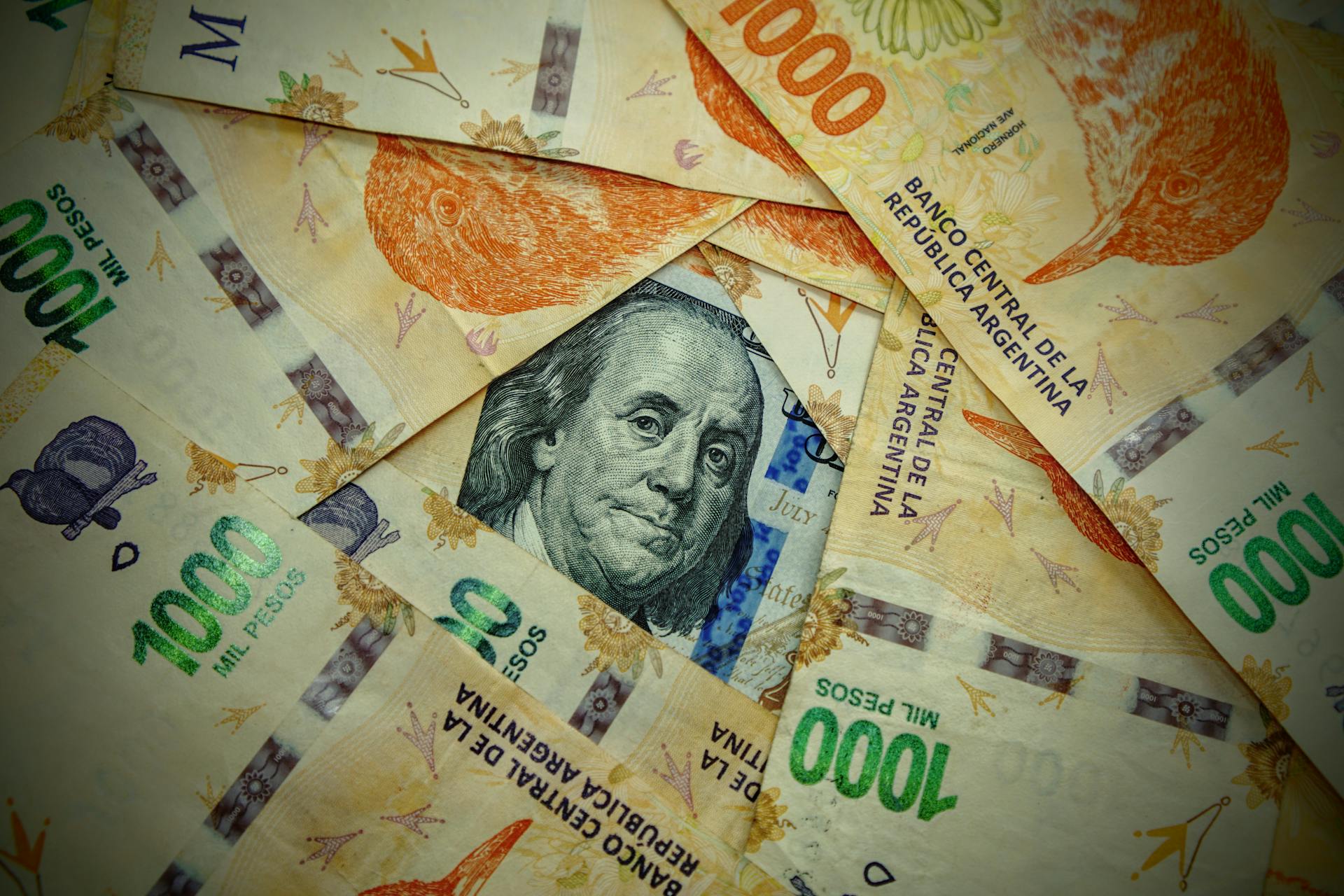
The Argentine Austral is a fascinating topic. It was the official currency of Argentina from 1985 to 1991.
It was introduced to replace the peso, which had become nearly worthless due to hyperinflation.
The Austral was divided into 100 centavos. This was a deliberate attempt to simplify the currency system and make it more manageable for the public.
The currency was nicknamed "aero" by locals, and its value fluctuated wildly during its six-year existence.
On a similar theme: China Yuan Money
Design and Appearance
The Argentine Austral is a beautiful and unique currency. It was introduced in 1985 as a replacement for the Argentine peso.
Its design featured a distinctive color scheme, with the obverse side of the banknote displaying a red and blue color combination. The reverse side, on the other hand, had a green and blue color scheme.
A fresh viewpoint: Peso Argentina a Dolar Blue
Banknotes
In 1985, a provisional issue of austral paper money was introduced, featuring 1, 5, and 10 austral notes, which were actually overstamped on obsolete 1000, 5000, and 10,000 peso argentino notes.
Here's an interesting read: Pallet Austral
These provisional issues were short-lived, withdrawn on November 30, 1987.
The Central Bank of Argentina issued definitive 1, 10, and 100 austral notes that same year.
In 1986, 5 and 50 austral notes were added to the mix.
The following year, 500 and 1000 austral notes were introduced.
Between 1989 and 1990, the Central Bank issued higher denomination notes, including 5000, 10,000, 50,000, 100,000, and 500,000 austral notes.
Some Argentine provinces and banks also issued their own local paper money, denoted in australes.
Explore further: 100 Israeli Shekel
1 Centavo Coin
The 1 centavo coin is a former circulation piece of the Republic of Argentina. It was issued by the Central Bank of Argentina in one type from 1985 to 1987.
The coin is made of an aluminum-bronze alloy, consisting of 92% copper and 8% aluminum. This unique composition gives the coin its distinctive properties.
The 1 centavo coin measures approximately 20.5 millimeters in diameter. Its mass and thickness vary by year, with earlier pieces weighing about 3.95 grams and 1.8 millimeters thick, while later pieces weigh 3.2 grams and 1.6 millimeters thick.

Each coin has a plain edge and is round in shape, with raised and undecorated rims on both sides. This design element gives the coin its distinctive appearance.
The obverse of the coin features an illustration of a greater rhea (Rhea americana) running to the right, designed by Italian-born Argentine sculptor Ermando Bucci. The Spanish name of the Republic of Argentina, "REPUBLICA ARGENTINA", is printed counterclockwise along the rim below.
The face value "1 CENTAVO" is engraved on two lines in the middle of the reverse, with the numeral "1" printed in a rounded font. The austral sign (₳) is inscribed above in even smaller print, distinguishing the piece from earlier Argentine currencies.
Here is a breakdown of the coin's mintage by year:
Obverse
The obverse of a banknote is the front side, and it's often where you'll find the most important information. The Central Bank of the Argentine Republic is clearly stated on the obverse.

The denomination of the banknote is also prominently displayed, in this case, Cien Australes, which translates to Hundred Australes.
Domingo F. Sarmiento's name is featured on the obverse, giving you a sense of the country's history and significance.
Frequencies show that some Numista users own multiple versions of this banknote, which can be a fun collection for enthusiasts.
Etymology and History
The Argentine Austral is a fascinating unit of currency, but have you ever wondered where it came from? It was introduced in 1985, replacing the old peso.
The Austral was created during a time of economic crisis in Argentina, as the country struggled to recover from a severe recession.
The name "Austral" is derived from the Spanish word for "southern", which refers to the country's location in South America.
Argentina had experienced a period of hyperinflation, with prices skyrocketing out of control, making everyday transactions almost impossible.
The Austral was divided into 100 centavos, but it was eventually replaced by the peso again in 1991.
The introduction of the Austral marked a significant attempt to stabilize the Argentine economy, but it ultimately failed to achieve its intended goals.
Suggestion: Argentine Peso Ley
Frequently Asked Questions
What does ARS stand for in money?
ARS is the ISO currency code for the Argentine peso, which is the official currency of Argentina.
Is the Argentine peso pegged?
The Argentine peso was pegged to the US dollar from 1992 to 2015. It was introduced as the peso convertible to maintain price stability.
Featured Images: pexels.com