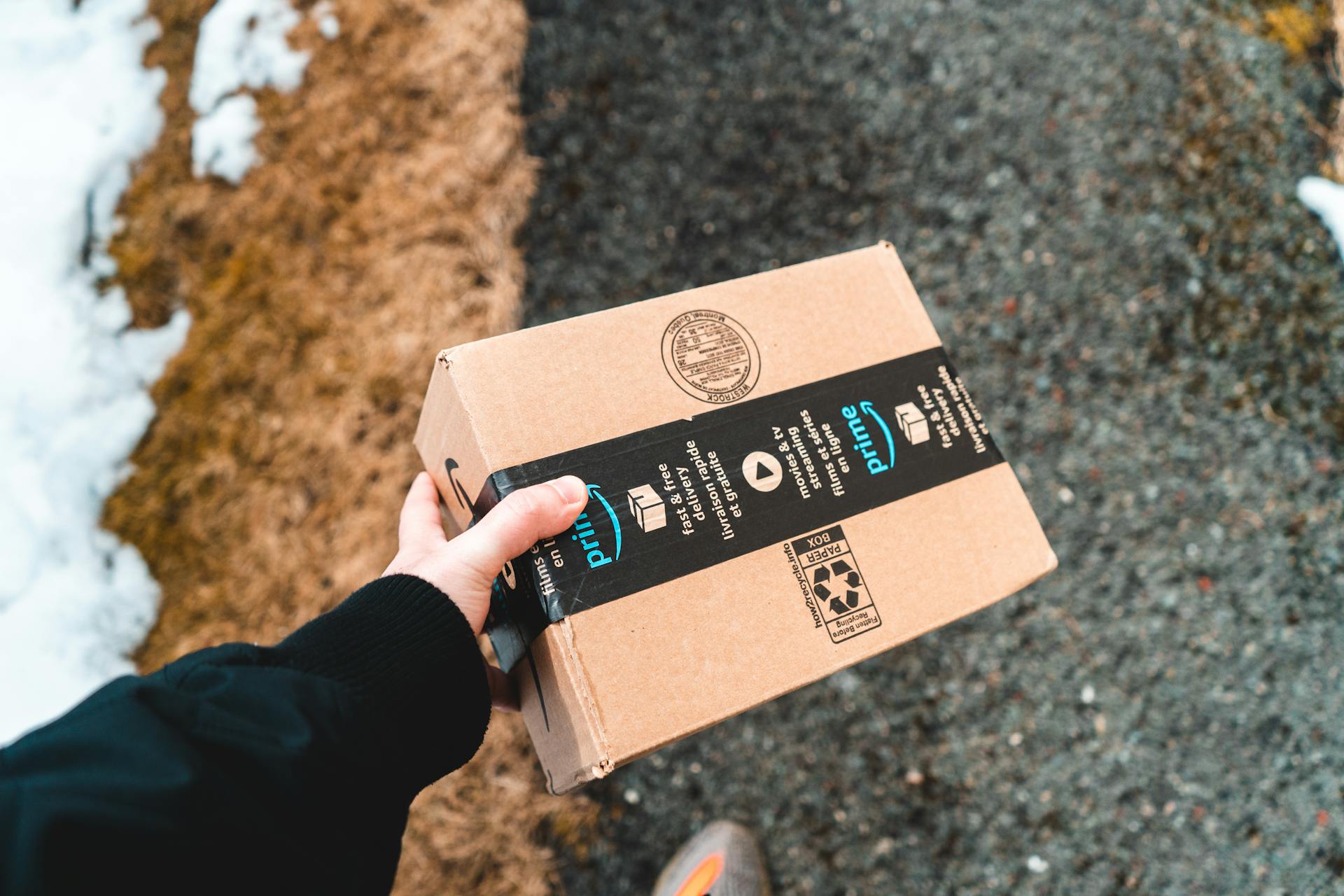
Amazon warehouse logistics is a complex system that requires precise planning and execution. Amazon operates over 185 fulfillment centers worldwide, each with its own unique layout and operations.
These facilities are strategically located near major transportation hubs to ensure efficient shipping and receiving. They are also designed to be highly automated, with robots and machines working alongside human workers to pick, pack, and ship orders.
Amazon's warehouse logistics system is built around the concept of "last mile delivery", where packages are delivered directly to customers' doors. This approach requires a high level of flexibility and adaptability, as Amazon must be able to quickly respond to changes in customer demand and shipping schedules.
Amazon's network of fulfillment centers, sortation centers, and delivery stations work together to ensure that packages are delivered on time and in good condition. With over 250,000 Amazon employees working in its warehouses and delivery network, the company is able to process millions of packages every day.
Readers also liked: How Much Does Amazon Pay to Deliver Packages
What is Amazon Warehouse Logistics?
Amazon Warehouse Logistics is a comprehensive solution designed to simplify your supply chain from end to end. It's a third-party logistics (3PL) service that helps ecommerce businesses manage long-term storage and inventory distribution.
You can store large volumes of inventory on a flexible, pay-as-you-go basis with Amazon Warehouse Logistics. This is particularly beneficial if you're struggling to find suitable warehousing spaces or manage your inventory efficiently.
With Amazon Warehouse Logistics, you gain direct access to Amazon's vast fulfillment network, which can be a game-changer for businesses that rely on Amazon for sales. This includes the ability to automatically move products to Amazon's fulfillment centers to ensure that inventory is readily available for immediate shipment when a customer places an order.
The auto-replenishment feature is another standout benefit of Amazon Warehouse Logistics. This feature monitors stock levels and automatically ships inventory to Amazon fulfillment centers when stock levels drop below a certain threshold, ensuring that your products remain in stock and available for purchase.
On a similar theme: Inventory Management Software
By participating in Amazon Warehouse Logistics, you can also distribute your products to various sales channels beyond just Amazon, including wholesalers, manufacturers, and brick-and-mortar stores. This flexibility allows you to manage your inventory across different sales channels effectively.
Here are some key features of Amazon Warehouse Logistics:
- Long-term storage solution: Store your inventory in Amazon's distribution centers for extended periods.
- Integration with Amazon Fulfillment Network: Leverage Amazon's extensive logistics network for distributing your products.
- Auto-replenishment feature: Monitor stock levels and automatically ship inventory to Amazon fulfillment centers when stock levels drop below a certain threshold.
- Multi-channel distribution: Distribute your products to various sales channels beyond just Amazon.
Benefits and Requirements
Amazon Warehousing and Distribution (AWD) offers numerous benefits, significantly improving your logistics and supply chain management. This includes cutting storage costs by a large percentage compared to traditional warehousing solutions.
To be eligible for AWD, you must have an active Amazon Professional Seller account, inventory that is accepted for storage in Amazon's distribution centers, meet Amazon's performance criteria, and follow Amazon's rules and guidelines.
AWD operates on a transparent, pay-as-you-go pricing model with no hidden fees or long-term contracts, giving you clear visibility into costs. This model helps you manage your expenses effectively.
Here are some key requirements for Amazon Warehousing and Distribution:
- Active Amazon Professional Seller account
- Inventory accepted for storage in Amazon's distribution centers
- Meet Amazon's performance criteria
- Follow Amazon's rules and guidelines
By utilizing AWD, you can leverage Amazon's extensive fulfillment network, which includes more than 175 fulfillment centers and 25 sorting centers across North America. This extensive network facilitates faster and more efficient delivery times to your customers.
Benefits for Sellers

Using Amazon's Fulfillment Centers and Warehousing Services can be a game-changer for sellers.
By leveraging Amazon's extensive network of fulfillment centers, you can enjoy faster and more efficient delivery times to your customers. This is especially important for small and medium-sized businesses, as it helps them compete with larger companies.
Amazon's fulfillment centers are equipped with state-of-the-art technology, including robots and automation systems, which help process orders faster. On average, Amazon fulfills an order every 1.14 minutes, minimizing delays and errors.
Streamlined order fulfillment is just one of the many benefits of using Amazon's fulfillment centers. Here are a few more:
- Prime Eligibility: By using Amazon's fulfillment centers, your products become Prime-eligible, giving you access to over 200 million Prime members worldwide who prioritize fast and free shipping.
- Increased Sales: Prime members spend an average of $1,400 per year, compared to non-Prime members who spend about $600.
- Improved Customer Trust: Customers see Amazon as reliable and fast, which boosts your brand's credibility and makes it more likely that customers will buy from you and return for future purchases.
- Reduced Customer Service Burden: Amazon's customer service team manages all inquiries, returns, and refunds for FBA orders, so you don't have to.
Amazon's fulfillment network is built to handle fluctuating demand, especially during peak seasons like Black Friday or the holidays. With over 175+ fulfillment centers globally, Amazon can manage increased order volumes without slowing down, allowing your business to scale effortlessly during high-demand periods.
By using Amazon's fulfillment centers and warehousing services, you can enjoy a range of benefits that can help you increase efficiency, drive growth, and improve customer satisfaction.
Requirements

To be eligible for Amazon Warehousing and Distribution, you'll need to meet certain requirements. You must have an active Amazon Professional Seller account.
You'll also need to make sure your inventory meets Amazon's storage requirements. This means avoiding products like perishable goods, shoes, jewelry, case packs with one unique SKU, heavy or bulky items, and products that require a temperature-controlled environment.
To enroll in AWD, you must meet Amazon's performance criteria. This involves meeting specific standards for pricing, product listing, and customer service.
Here's a quick rundown of the key requirements:
- Active Amazon Professional Seller account
- Inventory accepted for storage in Amazon's distribution centers
- Meet Amazon's performance criteria
- Meet Amazon's rules and guidelines for pricing, product listing, and customer service
By meeting these requirements, you'll be well on your way to taking advantage of Amazon Warehousing and Distribution.
Managing FBA Requirements
To become eligible for Amazon's Fulfillment by Amazon (FBA) program, you must meet Amazon's performance criteria, which includes adhering to pricing, product listing, and customer service guidelines.
Amazon's FBA requirements are strict, but with the right expertise, sellers can easily meet them. Our team understands the importance of labeling and packaging regulations, and we can take care of these details to avoid potential penalties or product delays.
Readers also liked: Perishable Product Shipping Insurance
Amazon's FBA orders are fulfilled quickly, with an average fulfillment time of 1.14 minutes, thanks to state-of-the-art technology like robots and automation systems. This fast fulfillment time helps minimize delays and errors, ensuring your products reach customers quickly.
To manage your FBA requirements effectively, it's essential to have real-time data on inventory levels, order statuses, and shipping details. Our seamless integration with Amazon Seller Central provides this level of visibility, enabling you to make data-driven decisions.
Here are some key benefits of using Amazon's FBA program:
- Streamlined order fulfillment for faster delivery
- Unlock Prime eligibility for fast shipping
- Build trust and credibility with customers
- Leave customer service to the experts
- Easily scale your business with increased demand
Supply Chain and Logistics
Amazon's supply chain is one of the most advanced around, with a smooth-sailing logistics network that enables the company to deliver packages in as little as a day, and sometimes within the same day thanks to Amazon Prime Air capabilities.
The key to Amazon's success lies in its ability to adapt to changing times, leveraging technological innovation and strategy to stay ahead of the competition. This has been the driving force behind Amazon's warehouse designs and warehouse processes.
Amazon's logistics network consists of various specialized warehouse locations, including fulfillment centers, which are the backbone of its logistics network. These centers ensure fast, efficient service for sellers and buyers alike.
At Amazon fulfillment centers, products are received, inspected, and stored efficiently until an order is placed. Amazon's advanced inventory management system continuously monitors stock levels, alerting sellers when stock is low.
Here are the different steps involved in the Amazon fulfillment process:
- Receiving and storing inventory
- Inventory management
- Picking process
- Packing process
- Shipping process
- Returns processing
The picking process begins when a customer places an order, and workers use handheld devices to locate the item in the warehouse, following algorithms that determine the fastest path to pick multiple orders at once, reducing time and increasing efficiency.
Amazon's warehouse and distribution program, AWD, streamlines the supply chain and inventory management process for sellers, allowing them to ship their inventory to Amazon distribution centers within the United States using Amazon's Partnered Carrier program.
Technology and Automation
Amazon's investment in automation has transformed its warehouse logistics, making it one of the most efficient and effective in the industry. Amazon has committed billions of dollars to developing and implementing automation technologies across its fulfillment centers.
Amazon's use of robots, such as the Kiva robots, has significantly improved the picking process. These robots transport entire shelves of products to human pickers, reducing the time and effort required to locate items. This has led to a faster and more accurate processing of orders.
Here are some key benefits of Amazon's automation technology:
Amazon's focus on automation has also led to the development of advanced robotics and cutting-edge automation, which ensures fast and accurate processing in its fulfillment centers.
What System Does It Use?
Amazon's fulfillment centers are at the forefront of technological innovation, combining advanced robotics and cutting-edge automation to ensure fast and accurate processing. This investment in automation not only enhances efficiency but also delivers key benefits to sellers by optimizing each stage of the fulfillment process.
Amazon uses multiple logistics and fulfillment models to ensure fast and efficient delivery across the world. These models include Amazon Warehouse and Distribution (AWD), Fulfillment by Amazon (FBA), and Multi-Channel Fulfillment (MCF).
Readers also liked: Business Revenue Models in E-commerce
Technology and Automation
Amazon has invested billions of dollars in developing and implementing automation technologies across its fulfillment centers, with a focus on improving efficiency, scalability, and cost reduction.
The company's use of robots within its fulfillment centers has significantly transformed how tasks are completed, with robots contributing to various functions that allow for smoother and more efficient workflows.
Amazon uses Kiva robots to transport entire shelves of products to human pickers, reducing the need for workers to walk through the warehouse to locate items. This can significantly improve efficiency and reduce labor costs.
Robots are also employed to sort products as they move through the center, and automated packing systems help determine the optimal box size for each order and pack the items securely.
Here's a breakdown of how robots are enhancing the fulfillment process:
- Moving Shelves (Kiva Robots): Amazon uses Kiva robots to transport entire shelves of products to human pickers.
- Sorting Products: Robots are employed to sort products as they move through the center.
- Packing Assistance: Automated packing systems help determine the optimal box size for each order and pack the items securely.
Amazon's automated systems reduce the time it takes to pick, pack, and ship products, allowing orders to be processed faster and improving customer satisfaction and loyalty.
Challenges and Fees
Amazon Warehouse Logistics can be a game-changer for businesses, but it's not without its challenges. One of the main challenges is managing storage fees, which can add up quickly.
Storage fees are calculated per cubic foot and can vary depending on the period of the year. For example, Amazon Warehousing and Distribution (AWD) may charge a surcharge fee during peak seasons.
To keep storage fees low, it's essential to optimize your inventory levels and avoid unnecessary storage fees. You can use Amazon's storage fee calculator to estimate your storage fee and plan accordingly.
Here are the current storage rates for Amazon FBA:
Keep in mind that these rates are subject to change, and it's always a good idea to check the Amazon website for the most up-to-date information.
Challenges of Using
Using Amazon Warehousing and Distribution (AWD) can be a great way to save costs and increase efficiency, but it's not without its challenges. One of the main issues is that you may face some unexpected fees.

Amazon Warehousing and Distribution (AWD) offers numerous benefits, including saving costs, increased efficiency, and scalability.
Some of the challenges you may face while using AWD include increased fees for services like storage and handling.
You may also experience some delays in shipping and receiving due to the high volume of packages being processed.
Fees
Amazon's fees can be a bit overwhelming, but understanding them is crucial for success on the platform. Amazon FBA charges sellers for two main services: Fulfillment Fees and Storage Fees.
Fulfillment Fees are charged per unit and vary depending on the size and weight of the item. For example, a standard-size item under 1 lb has a fulfillment fee starting at $3.22 per unit.
Storage Fees are calculated per cubic foot and include the costs of storing your inventory in Amazon's fulfillment centers. The current rates are $0.87 per cubic foot for standard-size items and $2.40 per cubic foot for oversized items from January to September.
Related reading: Shopify plus Credit Card Fees
Amazon's FBA fees are heavily influenced by the size and weight of your products. Items are classified into standard-size and oversize categories, with each category having its own fee structure.
Here's a breakdown of the Fulfillment Fees for standard-size and oversized items:
Keep in mind that these rates are subject to change and may vary depending on the time of year. It's essential to regularly assess your stock to avoid additional fees, such as long-term storage fees for inventory held longer than 365 days, which start at $6.90 per cubic foot or $0.15 per unit, whichever is greater.
For your interest: Wix Credit Card Processing Fees
Comprehensive 3PL Services
Our 3PL services cover the entire logistics spectrum for Amazon sellers, from warehousing and fulfillment to freight and transportation solutions.
We offer state-of-the-art storage facilities that ensure secure product storage, with efficient order processing and shipping services guaranteeing timely deliveries.
Our 3PL warehousing and fulfillment services form the backbone of our comprehensive supply chain and 3PL solutions, with storage facilities equipped with cutting-edge technology for secure and organized storage.
You might like: 3pl Logistics Business
We seamlessly integrate with Amazon Seller Central, providing real-time data and insights that empower sellers to optimize their inventory and logistics strategies.
For Amazon FBA sellers, our expertise in managing 3PL services for Amazon FBA requirements is unmatched, allowing them to confidently navigate the complexities of the platform and focus on scaling their businesses.
We take a consultative approach when working with Amazon sellers, seeking to understand their specific pain points and business objectives to design logistics solutions that address their individual needs.
Our ability to integrate with various e-commerce platforms and marketplaces adds to our versatility, allowing us to efficiently manage inventory and fulfillment across various channels.
Here are some key benefits of our comprehensive 3PL services:
- Secure product storage in state-of-the-art facilities
- Efficient order processing and shipping services
- Real-time data and insights for inventory and logistics optimization
- Customized logistics solutions tailored to individual business needs
- Integration with various e-commerce platforms and marketplaces
Delivery and Shipping
Amazon's cargo airline, Amazon Air, is in collaboration with the Air Transport Services Group, handling each order from start to finish. This comprehensive approach ensures that packages are delivered promptly and efficiently.
To create shipments to Amazon's Air Warehouse Distribution (AWD) system, sellers can use the tools available on Amazon Seller Central to manage their inventory, create shipments, and track replenishments. These tools simplify the process of shipping to AWD, making it easy to manage inventory within the program.
Sellers can book shipments for delivery to AWD through the Amazon Global Logistics (AGL) or Partnered Carrier Program (PCP). It's essential to select the correct AWD location and ensure the carrier is aware of the destination to avoid any hiccups.
Here are the key functions of Delivery Stations:
- Coordinating last-mile deliveries
- Ensuring packages reach customers promptly
Own Delivery Business
Amazon has invested heavily in its own delivery business, aiming to handle each order from start to finish. This includes custom delivery vehicles, robot-powered distribution centers, and automated warehouse systems.
Amazon Air is the company's cargo airline, in collaboration with the Air Transport Services Group. Amazon Freight is its trucking venture, offering a middle-mile logistics technology solution for shipping road freight.
Amazon Freight allows any seller to ship palletized shipments or full truckloads directly to Amazon fulfillment centers or non-Amazon facilities at competitive prices.
Create and Send Shipments
Creating shipments to Amazon's Air Warehouse Delivery (AWD) is a straightforward process. You can use the tools available on your Amazon Seller Central to manage your inventory and create shipments.
To start, you'll need to get into the system, allowing you to create and send shipments to AWD. Once you're in, you can start using the tools to simplify the process of shipping to AWD.
You can create shipments to AWD using the inventory management tools on your Amazon Seller Central. This makes it easy to manage your inventory within the program.
To book a shipment for delivery to AWD, you'll need to use the Amazon Global Logistics (AGL) or Partnered Carrier Program (PCP). Ensure you select the correct AWD location and that your carrier is aware of the destination.
Your carrier should be aware of the destination to avoid any hiccups in the shipping process. By following these steps, you can ensure a smooth delivery to AWD.
Related reading: Carrier Liability vs Cargo Insurance
Delivery Stations
Delivery Stations play a crucial role in getting packages to customers' doorsteps. They're the last stop before delivery, where sorted packages are loaded onto vehicles for final delivery.
At Delivery Stations, key functions include coordinating last-mile deliveries, ensuring packages reach customers promptly. This is where Amazon's own delivery fleet or third-party carriers come in to finalize the delivery process.
For example, Amazon's own delivery fleet is used to transport packages from Delivery Stations to customers' homes. This helps ensure timely and efficient delivery.
Delivery Stations are essential for getting packages to customers on time. They're the final hurdle before a package reaches its destination.
Employee and Seller Essentials
Amazon's warehouse logistics involves a complex system of fulfillment centers, sortation centers, and delivery stations.
To ensure smooth operations, Amazon requires employees to undergo rigorous training, which can take up to 23 days.
Amazon sellers must also meet strict requirements, including storing products in designated areas and labeling them correctly.
Getting Started
First, you need to register on the platform to access various features and tools. Registration is a straightforward process that takes only a few minutes.

Before you start selling, you need to set up your seller profile, including your name, email address, and password. This information will be used to identify you on the platform.
To get started, you'll need to verify your email address by clicking on the verification link sent by the platform. This ensures that you're a real person and helps prevent spam accounts.
Once you've verified your email address, you can start exploring the platform and familiarizing yourself with its features. Take some time to browse through the different sections and get a feel for how things work.
As you begin to use the platform, you'll need to agree to the terms and conditions, which outline the rules and expectations for using the platform. Make sure you read and understand these terms before proceeding.
Worth a look: Alibaba Payment Terms
How to Register
To register for an Amazon warehouse, you'll need to enroll in Amazon Warehousing and Distribution (AWD). Enroll in AWD by going to Amazon Seller Central and navigating to Menu > Growth > Explore Programs > Amazon Warehousing and Distribution.
A different take: Dhl Ecommerce Distribution Center
Click the “Enroll” button at the top of the AWD page to begin the registration process. Make sure you meet all the requirements and eligibility criteria for AWD.
After enrollment, you can start creating shipments directly to AWD. To book your shipments, use either Amazon Global Logistics (AGL) or the Partnered Carrier Program (PCP) for smooth delivery into the AWD network.
Once your inventory is in, you can take advantage of AWD’s powerful tracking tools to monitor milestones, manage replenishment, and optimize your supply chain.
Employee Protection
Amazon has invested in high-tech solutions to improve working conditions and prevent accidents in its warehouses. One example is the Robotic Tech Vest, a wearable device with collision detection technology that helps warehouse workers and robots avoid collisions.
The Robotic Tech Vest was rolled out in early 2019, and it's designed to enhance safety in Amazon facilities.
Sellers' Financial Essentials
Amazon Warehousing and Distribution (AWD) offers a transparent pricing model with no hidden fees or long-term contracts, giving you clear visibility into costs.
By using AWD, you can cut storage costs by a large percentage compared to traditional warehousing solutions.
AWD features an automated distribution system that increases your efficiency, reduces labor costs, and improves accuracy.
With AWD, you can leverage Amazon's extensive fulfillment network, which includes more than 175 fulfillment centers and 25 sorting centers across North America.
Amazon's auto-replenishment feature ensures a seamless flow of inventory into Amazon fulfillment centers, saving you time and money by removing the need for manual inventory management.
AWD integrates with Fulfillment by Amazon (FBA), providing a seamless fulfillment solution for businesses.
Amazon Accelerate complements AWD by offering a range of benefits, including access to Amazon's fulfillment network, advertising tools, and account management support, which helps the growth of small and medium-sized businesses on Amazon.
Fees associated with Amazon Fulfillment Centers (FBA) can impact profitability, so it's essential to understand the financial aspects and costs involved.
By using Amazon's Fulfillment by Amazon (FBA) service, you'll be charged a fulfillment fee, which varies depending on the product's weight and dimensions.
Amazon also charges a shipping fee for shipping products to customers, which is calculated based on the product's weight, dimensions, and shipping speed chosen.
Expand your knowledge: Paypal Wins Lawsuit against Cfpb's Fee Disclosures for Digital Wallets
Infrastructure and Locations
Amazon's warehouse logistics is a complex system, but it's built around a few key types of locations.
Fulfillment Centers (FCs) are the backbone of Amazon's fulfillment network. They're massive warehouses that store inventory and handle the entire order fulfillment process, including picking, packing, and shipping products to customers.
These FCs have a few key functions: storing seller inventory, picking and packing customer orders, and shipping to end consumers.
Amazon's logistics network relies on these FCs to get products from storage to customers efficiently.
Order Processing System
Amazon's order processing system is a well-oiled machine that ensures every order is accurately picked, packed, and shipped on time. This attention to detail minimizes errors and enhances the overall shopping experience.
Our efficient order processing system is crucial in the e-commerce world, as it can significantly impact customer satisfaction and loyalty.
Additional reading: Customer Pay Shop Charge for Repair Order
Frequently Asked Questions
What's the difference between Amazon delivery and Amazon Logistics?
Amazon Logistics is a last-mile delivery service that brings packages directly to customers' doors, while Amazon delivery refers to the overall shipping process, including transportation by top carriers like UPS, USPS, and FedEx.
Featured Images: pexels.com