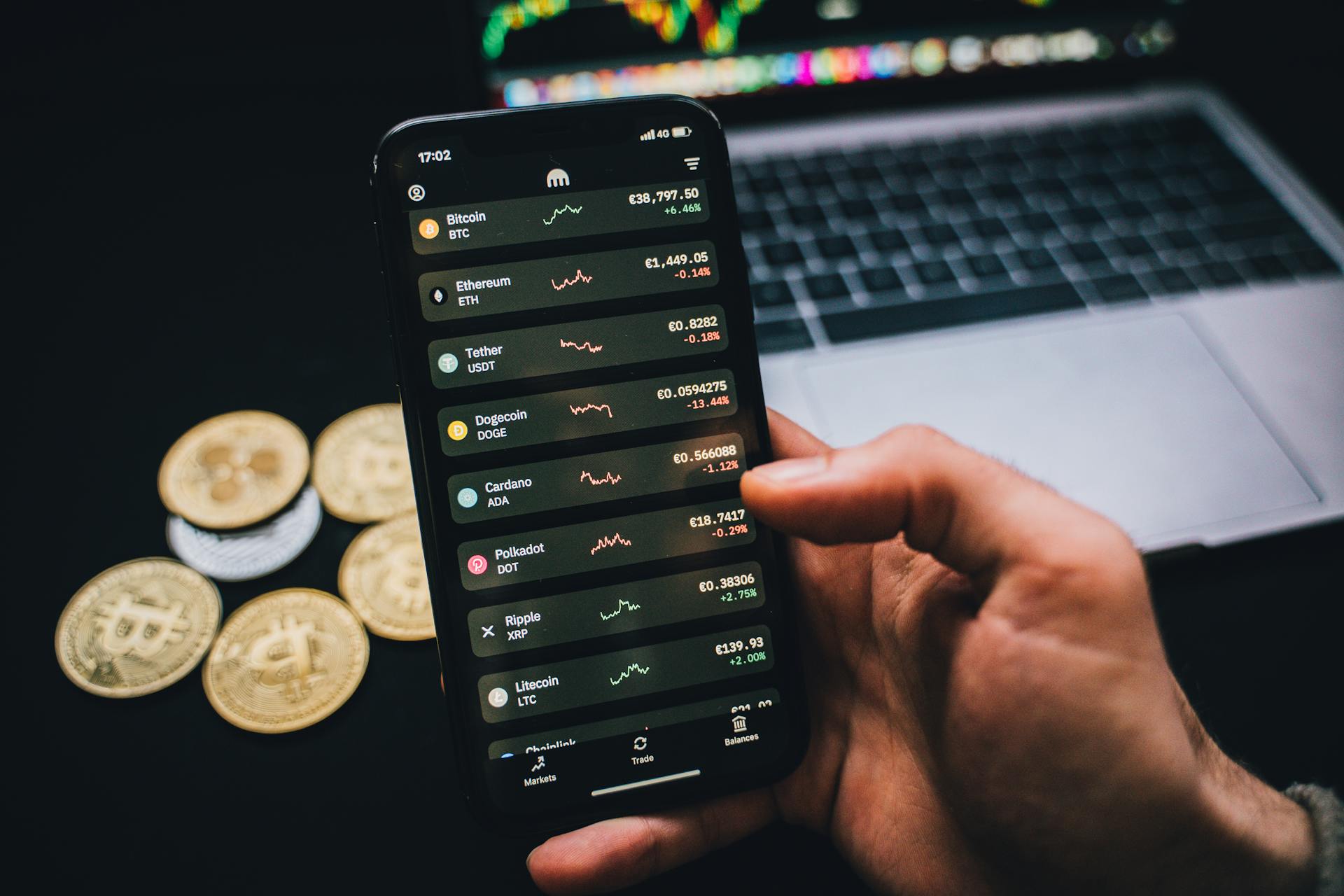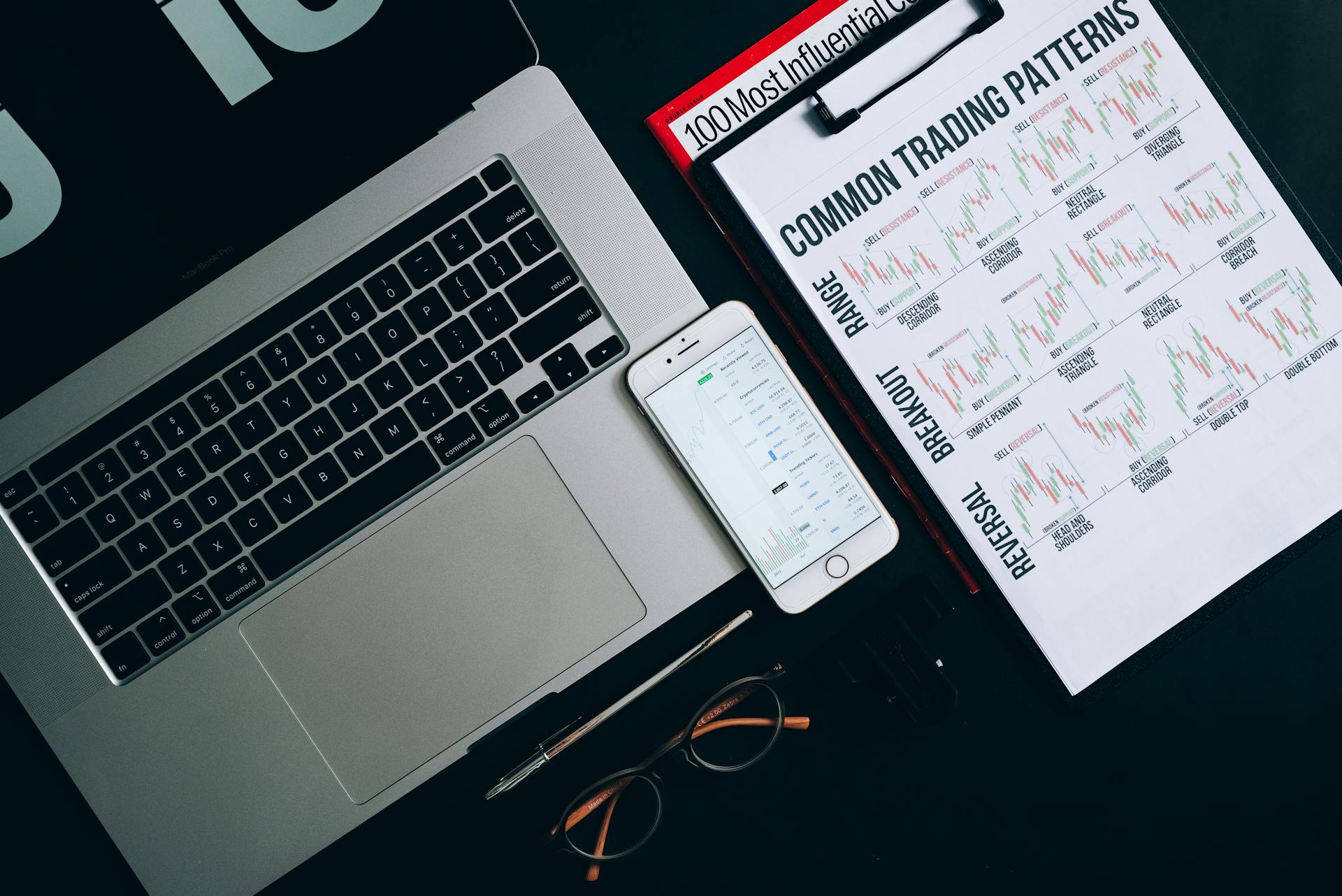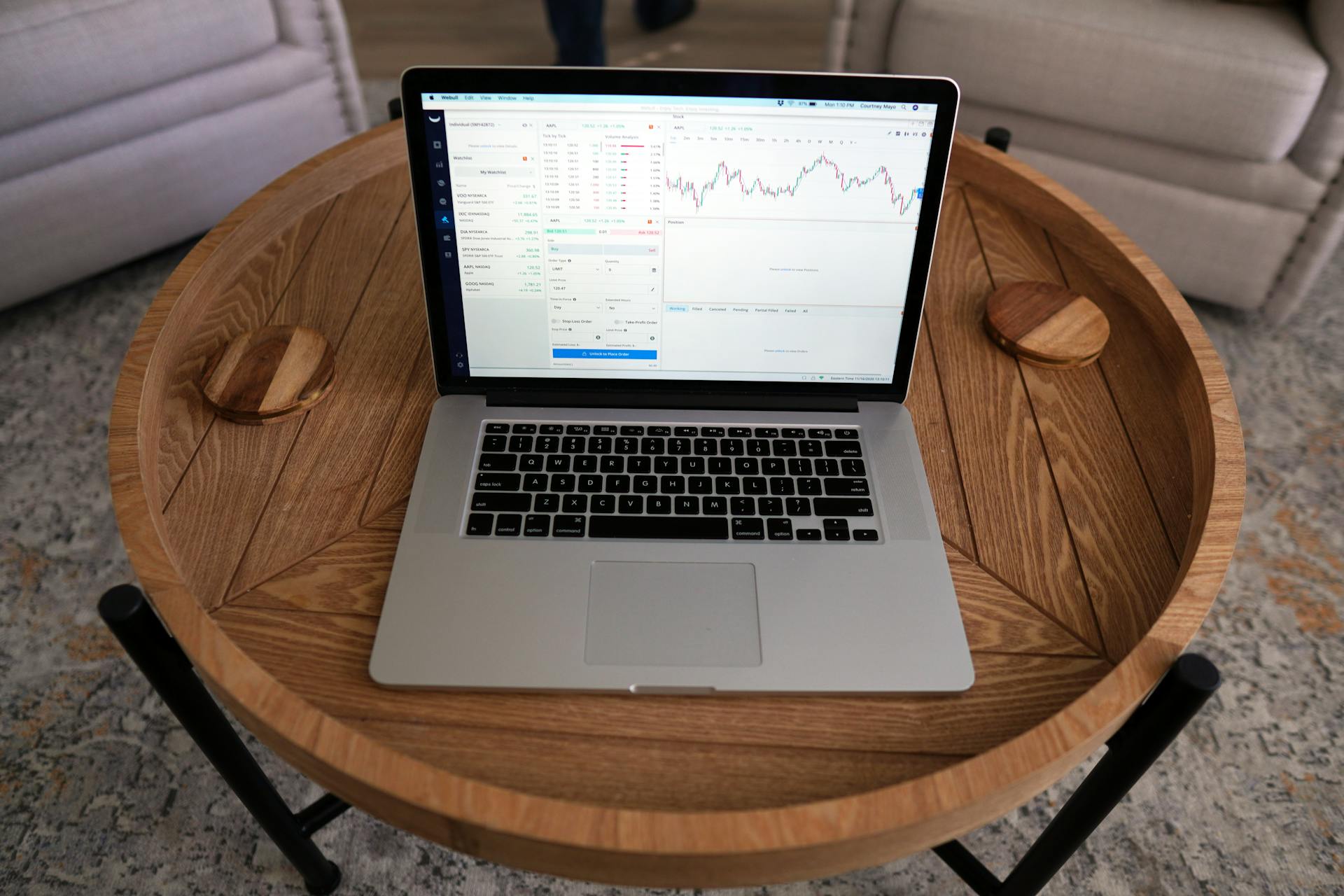
Algorithmic traders use pre-programmed trading instructions to automatically execute trades based on specific rules and conditions.
These algorithms can be used for various trading strategies, including trend following, mean reversion, and statistical arbitrage.
Algorithmic traders can execute trades at high speeds and with low latency, making them ideal for volatile markets.
They can also automate tasks such as data analysis, risk management, and trade reporting, freeing up time for more strategic decision-making.
A fresh viewpoint: Equity Market Making
What Is Algorithmic Trading
Algorithmic trading is a system that uses pre-programmed instructions, or algorithms, to automatically execute trades in the financial markets. It's like a robot that trades on your behalf, but instead of being controlled by a human, it's controlled by a set of rules.
These rules are based on mathematical models and statistical analysis, which help identify profitable trading opportunities. By analyzing vast amounts of data, algorithms can identify patterns and trends that might not be visible to a human trader.
For your interest: Etrade Day Trader Rules
Algorithmic trading can be used for a variety of purposes, including hedging, arbitrage, and trend following. It's a popular choice for institutional investors, such as hedge funds and pension funds, who need to manage large portfolios.
The use of algorithms can help reduce the emotional influence of human traders, who might make impulsive decisions based on market sentiment.
See what others are reading: Types of Private Investment Funds
Advantages and Disadvantages
Algorithmic trading has both advantages and disadvantages that you should be aware of before deciding to use it.
One of the main advantages of algorithmic trading is that it provides the best execution of trades, often at the best possible prices. This is because algorithmic trading systems can execute trades at high speeds, with low latency, and with reduced transaction costs.
Algorithmic trading also allows for simultaneous automated checks on multiple market conditions, reducing the risk of human error. Additionally, it eliminates the risk of manual errors or mistakes when placing trades, as well as the impact of human emotions on trading decisions.
A unique perspective: Algo Trading Advantages
However, there are also several disadvantages of algorithmic trading. One of the main risks is that algorithmic trading relies on fast execution speeds and low latency, which can be affected by technical issues or failures. This can disrupt the trading process and result in losses.
Algorithmic trading also relies on historical data and mathematical models to predict future market movements, but unforeseen market disruptions, known as black swan events, can occur. These events can result in losses for algorithmic traders.
Here are some of the key advantages and disadvantages of algorithmic trading:
- Best Execution: Trades are often executed at the best possible prices.
- Low Latency: Trade order placement is instant and accurate.
- Reduced transaction costs.
- Simultaneous automated checks on multiple market conditions.
- No Human Error: Reduced risk of manual errors or mistakes when placing trades.
- Backtesting: Algo-trading can be backtested using available historical and real-time data to see if it is a viable trading strategy.
- Lack of human judgment in real time.
- Can lead to increased volatility or market instability at times.
- High capital outlays to build and maintain software and hardware.
- May be subject to additional regulatory scrutiny.
Types of Algorithmic Trading
As an algorithmic trader, you have the freedom to experiment with different types of trading strategies. Nearly all new traders soon discover the benefits of trading multiple strategies, which can help reduce risk and boost returns.
You can combine daytrading, swing trading, and long term trading strategies, all at the same time, or choose the one that you like the most. This flexibility is one of the beauties of algorithmic trading.
There are various types of algorithmic trading strategies, including those that can be used for daytrading, swing trading, and long term trading.
Here are the main types of algorithmic trading strategies:
- Daytrading
- Swing trading
- Long term trading
Trend-Following
Trend following strategies are a popular type of algorithmic trading, where trades are initiated based on the occurrence of desirable trends in moving averages, channel breakouts, price level movements, and related technical indicators.
These strategies don't involve making predictions or price forecasts, which makes them easy to implement through algorithms. In fact, trend following strategies are characterized by a low win rate, sometimes as low as 20-25%, but this is compensated by the outsize winning trades that make up for the losses.
Trend following strategies work by riding the market trend, meaning they profit from the tendency of markets to continue in the direction of the momentum. This approach is quite different from mean-reversion strategies, which try to profit from the opposite tendency.
Here are some key characteristics of trend following strategies:
- Low win rate (20-25%)
- Outsize winning trades compensate for losses
- Ride the market trend
- Easy to implement through algorithms
As an algorithmic trader, you'll likely spend most of your time finding and managing trend following strategies, which can be a fun and rewarding experience. With the right approach, you can use trend following strategies to your advantage and profit from the markets.
Here's an interesting read: Quantitative Hedge Fund Strategies
Arbitrage
Arbitrage is a type of algorithmic trading that involves finding price imbalances and profiting from the difference in price. It's a way to exploit price differentials between two markets, making it a risk-free profit opportunity.
Arbitrage trading can be replicated for stocks vs. futures instruments, and even across different exchanges. For example, Royal Dutch Shell (RDS) is listed on the Amsterdam Stock Exchange (AEX) and the London Stock Exchange (LSE), allowing for arbitrage opportunities.
The key to successful arbitrage trading is identifying price discrepancies quickly and executing trades efficiently. This requires a computer program that can read current market prices, access price feeds from both exchanges, and convert prices between currencies.
To execute an arbitrage trade, the program should perform the following steps:
- Read the incoming price feed of RDS stock from both exchanges.
- Using the available foreign exchange rates, convert the price of one currency to the other.
- If there is a large enough price discrepancy, place the buy order on the lower-priced exchange and sell the order on the higher-priced exchange.
However, arbitrage trading comes with its own set of risks and challenges, including system failure risks, network connectivity errors, and time lags between trade orders and execution. Imperfect algorithms can also lead to losses, making it essential to thoroughly backtest any arbitrage strategy before implementing it.
Mean Reversion
Mean reversion is a trading strategy based on the concept that high and low prices of an asset are temporary and will revert to their mean value periodically.
This strategy involves identifying a price range and implementing an algorithm to automatically place trades when the price breaks in and out of its defined range.
Mean reversion strategies work best in markets with a strong tendency to revert to their mean, such as the S&P 500 stock market index.
The RSI2 trading strategy, invented by Larry Connor, is a well-known example of a mean reversion strategy that can be refined further to increase profitability.
Mean reversion strategies can be applied to other markets beyond equities, such as the Japanese Yen market.
A major edge in the market can be gained by using mean reversion strategies, as seen in the RSI2 trading strategy.
Consider reading: Algorithmic Trading and Quantitative Strategies
Time-Weighted Average Price (TWAP)
Time-weighted average price strategy breaks up a large order and releases dynamically determined smaller chunks of the order to the market using evenly divided time slots between a start and end time.
Related reading: Full Time Day Trader
The goal of TWAP is to execute the order close to the average price between the start and end times.
This approach aims to minimize market impact by spreading out the order over time.
By executing the order in smaller chunks, TWAP reduces the risk of sudden price movements.
The average price is calculated based on the time-weighted average of the market prices between the start and end times.
This strategy is particularly useful for large orders that need to be executed over a specific time period.
Explore further: Equity Market Opening Time
Percentage of Volume
Percentage of Volume is a strategy used in algorithmic trading where the system sends partial orders based on the defined participation ratio and the volume traded in the markets.
This approach helps to manage risk and increase the chances of filling orders by spreading them across multiple trades.
The participation ratio is a key factor in this strategy, as it determines the percentage of market volumes at which orders are sent.
This ratio can be adjusted based on market conditions and the user's risk tolerance.
The system increases or decreases the participation rate when the stock price reaches user-defined levels, allowing for dynamic adjustments to be made in real-time.
Check this out: Profitable Algo Trading Strategy
Mathematical Model-Based Trading
Mathematical Model-Based Trading is a proven approach that leverages mathematical models to inform trading decisions.
These models, like the delta-neutral trading strategy, allow traders to combine options and underlying securities in a way that minimizes risk. A delta-neutral portfolio consists of multiple positions with offsetting positive and negative deltas, ensuring the overall delta totals zero.
With the right mathematical model, traders can make more informed decisions and potentially increase their trading effectiveness.
For more insights, see: Multiple Factor Models
Index Fund Rebalancing
Index fund rebalancing creates profitable opportunities for algorithmic traders, who can capitalize on expected trades that offer 20 to 80 basis points profits.
Algorithmic trading systems allow traders to initiate trades for timely execution and the best prices.
VWAP
The Volume-Weighted Average Price (VWAP) is a strategy that breaks up a large order into smaller chunks to execute close to the VWAP.
This approach uses stock-specific historical volume profiles to determine the optimal release timing of each chunk.
It aims to minimize market impact and execution costs by releasing the order gradually over time.
The VWAP strategy is particularly useful for large orders that could otherwise significantly impact the market price.
By releasing the order in smaller chunks, traders can execute their trades more effectively and efficiently.
Mathematical Model-Based
Mathematical Model-Based trading strategies have been proven to be effective in the world of finance. One such strategy is the delta-neutral trading strategy, which involves a portfolio of options and the underlying security with a total delta of zero.
This strategy is made possible by mathematical models that allow for precise calculations of risk and potential returns. By combining multiple positions with offsetting positive and negative deltas, traders can minimize risk and maximize potential gains.
Delta-neutral trading strategies are not just theoretical; they have been successfully implemented by traders who have seen significant profits. The key to success lies in understanding the underlying mathematics and being able to execute the strategy with precision.
In fact, algorithmic trading platforms like Swastika Algo Trading Platforms offer powerful tools that can help traders implement delta-neutral strategies with ease. With these platforms, traders can access powerful computer-assisted programs that follow their instructions and buy and sell stocks based on predefined conditions.
By leveraging mathematical models and algorithmic trading platforms, traders can take their trading to the next level and achieve significant profits.
On a similar theme: Algorithmic Trading Winning Strategies and Their Rationale
Quantum Computing
Quantum computing is revolutionizing algo trading with unmatched computational power and new opportunities in financial markets.
Quantum computers can process complex calculations exponentially faster than traditional computers, making them ideal for tasks like backtesting and optimization of trading models.
This means traders can analyze vast amounts of data and identify patterns that would be impossible to detect with classical computing.
With quantum computing, algo trading strategies can be refined and improved in a matter of minutes, not hours or days.
By harnessing the power of quantum computing, traders can gain a significant edge in the market and make more informed investment decisions.
Explore further: Power Algo Trading
Sentiment Analysis in Trading
Sentiment analysis is a powerful tool in algorithmic trading. It helps traders make smarter decisions by leveraging market sentiment data.
By incorporating sentiment analysis into your trading algorithm, you can gain a deeper understanding of market trends and make more informed decisions. This can be a game-changer for traders who want to stay ahead of the curve.
Related reading: MIDAS Technical Analysis
Sentiment analysis can be used to gauge market sentiment by analyzing social media, news articles, and other sources of market data. This information can be used to inform trading decisions and improve overall trading performance.
Enhancing your algorithmic trading with sentiment analysis can help you make more accurate predictions and avoid costly mistakes. It's a valuable addition to any trading strategy.
Explore further: Currency Market Analysis
Technical Requirements
To become an algorithmic trader, you'll need a solid understanding of computer programming and trading platforms. You can either hire programmers or use premade trading software to implement your strategy.
To place orders, you'll need network connectivity and access to trading platforms. This is crucial for executing trades in real-time.
Here are the key technical requirements for algorithmic trading:
- Computer programming knowledge to program the required trading strategy
- Network connectivity and access to trading platforms to place orders
- Access to market data feeds to monitor for opportunities
- The ability and infrastructure to backtest the system before it goes live
- Available historical data for backtesting
A good starting point for your trading computer is a modern CPU with 4 or more cores, 8gb of RAM, and a recent Intel I7 series processor. This will provide a solid foundation for running your algorithmic trading software.
Implementation Shortfall
Implementation Shortfall is a strategy that aims to minimize the execution cost of an order by trading off the real-time market.
This approach saves on the cost of the order and benefits from the opportunity cost of delayed execution. The strategy is based on the idea that the stock price may move favorably or adversely, and it adjusts the targeted participation rate accordingly.
If the stock price moves favorably, the strategy increases the targeted participation rate to take advantage of the momentum. Conversely, if the stock price moves adversely, it decreases the targeted participation rate to minimize losses.
Technical Requirements
To start algorithmic trading, you'll need a computer program that can implement your trading strategy. This requires computer programming knowledge, which can be obtained by hiring programmers or using premade trading software.
You'll also need network connectivity to access trading platforms and place orders. This is a crucial aspect of algorithmic trading, as it allows your program to interact with the market in real-time.
On a similar theme: Asset-backed Commercial Paper Program
To monitor market data and identify opportunities, you'll need access to market data feeds. This can be achieved through various means, including subscription-based services or APIs.
Backtesting is another essential component of algorithmic trading. This involves trying out your algorithm on historical periods of past stock market performance to see if it would have been profitable. You'll need available historical data for this purpose, depending on the complexity of the rules implemented in the algorithm.
Here are the technical requirements for algorithmic trading:
A modern CPU with 4 or more cores is recommended for algorithmic trading. This will ensure that your program can process large amounts of data quickly and efficiently.
Choosing a Platform
Tradestation is a popular platform that has been given many new features over the years. It's a very convenient solution as it includes market data and connection to the broker, making it a one-stop-shop for algorithmic traders.
The platform has survived on the market for a long time and is used by nearly all students at The Robust Trader. Despite its shortcomings, most traders are happy with it.
You can use Tradestation for free if you have an account with TradeStation, or you can pay a $99 monthly subscription fee. This is a huge plus, considering that market data can cost you quite a lot of money.
Get a Robot for MetaTrader 5
You can get a trading robot for MetaTrader 5 in various ways. You can buy a trading strategy to start trading immediately, without spending hours developing one yourself. This is especially helpful for beginners who want to jump-start their careers in algorithmic trading.
There are many platforms that offer trading robots, but we like TradeStation the most. You can also develop your own trading robot using MetaTrader 5's MQL5 IDE, which provides a wide range of functionality and user-friendly options.
Developing your own trading robot can be done by anyone, regardless of skill level. Beginners can use the MQL5 Wizard to generate a simple trading robot in just a few clicks. Experienced developers can take advantage of all the features of the MQL5 IDE, including the MQL5 language, MetaEditor, Strategy Tester, and execution module.
If you don't have time to develop your own robot, you can also order a custom trading robot from a professional programmer. Hundreds of developers offering their services through MQL5 Freelance are ready to develop your custom robot in the shortest possible time and at a reasonable price.
Here's an interesting read: 5 Year Libor Swap Rate
Here are some options for acquiring a trading robot for MetaTrader 5:
- Purchase or rent a trading application from the MetaTrader Market
- Download a free application from the MQL5 Code Base
- Order a custom trading robot from a professional programmer through MQL5 Freelance
Remember, you can also test any product from the Market for free before deciding to purchase it.
A Platform
Choosing the right trading platform is crucial for algorithmic traders. You'll need a platform that can backtest strategies, test for robustness, and automate order execution.
Tradestation, Multicharts, and Amibroker are good alternatives that have all the features an algorithmic trader needs. Amibroker is superior to Multicharts and Tradestation when it comes to backtesting baskets of securities.
You don't have to worry about the connection to the broker or market data with Tradestation, as it has all the features you'll need, including automatic order execution and advanced backtesting features.
Tradestation is the platform that nearly all our students use, and despite its shortcomings, most are happy with it.
Curious to learn more? Check out: Stock Order Book
Tradestation Disadvantages
TradeStation has a tendency to crash sometimes, but restarting the program usually resolves the issue and you'll get a chance to save your data.
Fortunately, the platform runs smoothly during auto trading, as the author's TradeStation has been active on a remote server for six months, trading 24/7 without a single crash.
The platform is slower than the competition, but it still gets the job done at reasonable speeds. However, if you're testing massive portfolios of stocks, you might want to consider Amibroker.
Here are the two major downsides to TradeStation:
- It crashes sometimes
- It is slower than the competition
Platform Features
As an algorithmic trader, you'll need a robust trading platform that can handle the demands of backtesting and automating order execution. Trading software has improved significantly in recent years, offering good alternatives to the usual suspects.
Tradestation, Multicharts, and Amibroker are some of the options available, each with their own strengths and weaknesses. Amibroker excels at backtesting baskets of securities.
You'll want to consider automatic order execution and advanced backtesting features, where Tradestation and Multicharts hold an edge. A Walk Forward optimizer and Cluster analysis are powerful tools for testing the robustness of a trading strategy.
These features will help you optimize your trading strategy and find the best settings.
Market Data and Access
Market data is a crucial aspect of algorithmic trading. You'll need both historical data and real-time data to test and trade your strategies.
To access historical data, you can opt for external data providers like E-signal, IQfeed, and Barchart. These providers offer plans with at least 10 years of historical data, which is essential for accurate backtesting.
Free market data is not reliable and can lead to inaccurate backtesting results. If you're serious about your trading, it's best to invest in a paid data plan.
Here are some market data providers you can consider:
- E-signal
- IQfeed
- Barchart
Strategy Development
As an algorithmic trader, you'll spend most of your time finding and managing trading strategies. This involves searching for ideas to test, coding them into your trading platform, and putting them to the test to ensure they're robust enough to continue making profits.
The process of finding a trading strategy is crucial, and it's essential to have a systematic approach. You can find trading ideas by being exposed to market data, making notes of what you see, reading about and listening to others, and even taking a break to process information. This can lead to more ideas to test, as you'll often find that one idea sparks another.
One of the main types of algorithmic trading strategies is curve fit trading, which can look fantastic but often fails due to its reliance on historical data. To avoid this, choose a parameter combination that has performed well and has good surrounding values. This approach will help you create a more robust trading strategy.
Here are some key steps to follow when developing a trading strategy:
- Be exposed to market data and make notes of your observations.
- Read about and listen to others speaking about the markets.
- Take a break to process information and come back to your ideas.
- Choose a parameter combination that has performed well and has good surrounding values.
Remember, backtesting is a crucial step in strategy development. With powerful backtesting features like TradeStation's Walk Forward optimizer and Cluster analysis, you can test the robustness of your trading strategy and make adjustments as needed.
How to Learn
To learn strategy development, you'll need a strong foundation in trading knowledge or experience with financial markets. Algorithmic trading relies heavily on quantitative analysis or quantitative modeling, so be prepared to dive into numbers and data.
Having a coding or programming background is also essential, as algorithmic trading often relies on technology and computers. This will help you create and implement effective trading strategies.
Understanding the stock market and its intricacies is crucial for strategy development. You'll need to stay up-to-date with market trends and be able to analyze data to make informed decisions.
By combining trading knowledge, quantitative analysis, and technical skills, you'll be well on your way to developing effective trading strategies.
Build a Strategy
Building a strategy is where the magic happens in strategy development. It's the process of finding and managing algorithmic trading strategies that will make you money.
To start, you need to understand the different types of trading strategies that exist. Algorithmic trading allows you to do daytrading, swing trading, and long term trading, all at the same time, or just choose the one that you like the most.
Finding a trading strategy is a crucial step in building a strategy. It involves coming up with ideas to test, coding them into your trading platform, and then putting them to the test to ensure that they are robust enough to continue making profits going forward.
There are several ways to find trading ideas, including being exposed to market data, making notes of what you see in the data, reading about and listening to others speaking about the markets, and taking a break to process all the information you have exposed yourself to.
Once you have a trading idea, you need to convert it into code so that you can backtest it. This involves defining the trading idea in a way that can be tested, such as programming the idea of when the RSI indicator crosses under a threshold you set.
Backtesting is a crucial step in building a strategy, and it allows you to test your strategy using historical data to assess its viability before applying it in live markets. You can use tools like TradeStation, Multicharts, and Amibroker to backtest your strategies.
When backtesting, it's essential to avoid curve fitting, which is when you optimize your strategy to fit the data rather than the other way around. This can lead to poor performance in live markets.
Here are some tips for backtesting:
- Avoid using the optimizer to find the best value
- Look for clusters of strong values around the optimum
- Use walk forward analysis and cluster analysis to test the robustness of your strategy
By following these steps and tips, you can build a strategy that will help you achieve your trading goals. Remember, building a strategy is an ongoing process, and it requires continuous testing and refinement to ensure that it remains profitable over time.
Testing and Evaluation
Testing and Evaluation is a crucial step in becoming a successful algorithmic trader. You can't just create a strategy and expect it to work in live markets. You need to test and evaluate it first.
There are several methods you can use to test the robustness of a trading strategy, including in-sample and out-of-sample testing, Walk Forward Analysis, and Forward Testing.
In-sample testing involves backtesting and tweaking a strategy on a portion of the data, and then loading the out-of-sample portion to see how it performs. If it fails, you may have created a curve-fit strategy.
Here are some common mistakes to avoid when testing a strategy:
• Indeliberately converting out-of-sample data to in-sample data
• Overestimating a strategy's greatness and becoming overly excited about its potential
To avoid these mistakes, it's essential to keep your out-of-sample data unseen and not use it to refine your strategy.
Forward Testing is another method that involves letting a strategy sit and evaluate its performance after some time has passed. This helps you avoid biases and gain a more objective view of the situation.
Some popular backtesting features include:
• Walk Forward Analysis
• Cluster analysis
• Optimizing trading strategy settings
These features can be found in trading software like TradeStation and Amibroker.
Here are some key points to keep in mind when interpreting the results of your backtest:
• Look for a sloping upwards curve
• Pay attention to performance metrics
• Experiment with adding filters and conditions to improve the strategy
Forex Trading
Forex trading is a form of automated trading where a computer program follows a set of mathematical rules to solve a specific problem, such as buying and selling currencies at specific prices.
Algo trading is particularly suitable for forex scalping, a strategy that involves profiting from small price changes within a couple of seconds.
Forex scalping involves opening a large number of trades per day, and algo trading can significantly improve execution speed compared to manual trading.
Algo trading can also help remove emotions from trading, as algorithms don't work on opinions or feelings, only facts and data.
For your interest: Forex Algorithmic Trading
Forex
Forex trading is a high-speed activity where even a small delay can make a big difference. An algorithm can instantly process data, whereas a human trader might take minutes to analyze and execute a trade.
Algorithmic trading in forex is a form of automated trading where a set of mathematical rules, or an algorithm, is used to make trades. Algos can operate at high speed, processing data and executing trades in a matter of seconds.
Forex scalping is a strategy that involves profiting from small price changes, which can occur within a couple of seconds. Algo trading is particularly suitable for this type of trading due to its ability to improve execution speed.
Algorithms operate based on rules, which can be as simple or complex as the programmer wants them to be. However, relying solely on algorithms can be a risk, as they may not account for changing market conditions or unexpected events.
Recommended read: Algo Trading Algorithms
Market volatility is a key factor in forex trading, and algorithms can be used to harness market fluctuations in favor of the trader. By analyzing market sentiment and news releases, traders can make more informed decisions.
Creating complex algorithms is a specialized skill that requires a background in mathematics, statistics, or computer science. However, modern trading platforms have made it easier to create simple algorithms or custom indicators.
Algorithms can help remove cognitive bias from trading decisions, as they are based on facts and data rather than emotions or opinions. However, no algorithm is foolproof, and traders need to determine their objectives and strategy before using algorithms.
Daytrading can be done in various markets, including forex, and combining it with automatic order execution can extend the possibilities beyond what a discretionary trader can achieve.
See what others are reading: Foreign Exchange Algorithmic Trading
Who Uses Forex?
Forex trading isn't just for individual traders; it's also widely used by various institutions. Commercial banks, for instance, make use of algo trading to execute trades.
Investment funds and hedge funds also engage in algo trading to make informed decisions. Algo trading is especially important for these institutions because it helps them stay competitive in the market.
Non-bank market makers are another group that uses forex trading algorithms. They often rely on high-frequency trading, a type of algo trading that makes use of electronic trading tools to execute trades at very high speeds.
Retail traders can also use forex trading algorithms, and according to a study, 40% of institutional FX traders expect to increase their usage of algo trading in the future.
Choose a Forex Broker
Choosing a forex broker is the first crucial decision you'll make when starting your trading journey.
Finding the right broker is essential because it can make or break your trading experience.
Your broker will be responsible for executing your trades, so you want to choose one that's reliable and trustworthy.
The first crucial decision you will have to make is to find the right forex broker before starting your trading journey.
Read More
A unique perspective: Algo Trading Broker
Automated Trading
Automated trading is a game-changer for algorithmic traders. It allows you to automate your trading strategies, freeing you from the emotional rollercoaster of discretionary trading.
With automated trading, you can set up a system that follows your instructions, buy and sell stocks based on predefined conditions, making your trading experience more effective. This is made possible by computer-assisted programs, like the ones offered by Swastika Algo Trading Platforms.
Automated trading can be done through specialized MetaTrader 5 applications, which are referred to as trading robots. These robots can analyze quotes of financial instruments and execute trade operations on the Forex and exchange markets.
The power of trading robots was demonstrated during the Automated Trading Championships 2006-2012, where hundreds of developers and thousands of traders competed for a prize of $80,000.
Algorithmic trading systems can automatically monitor stock prices and place buy and sell orders when predefined conditions are met. This eliminates the need for manual monitoring and order execution, making trading more efficient.
Broaden your view: Automated Hedging Grain Markets
Here are some key benefits of automated trading:
- Eliminates emotional decision-making
- Increases trading efficiency
- Reduces the risk of human error
- Allows for 24/7 trading
Automated trading can also be used for day trading, which is a very time-consuming trading form. However, with algorithmic trading, you have advanced backtesting tools and exact order execution to find and take advantage of elusive edges that discretionary traders struggle with.
In summary, automated trading is a powerful tool for algorithmic traders, offering increased efficiency, reduced risk, and improved trading performance.
Here's an interesting read: Algo Trading Automated Software
Frequently Asked Questions
How much does an Algorithmic Trader make?
An Algorithmic Trader's average annual salary in the US is $85,750, translating to approximately $41.23/hour. Discover the details behind this lucrative career path.
Is algo trading legal?
Algo trading is legal in India, applicable to both retail and institutional investors
Has anyone made money from algorithmic trading?
Yes, experienced algorithmic traders have successfully made money by developing and executing well-researched trading strategies. With the right approach, algorithmic trading can be a profitable way to trade financial markets.
Who is the most successful algo trader?
The most successful algo trader is Jim Simons, a mathematician who founded Renaissance Technologies and managed the highly successful Medallion Fund. His innovative approach to quantitative investing has made him a legend in the financial industry.
Which is the best algorithm for trading?
The best algorithm for trading is trend following, which involves analyzing market trends and making trades based on their direction. This strategy can be applied to various markets, including stocks, FOREX, and CFDs.
Featured Images: pexels.com