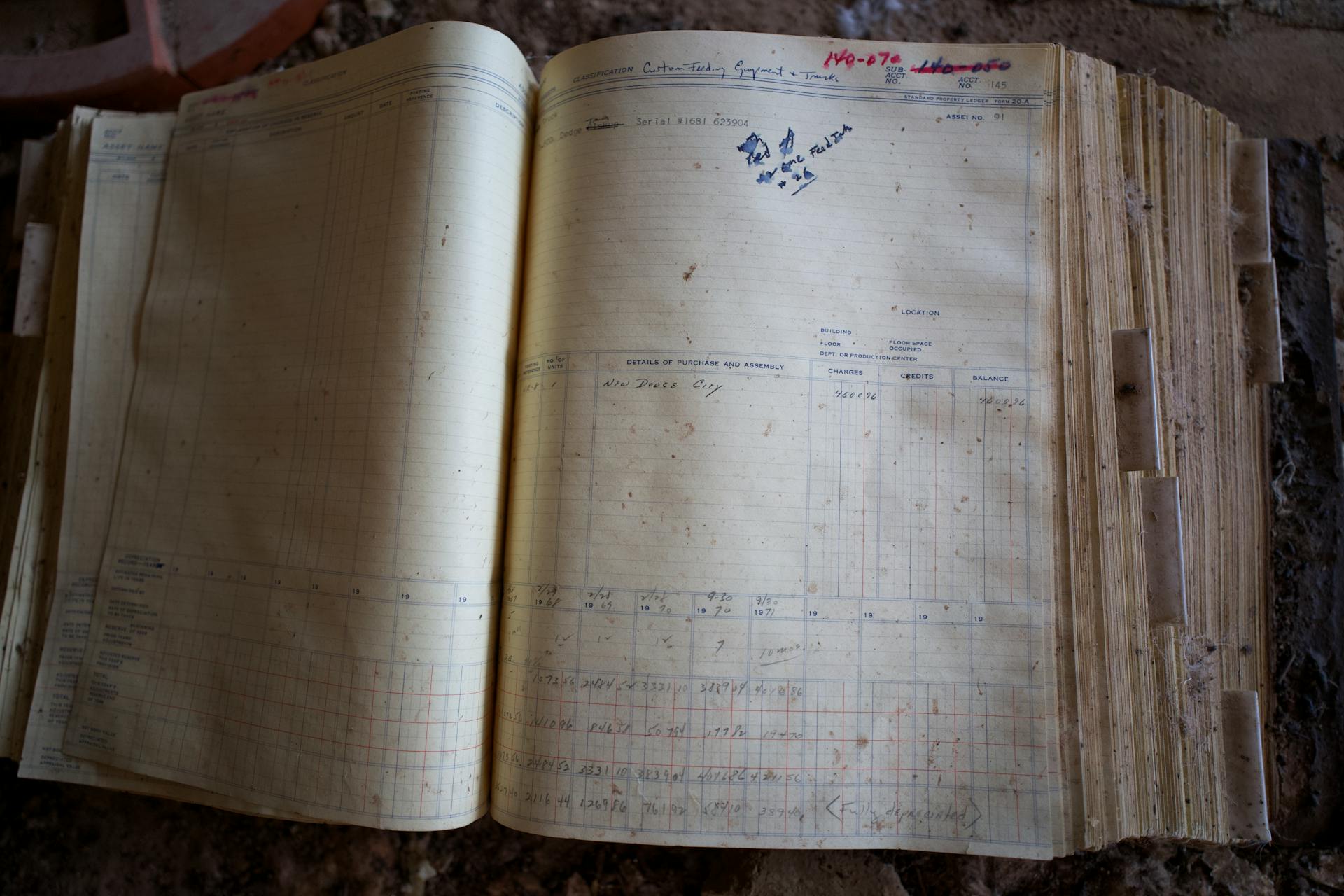
Accumulated depreciation is a key component of a company's balance sheet, reflecting the total decrease in value of its assets over time. It's calculated by adding up the annual depreciation expense for each asset.
Depreciation expense is typically recorded as an expense on the income statement, reducing the company's net income. For example, if a company purchases a piece of equipment for $10,000 and depreciates it over 5 years, the annual depreciation expense would be $2,000.
Accumulated depreciation is a contra-asset account, meaning it has a credit balance. This is because it represents the decrease in value of an asset, which is a decrease in the asset's value, not an increase.
As a result, the balance of accumulated depreciation is subtracted from the cost of the asset when reporting its value on the balance sheet.
Worth a look: Depreciate in Value
What Is Accumulated Depreciation
Accumulated depreciation is an accounting term that refers to the cumulative reduction of an asset over time. It shows the entire depreciation cost documented for an asset since its purchase.
Accumulated depreciation is a contra asset account that captures the total depreciation recorded against a fixed asset since it was placed in service. It's listed in the asset section of the balance sheet, even though it holds a credit balance.
Assets that accumulate depreciation include buildings, vehicles, machinery, and equipment. These assets gradually lose value over time due to wear and tear, obsolescence, or other factors.
Accumulated depreciation is crucial for financial reporting and asset valuation. It provides insight into an asset's true value and allows businesses to track its decrease in value over time.
Long-term or non-current assets are subject to depreciation because they're expected to benefit the company over an extended period.
Check this out: Depreciated Amount
Calculation Methods
Accumulated depreciation is the total amount of depreciation expense recorded for an asset on a company's balance sheet. It's calculated by summing up the depreciation expense amounts for each year up to that point.
There are three common methods to calculate accumulated depreciation: straight-line depreciation, declining balance depreciation, and the sum-of-years'-digits depreciation. Each method has its own formula and application.
Straight-line depreciation is one of the simplest methods, where the annual depreciation expense is calculated as (Cost of the Asset – Estimated Salvage Value) ÷ Estimated Useful Life of an Asset. For example, a company acquires a piece of equipment for $120,000, expecting a salvage value of $25,000 after six years of use.
Declining balance depreciation, or double declining balance depreciation, accelerates the recognition of depreciation expenses in the early years, reflecting the belief that assets depreciate more rapidly initially. The formula for declining balance depreciation is Depreciation Expense = Beginning Year Book Value × Depreciation Rate.
The sum-of-years'-digits depreciation method is an expedited technique to calculate an asset's depreciation. In this method, the expected lifespan of the asset is considered, and the digits for each year are added together. For example, if an asset is anticipated to last four years, the sum-of-the-years'-digits would be calculated by adding 4 + 3 + 2 + 1, resulting in 10.
Here's a comparison of the three methods:
Accumulated depreciation can be a significant factor in a company's financial statements, and choosing the right method is crucial. Consistency is key, so choose a method and stick with it for reporting purposes.
Related reading: Sample Cash Flow Statement Direct Method
Accounting and Financial Impact
Accumulated depreciation is a crucial aspect of accounting that affects a company's financial health and transparency.
Accumulated depreciation shows how assets naturally wear down or become outdated over time, spreading the cost of an asset over its useful life to match expenses with revenue. This practice ensures a transparent representation of profitability.
Depreciation also comes with tax advantages, enabling businesses to deduct a portion of an asset's cost and effectively manage their tax liabilities.
Accumulated depreciation is initially recorded as a credit balance when depreciation expense is recorded, and it directly affects the balance sheet by reducing the book value of assets.
The three most common methods of depreciation calculation are primarily influenced by cash flow and earnings targets, which can even impact bonus compensation tied to EBITDA.
Accumulated depreciation reduces the book value of assets by recording against the gross amount of fixed assets, such as buildings, machinery, and equipment, reflecting the declining value of assets over time due to use and wear.
Broaden your view: Do You Subtract Accumulated Depreciation from Assets
Here are the three most common methods of depreciation calculation and their strategic impact:
Accumulated depreciation plays a pivotal role in shaping the financial health of a business, and understanding how depreciation expenses impact financial statements is key to grasping the broader implications of these expenses.
Recommended read: Hedge Fund Financial Statements
Record Keeping and Audits
Maintaining thorough documentation for all your assets is crucial for audits and informed decisions about asset management. This documentation should include purchase date, cost, depreciation method, revisions to useful life, and any impairment or disposals.
Regular audits of your assets and depreciation schedules can help catch discrepancies or errors early, which is essential for accurate financial reporting. Conducting these audits regularly will also allow you to adjust the records accordingly.
Keep Detailed Records
Keeping detailed records is crucial for audits and informed decision-making about asset management. This includes documentation of purchase date, cost, depreciation method, revisions to useful life, and any impairment or disposals.
It's essential to maintain thorough documentation to ensure accuracy and transparency. This documentation will help you make informed decisions about asset management.
Accumulated depreciation is recorded in a contra account, which has a credit balance. This reduces the gross amount of the fixed asset.
You should keep records of depreciation expenses, which represent the amount for a single period. The accumulated depreciation is the sum of depreciation expenses recorded for the asset up to that point.
Here are some key records to maintain:
- Purchase date
- Cost
- Depreciation method
- Revisions to useful life
- Impairment or disposals
Audits and Updates
Regular audits and updates are crucial for accurate financial reporting. Conducting regular audits of your assets and depreciation schedules can help catch any discrepancies or errors early.
Maintaining thorough documentation is essential for these audits. This includes keeping records of purchase dates, costs, depreciation methods, revisions to useful lives, and any impairment or disposals.
Regularly reviewing asset lifespan can help ensure accurate depreciation calculations. This can be due to technological advancements, changes in market conditions, or wear and tear that exceeds or falls short of expectations.

You should regularly review and adjust the useful lives and salvage values of your assets. This can help ensure that your depreciation calculations accurately reflect their current usage and condition.
By conducting regular audits and updates, you can catch errors early and make informed decisions about asset management. This can also help you maintain accurate financial records and avoid costly mistakes.
Comparison and Analysis
Accumulated depreciation can vary significantly over time, depending on the method used.
The straight-line method shows a constant depreciation of $9,000 per year for five years.
In contrast, the DDB method shows a decreasing depreciation rate over the five-year period, from $20,000 in year one to $2,592 in year five.
The UOP method, which assumes 20% of the asset's output is depreciated each year, also shows a constant depreciation of $9,000 per year for five years.
Here's a comparison of the three methods over the five-year period:
Presentation and Disclosure
Accumulated depreciation appears as a negative figure within the long-term assets section of the balance sheet, immediately below the fixed assets line item.
This presentation is necessary to offset the fixed assets, which have a debit balance on the balance sheet.
Accumulated depreciation is used instead of a direct reduction of the fixed assets account, allowing readers to see the original amount of the investment.
Signals to Investors

Accumulated depreciation is a key signal to investors, and analysts track the ratio of accumulated depreciation to the asset's original cost. A high ratio indicates aging equipment and potential future cash outlays.
A low ratio suggests recent investment, which can be a good sign for investors.
Investors also look at the ratio of property, plant, and equipment (PP&E) to total assets, which can indicate the company's investment in its operations.
For more insights, see: How to Depreciate Equipment
Presentation of
Accumulated depreciation appears as a negative figure within the long-term assets section of the balance sheet, immediately below the fixed assets line item.
This presentation is necessary to offset the fixed assets, which have a debit balance on the balance sheet. A direct reduction of the fixed assets account is not used, so readers can see the original amount of the investment.
Accumulated depreciation is used to show the reduction in value of fixed assets over time. This allows readers to see the full picture of a business's investments in fixed assets.
The presentation of accumulated depreciation as a negative figure helps to avoid misleading readers who might think a business has never invested in fixed assets, only showing a net book value figure.
Take a look at this: Life Insurance Cash Surrender Value on Balance Sheet
Expense and Amortization
Accumulated depreciation is the total amount of depreciation expense recorded since an asset was put into service.
It accumulates year after year and is shown as a contra-asset account on the balance sheet.
The annual depreciation expense for a machine costing $10,000 with a 10-year expected life is $1,000 if using the straight-line method of depreciation.
After three years of use, the accumulated depreciation would be $3,000, reflecting the machine's reduced value over time.
Accurate tracking of both depreciation expense and accumulated depreciation ensures that lenders, investors, and tax authorities remain confident in the reliability of your records.
The total principal repaid on a loan, like the accumulated depreciation, shows the running total of depreciation recorded.
Check this out: What Is Prior Year Accumulated Depreciation
Tax and Financial Analysis
Tax depreciation is a method used to calculate the depreciation expense for tax reporting purposes, as prescribed by the Internal Revenue Service (IRS). This method allows businesses to deduct the cost of depreciating assets, reducing taxable income.
The IRS prescribes specific methods and useful life estimates for different types of assets, which often differ from those used in accounting depreciation.
If this caught your attention, see: Indirect Method of Cash Flow Statement
Tax

Tax depreciation is used to calculate the depreciation expense for tax reporting purposes, as per the guidelines set by the Internal Revenue Service (IRS).
The IRS prescribes specific methods and useful life estimates for different types of assets, which often differ from those used in accounting depreciation.
The Modified Accelerated Cost Recovery System (MACRS) is one common method used for tax depreciation.
Section 179 deductions are another common method that allows businesses to deduct the cost of depreciating assets in the first year of use.
Businesses can use tax depreciation to reduce taxable income, which can lead to lower tax liabilities.
A fresh viewpoint: Cost Less Accumulated Depreciation Equals
Financial Analysis
Financial analysis is a crucial aspect of tax planning, helping individuals and businesses make informed decisions about their financial situation.
A thorough financial analysis involves reviewing income, expenses, assets, and liabilities to identify areas of improvement and potential tax savings.
Tax deductions can be claimed on charitable donations, with a maximum deduction of 60% of adjusted gross income for cash donations to public charities.
Take a look at this: Non Gaap Financial Measures
Businesses can also claim tax credits for hiring employees from low-income families, with a maximum credit of $2,400 per employee in 2022.
The tax implications of selling a business can be significant, with capital gains tax rates ranging from 0% to 20% depending on the length of time the business was held.
Tax losses can be carried forward to future years, but only up to 80% of taxable income in a given year.
Frequently Asked Questions
Is accumulated depreciation an asset or liability?
Accumulated depreciation is neither an asset nor a liability, but rather a reduction in an asset's value over time. It's not a debt to be repaid, but rather a reflection of an asset's decreasing worth due to wear and tear.
Is accumulated depreciation a debit or credit balance?
Accumulated depreciation typically has a credit balance, as it's used to calculate the net value of a fixed asset. This credit balance is a result of its accounting relationship with the related fixed asset account.
Should accumulated depreciation be negative on a balance sheet?
Accumulated depreciation is a contra asset account with a natural negative balance. This negative balance offsets the balance of the associated asset account on the balance sheet.
Featured Images: pexels.com