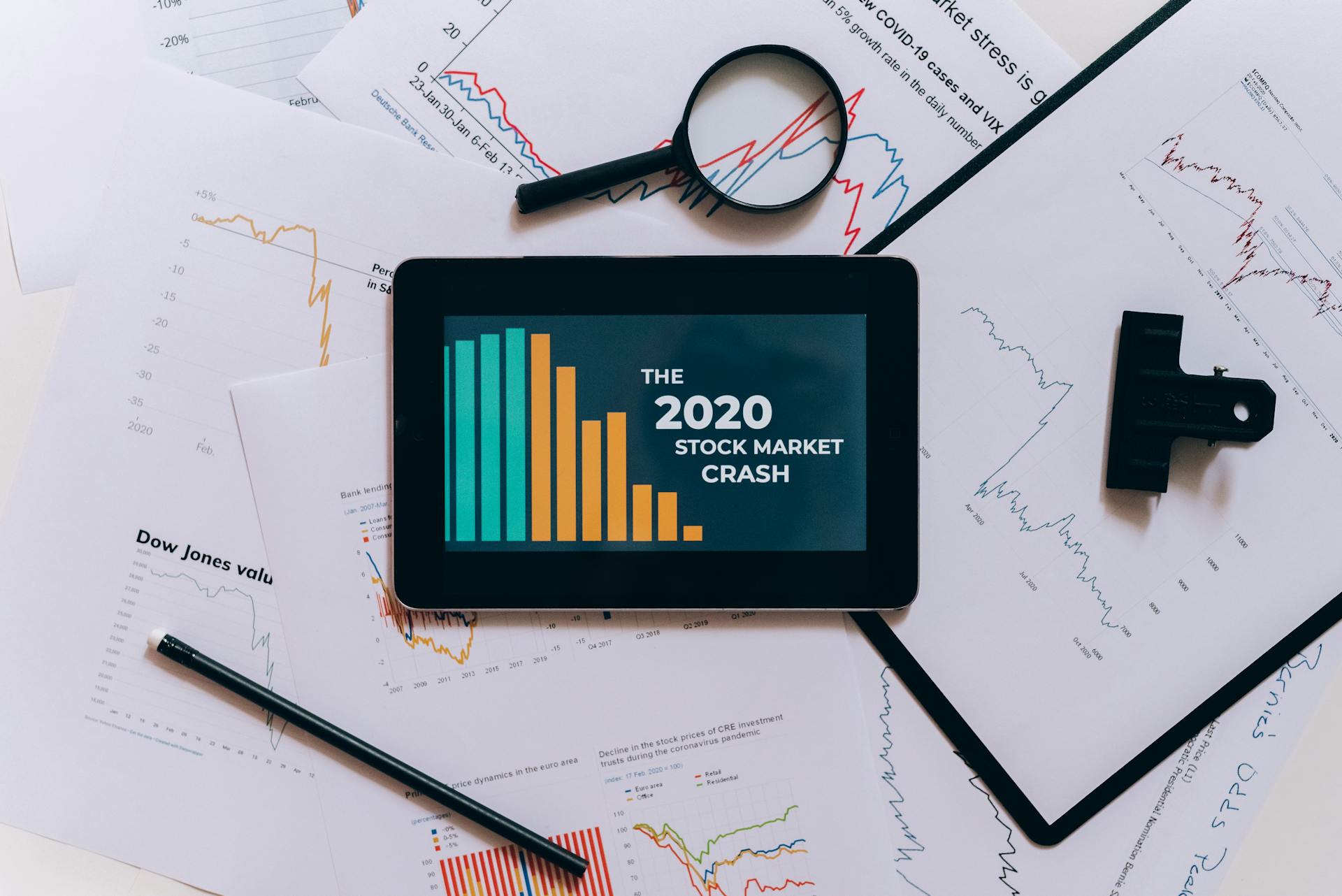
The 2020 stock market crash was a significant event that had far-reaching consequences for investors and the global economy. The crash was triggered by the COVID-19 pandemic, which caused widespread lockdowns and a sharp decline in economic activity.
The pandemic led to a massive sell-off in stocks, with the Dow Jones Industrial Average plummeting by over 30% in a matter of weeks. This rapid decline was unprecedented in modern history.
Investors were caught off guard by the speed and severity of the crash, with many losing significant portions of their portfolios. The crash was a stark reminder of the risks and uncertainties of investing in the stock market.
The economic consequences of the crash were severe, with many businesses forced to shut down or significantly reduce operations. This led to widespread job losses and a sharp decline in consumer spending.
Intriguing read: Economic Impact of the COVID-19 Pandemic
Causes of the Crash
The 2020 stock market crash was a wild ride, and understanding its causes can help us make sense of what happened.
On March 16, 2020, the VIX soared to 82.69, marking the highest level since the 2008 global financial crisis.
This extreme volatility was a clear sign of investor fear, as people rushed to reduce risk and reposition their portfolios.
A sharp increase in trading volume coincided with the surge in volatility, indicating a high level of activity and participation in the market.
The VIX reflects deep uncertainty and disagreement among market participants about future price movements.
Volatility doesn't indicate the direction of the market, but rather the range of possible outcomes.
During March 2020, that range was exceptionally wide, highlighting the extreme fear and unpredictability that gripped the market.
Worth a look: 2020 Russia–Saudi Arabia Oil Price War
Impact of the Crash
The 2020 stock market crash had a profound impact on the global economy. The S&P 500 index plummeted by over 34% in just 23 trading days, wiping out trillions of dollars in investor wealth.
Many investors panicked and sold their stocks, leading to a massive sell-off. The Dow Jones Industrial Average fell by over 13,000 points in a matter of weeks.
The crash was triggered by the COVID-19 pandemic, which spread rapidly around the world, causing widespread lockdowns and economic disruption. The pandemic led to a sharp decline in consumer spending and business activity.
The impact of the crash was felt far beyond the stock market, with many businesses forced to lay off employees and close their doors. The global economy contracted by over 3% in 2020, the largest decline since the 2009 financial crisis.
The crash also highlighted the importance of diversification in investing. Investors who had diversified their portfolios were less affected by the crash than those who had invested heavily in individual stocks.
Dow's Decline
The Dow's Decline was a significant event in the 2020 stock market crash. On Monday, the Dow Jones Industrial Average fell nearly 3,000 points, or 12.94%, at the close of trading. This was the worst day for stocks since the "Black Friday" crash in 1987.
For more insights, see: When Did the Dow Hit 30 000
Trading on Wall Street was temporarily halted after markets plunged early into the trading session. The Dow plummeted more than 2,250 points or 9.7% just after trading began. This triggered a "circuit-breaker" halt of 15 minutes, which allowed markets to stabilize briefly.
The Dow has seen massive volatility since the outbreak of the COVID-19 pandemic, with a decline of over 1,000 points. This led to the Dow entering a bear market for the first time in 11 years.
Here are the key statistics from that fateful day:
Liz Ann Sonders, chief investment strategist at Charles Schwab, noted that the pandemic is a "human and health crisis", rather than a financial crisis. This highlights the unique challenges faced by investors during this period.
Recovery
The recovery from the 2020 stock market crash was a strategic move, not driven by optimism.
Capital rotated into businesses that fit the new conditions, rather than being hopeful about the market's future.
Technology recovered because it became critical infrastructure, not because the market was confident.
The rebound was not about being hopeful, but about adapting to the new reality.
Businesses that were resilient and adaptable were able to thrive in this new environment.
The recovery was a result of capital flowing into industries that were well-positioned to succeed in the post-crash economy.
Intriguing read: New York Stock Market History
Frequently Asked Questions
What were the biggest losers in the 2020 crash?
During the 2020 stock market crash, petroleum, real estate, entertainment, and hospitality stocks plummeted in value. These sectors exhibited extreme volatility, making them the biggest losers of the crash.
Featured Images: pexels.com